- Global (EN)
- Africa (EN)
- Australia (EN)
- Belgium (EN)
- Brasil (PT)
- Canada (EN)
- Canada (FR)
- China (CN)
- France (FR)
- Germany (DE)
- Germany (EN)
- Hong Kong, China (EN)
- India (EN)
- Indonesia (EN)
- Ireland (EN)
- Italy (IT)
- Italy (EN)
- Japan (JP)
- Korea (KR)
- Latin America (ES)
- Malaysia (EN)
- Middle East (EN)
- Netherlands (EN)
- Spain (ES)
- UK (EN)
- Global (EN)
- Africa (EN)
- Australia (EN)
- Belgium (EN)
- Brasil (PT)
- Canada (EN)
- Canada (FR)
- China (CN)
- France (FR)
- Germany (DE)
- Germany (EN)
- Hong Kong, China (EN)
- India (EN)
- Indonesia (EN)
- Ireland (EN)
- Italy (IT)
- Italy (EN)
- Japan (JP)
- Korea (KR)
- Latin America (ES)
- Malaysia (EN)
- Middle East (EN)
- Netherlands (EN)
- Spain (ES)
- UK (EN)

Start your journey with Edelman
Looking for work that matters? Explore careers at Edelman and join a global team committed to shaping conversations, building trust, and driving change.
BROWSE CAREERS
Whether you're looking for strategic guidance or specific expertise, our team is ready to help. Contact us to explore how Edelman can partner with your business.
Contact Us
Special Report: Trust and Health
Explore Report by Market
Select a market to view the local report
Health is confronting division, confusion, and competing influences
The 5th annual Edelman Trust Barometer Special Report: Trust and Health reveals a fractured health landscape marked by division, declining trust, and widespread confusion. Across markets, most people believe at least one contested health claim, underscoring how uncertainty around health information has gone mainstream.
· Globally, people are significantly less confident in making health decisions.
· Healthcare providers are competing with peers, creators, and artificial intelligence for attention and influence.
· Better engagement starts with understanding people’s concerns and helping guide them toward positive health outcomes.
In this environment, building trust requires clarity, empathy, and communication that meets people where they are.
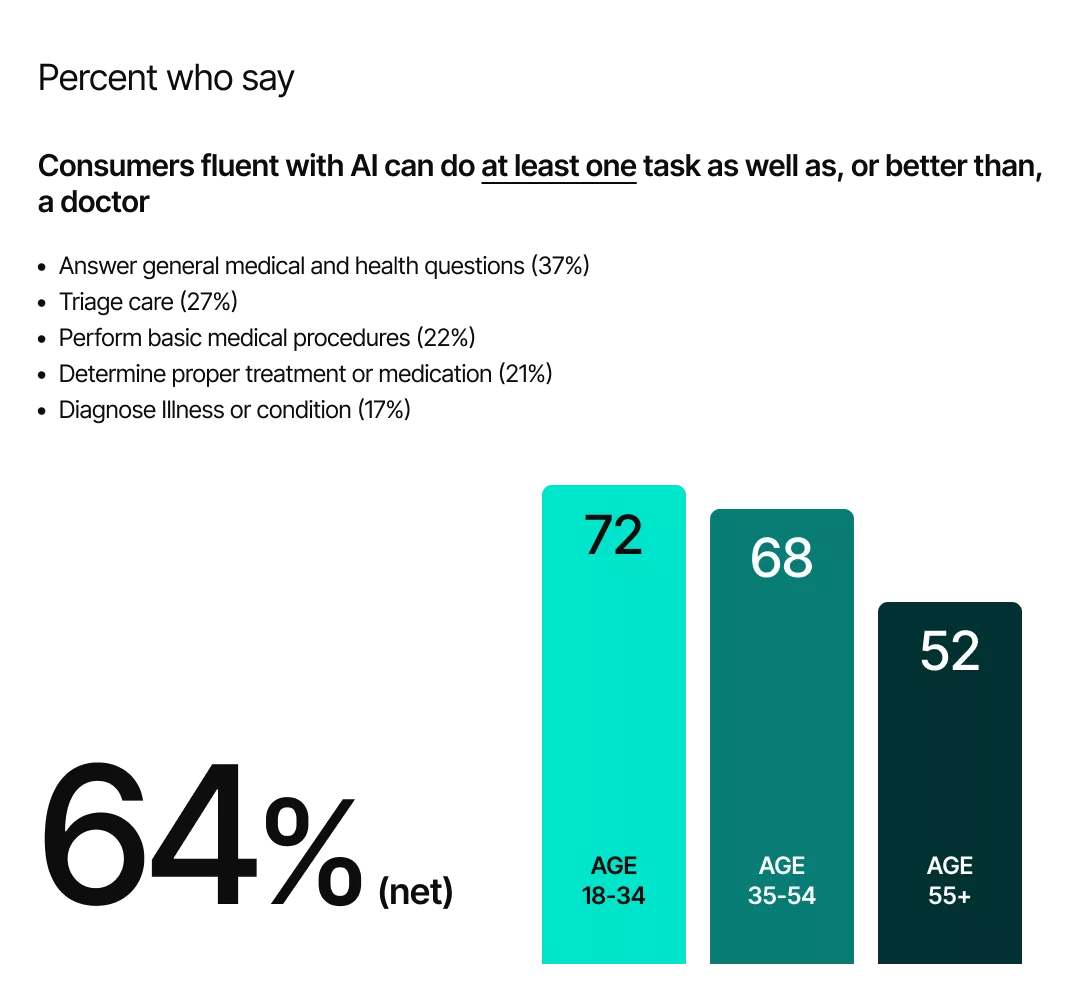
Consumer AI Use Encroaches on Medical Expertise
AI is reshaping perceptions of medical expertise, with 64% of consumers believing users fluent with AI can match or outperform doctors in at least one health task. This sentiment is strongest among younger generations, raising questions around trust, accuracy, and the evolving role of medical professionals.
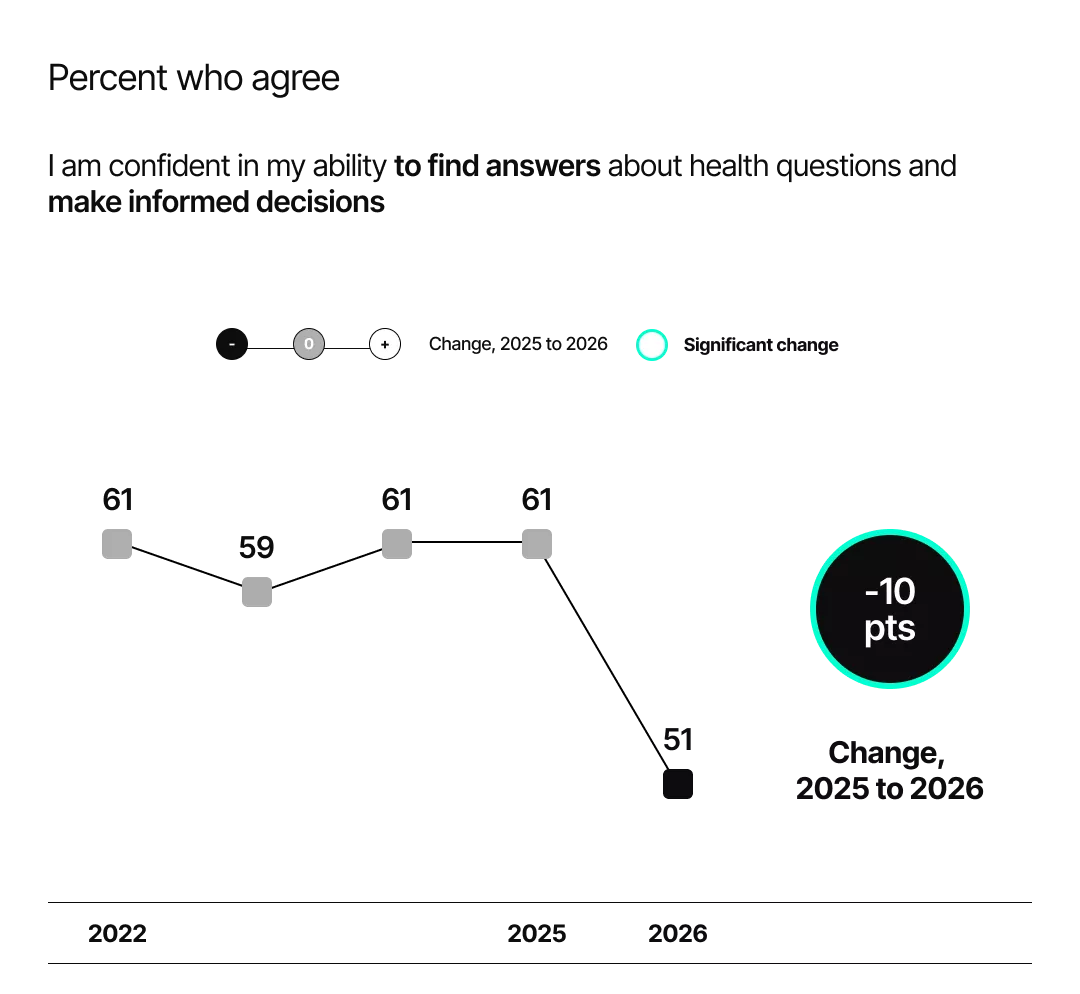
Confidence To Make Health Decisions Plummets
Confidence in making health decisions is declining globally, with a 10-point drop year-on-year (2025 vs. 2026). This sharp decrease signals growing uncertainty in navigating health information.
Most People Hold At Least One Divisive Health Belief
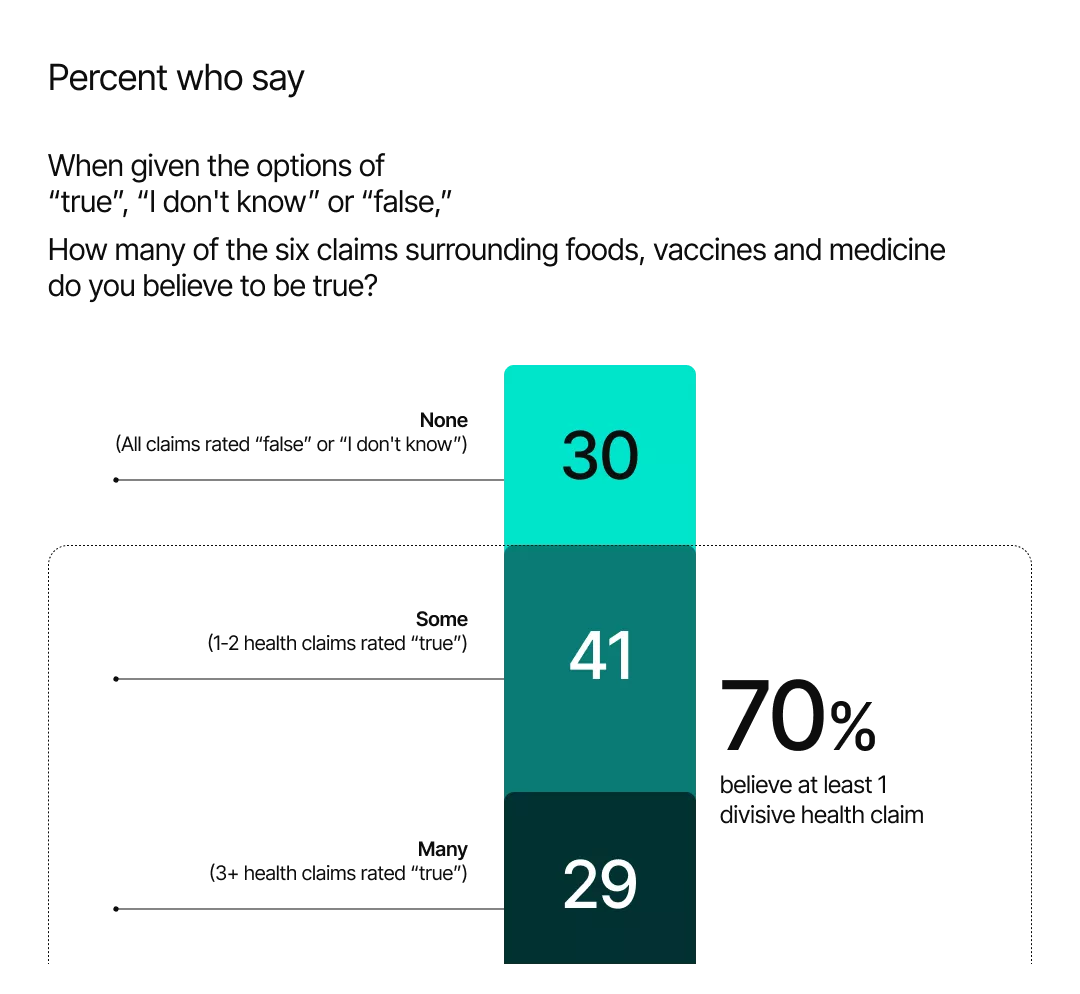
Health misinformation is widespread, with 70% of people believing at least one of six divisive health claims about foods, vaccines, and medicines. This underscores growing confusion, and the need for clear, credible, and trusted guidance.
What Healthcare Providers Must Know
1. Divisive health beliefs are pervasive
The reality is that there are many divides in how people think about health, both in developed and developing countries and across levels of education. Rather than pushing for uniformity of belief, it’s more effective to invest in health outcomes and impact.
2. Public health requires trust to be brokered
The majority of people are hesitant to trust across health beliefs in every country measured. To adapt to this, communicators and practitioners need to elevate goals shared across groups. Convening and community engagement support the process.
3. Tailor influence in a fragmented landscape
People are open to new recommendations on health issues when they hear from trusted voices. Amp up frequency and match the many points of contact that consumers and patients are getting their information from.
4. More than experts, providers must be guides
With so much information available and so many experts to choose from, providing care requires facilitating understanding. In a fragmented system, providers win influence through partnership, humility, and helping patients navigate decisions.
.
Top Findings
01
Divisive health beliefs are pervasive, not fringe
⟲
70% of people worldwide believe at least one of six divisive health claims about foods, vaccines, and medicines to be true, including 32% who believe fluoride in water is harmful or unhelpful to health and 25% who believe vaccines are used for population control.
02
Belief in divisive health claims is widespread, crossing age, political, and educational divides
⟲
Education level does not meaningfully impact belief in divisive health claims: 69% of people with a university degree believe at least one divisive health claim to be true, nearly identical to the 70% of those without a university degree. These beliefs also cut across demographic groups, including both the political right (78%) and the left (64%).
03
People with many divisive health beliefs trust more voices on health matters than those who don’t
⟲
Those who don’t believe any divisive health claims only trust their doctor and medical experts to tell the truth on health issues. Those who believe many divisive health claims trust doctors, medical experts, friends and family, and their CEO (among employees).
Featured Insights

Global Launch Event
The global launch of the 2026 Edelman Trust Barometer Special Report: Trust and Health was led by Richard Edelman, CEO, alongside Courtney Gray Haupt, Global Health Chair and Global Client Leader, and Jennifer Hauser, Global Health Chair, US Health Portfolio Lead, and New York President at Edelman. The event also featured a distinguished panel of experts, including Dr. Megan Ranney, Dean of the Yale School of Public Health; Dr. Garth Graham, Director and Global Head of Healthcare and Public Health at Google and YouTube; Dr. Uché Blackstock, Founder and CEO of Advancing Health Equity; and Sreejit Mohan, Vice President and Global Head of Communications, Specialty Care at Sanofi.
Subscribe for our research and insights directly to your inbox:
Methodology: The 2026 Edelman Trust Barometer Special Report: Trust and Health is the firm’s 5th annual Trust and Health survey. The research was produced by the Edelman Trust Institute and consists of 25-minute online interviews conducted between February 28 and March 11, 2026. Learn more >
16,006 | 16 | 1,000 |
.
Effective communication drives influence in healthcare
Learn how your company can make a difference in people’s health.