


Health Trust in Transition:
How AI and Information Are Changing Patient Experience
Insights from Edelman's Global Health Chairs
Courtney Gray Haupt & Jennifer Hauser


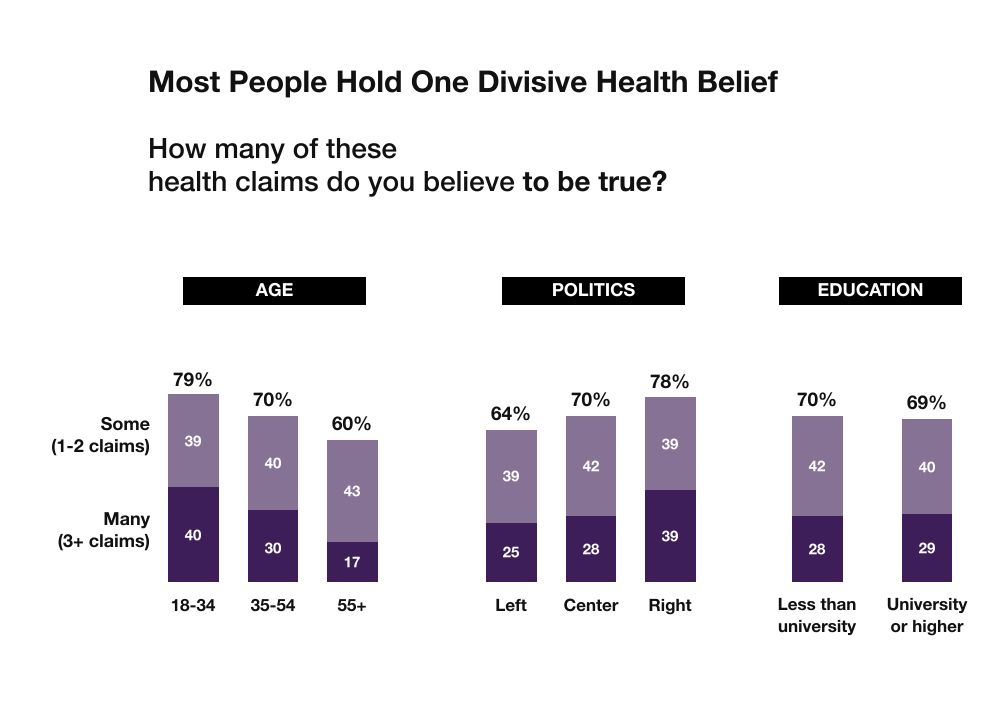
The majority (70%) of people worldwide believe at least one of six divisive health claims about foods, vaccines, and medicines to be true, cutting across age, political affiliation, and education.
The 2026 Edelman Trust Barometer Special Report: Trust and Health shows a health landscape defined by division, declining trust, and a wide mix of influences shaping how people make decisions.
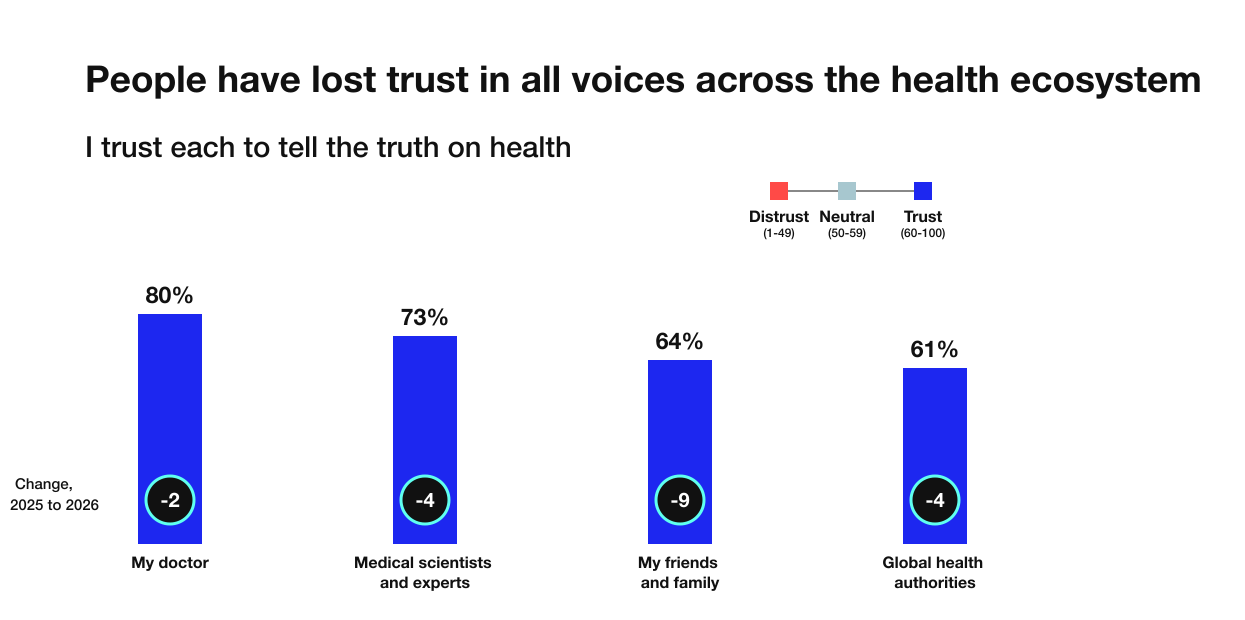
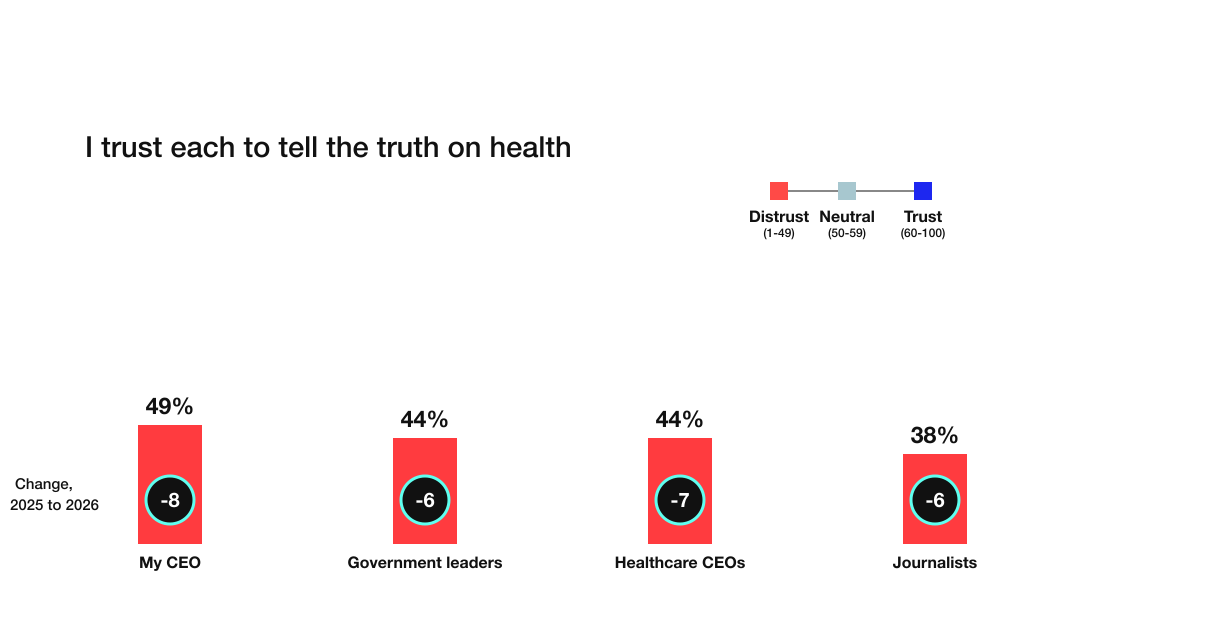
Across markets, trust to tell the truth is falling across the healthcare ecosystem, journalists, government leaders, and even “my CEO” (among employees), while people turn to AI, peers, creators, family, and friends.
“My doctor” remains the most trusted source to tell the truth on health issues. But perceptions of credible expertise are expanding. Influence is no longer based on credentials alone; it’s also built through consistency, relatability, and empathy.
Rebuilding trust in such a fragmented healthcare environment requires clearer, more human communication – along with greater humility and engagement across a broader, more diverse set of trusted voices.

Plummeting Confidence in Health Decision Making
The public's confidence is slipping when it comes to navigating health decisions, according to the Report. Globally, 51% of people feel confident in their ability to find answers and make informed healthcare choices – a 10-point drop in a single year. This decline is widespread, with 14 of 16 markets seeing significant decreases, led by the United States and France (both down 14 points from 2025).
A key potential driver is the sheer volume and variety of information sources competing for share of voice. People are weighing input from credentialed authorities like doctors alongside uncredentialed influences such as AI or social media creators.
In one year alone, trust is falling across the entire health ecosystem. With so many voices, and declining trust across them, people are left feeling increasingly confused and uncertain about what to believe.


"Those with divisive health beliefs are active participants in their care, drawing from a wider range of voices and perspectives.
In this fragmented environment, doctors still matter – but they’re no longer the only authority."
Jennifer Hauser
Global Health Chair, US Health Portfolio Lead, and New York President, Edelman

Divisive Health Beliefs are Pervasive
Belief that at least one divisive health claim is true is widespread, crossing age, political, and educational divides. Nevertheless, the Report shows that most (69%) are hesitant or unwilling to trust others who rely on different facts than they do.
Rebuilding trust in this environment starts with acknowledging those differences, rather than dismissing them.

Health claims evaluated by respondents: 1) Animal protein is healthier than plant-based. 2) Fluoride in water is harmful or unhelpful to health. 3) Risk of childhood vaccinations outweighs benefits. 4) Raw milk is healthier than pasteurized. 5) Acetaminophen/paracetamol use during pregnancy causes autism. 6) Vaccines are used for population control. Health claims evaluated as ‘false’, ‘I don’t know’, or ‘true’ by respondents.
Health claims evaluated by respondents: 1) Animal protein is healthier than plant-based. 2) Fluoride in water is harmful or unhelpful to health. 3) Risk of childhood vaccinations outweighs benefits. 4) Raw milk is healthier than pasteurized. 5) Acetaminophen/paracetamol use during pregnancy causes autism. 6) Vaccines are used for population control. Health claims evaluated as ‘false’, ‘I don’t know’, or ‘true’ by respondents.


70% of people worldwide believe at least one of six divisive health claims about foods, vaccines, and medicines to be true.
That includes 32% who believe fluoride in water is harmful or unhelpful to health, and 25% who believe vaccines are used for population control.
As Trust Erodes, People Turn to AI
The issue isn't a "death of expertise" – it's an expansion of it. As the Report shows, consumers now must grapple with a wider range of voices as credible on health, from AI to creators to individuals doing their own research.
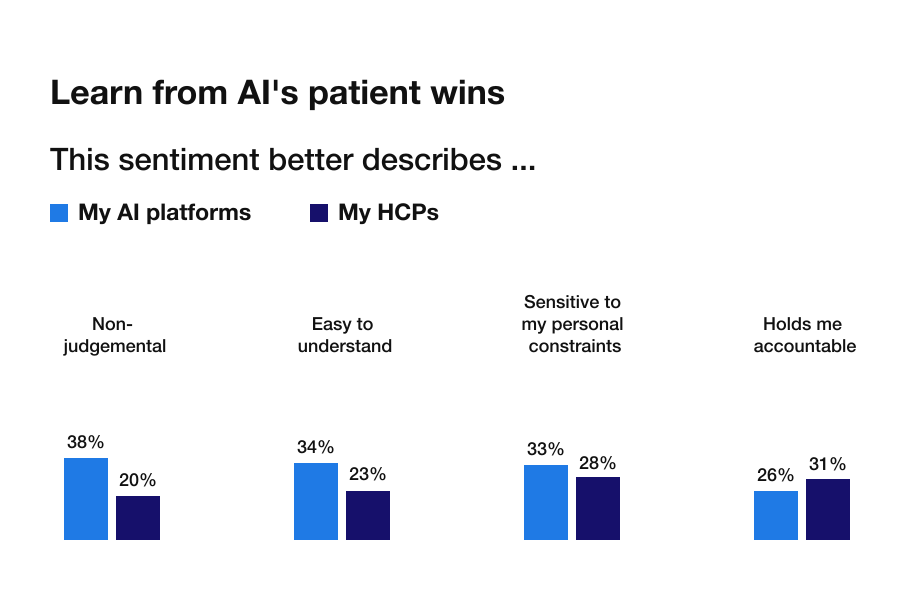
AI is becoming a meaningful tool in how people make health decisions. Among the 35% who use AI to manage their health, its appeal over doctors is straightforward: it feels nonjudgmental, easy to understand, and sensitive to personal constraints.
In contrast, healthcare providers are more often perceived as holding patients accountable when compared to the AI platforms.
Doctors still have the strongest influence on personal health decisions over uncredentialed sources when it comes to diagnosis and short-term treatment. But their lead is less pronounced in prevention of disease. In areas like diet and nutrition, and vitamins and supplements, uncredentialed sources are often more influential.

"The shift isn’t away from doctors – it’s in how people want to be guided. Patients want to feel heard, not told.
AI is meeting that need by being nonjudgmental and easy to understand, even as doctors continue to lead on diagnosis and treatment."
Courtney Gray Haupt
Global Health Chair and Global Client Leader, Edelman

Calibrating to the Moment
As trust fragments and influence spreads across more voices, the Report articulates how healthcare needs to adapt. Authority alone is no longer enough. Trust must be earned through clarity, empathy, and relevance at every touchpoint. Providing care now also means helping people understand.
Even among those who believe some or many divisive health claims, “my doctor” remains uniquely positioned to bridge divides and broker trust across both sides. But that role isn't guaranteed, and meeting this moment requires more.
Healthcare must compete on experience, not just expertise.
The good news: people are open to changing their minds – especially when they hear consistent messages from voices they trust over time. More than being told what to do, they want to feel heard.

 Built with Shorthand