- Global (EN)
- Africa (EN)
- Australia (EN)
- Belgium (EN)
- Brasil (PT)
- Canada (EN)
- Canada (FR)
- China (CN)
- France (FR)
- Germany (DE)
- Germany (EN)
- Hong Kong, China (EN)
- India (EN)
- Indonesia (EN)
- Ireland (EN)
- Italy (IT)
- Italy (EN)
- Japan (JP)
- Korea (KR)
- Latin America (ES)
- Malaysia (EN)
- Middle East (EN)
- Netherlands (EN)
- Spain (ES)
- UK (EN)
- Global (EN)
- Africa (EN)
- Australia (EN)
- Belgium (EN)
- Brasil (PT)
- Canada (EN)
- Canada (FR)
- China (CN)
- France (FR)
- Germany (DE)
- Germany (EN)
- Hong Kong, China (EN)
- India (EN)
- Indonesia (EN)
- Ireland (EN)
- Italy (IT)
- Italy (EN)
- Japan (JP)
- Korea (KR)
- Latin America (ES)
- Malaysia (EN)
- Middle East (EN)
- Netherlands (EN)
- Spain (ES)
- UK (EN)
- Über Uns
- Trust
- Expertise
- Work
- Insights
- Kontakt
- Edelman (Deutschland)
- 2026 TRUST BAROMETER

Starte deine Karriere bei Edelman Deutschland
Du suchst eine sinnvolle Aufgabe? Entdecke die vielfältigen Karrieremöglichkeiten bei Edelman Deutschland und werde Teil eines globalen Teams, das Gespräche gestaltet, Vertrauen aufbaut und Veränderungen vorantreibt.
ZU DEN JOBS
Kontaktieren Sie uns und erfahren Sie, wie Edelman Deutschland Ihr Unternehmen dabei unterstützen kann, Ziele zu erreichen, Vertrauen aufzubauen und Wirkung zu erzielen.
Contact UsStart your journey with Edelman
Looking for work that matters? Explore careers at Edelman and join a global team committed to shaping conversations, building trust, and driving change.
BROWSE CAREERS
Whether you're looking for strategic guidance or specific expertise, our team is ready to help. Contact us to explore how Edelman can partner with your business.
Contact UsThe world’s leaders are gathering next week in Egypt for the 2022 United Nations Climate Change Conference, or COP27, hoping to galvanize the global community around climate change. But as new Edelman Trust Institute research shows, there are significant trust-related barriers to overcome. To succeed in the decade ahead, we need to move global institutions from reporting to rallying, to move beyond the inside game of annual ESG reports to an outside game that excites stakeholders about the possibility of economic growth with sustainability.
Our second annual Trust Barometer Special Report: Trust and Climate Change, a global survey of 14,000 people in 14 countries, finds that Business, normally the most trusted institution in the world, lags badly on sustainability. There is a public perception of promises made but not kept and CEOs are among the least trusted climate spokespeople. Government is more trusted than Business to do what is right in addressing climate change, based on unlimited financial resources and regulatory authority, but is hamstrung by the majority-held belief that politics, not science is driving climate policy. The consumer is on the sidelines, paralyzed by confusing data, concerned about a joyless future, and more convinced that current climate change solutions are positively impacting society than individuals.
Here are the key findings from the 2022 Edelman Trust Barometer Special Report: Trust and Climate Change:
- Fears Escalate—More than three-quarters of respondents are worried about the effects of climate change, from drought to rising sea levels. This is universal across gender, income levels, and age groups. Seventy one percent say that we must move faster on climate issues. Two-thirds say that people will need to dramatically change their habits to address climate change; it can’t be done by institutions alone.
- Business Has a Trust Problem on Sustainability—Nearly two-thirds of respondents believe companies are doing mediocre or worse at keeping their climate commitments. CEOs are distrusted as spokespeople on climate – less than half of people (41 percent) trust them to tell the truth about climate change and what needs to be done to address it, nearly half as many as scientists/climate experts (76 percent) or a person like me (67 percent).
- Government Expected to Lead on Climate Change—National government has a stunning 22-point advantage over business (32 percent) when it comes to which institutions people think should lead on climate change. Government has a three-point trust advantage (56 percent to 53 percent) over Business in being trusted to do what is right in regard to climate. The most important driver of our respondents’ trust in Government is its performance on balancing climate action with the country’s present energy needs, enabling quality of life and prosperity — when it does this well, people are 10% more likely to trust Government to do what is right on climate. A majority of respondents (52 percent) globally believe climate policy in their country is driven by politics, regardless of what the science says. This could not be more timely, as Government is going to face added pressure to balance energy, quality of life, and climate needs as fuel costs mount this winter because of the Russian invasion in Ukraine.
- The Ugly Rise of Nationalism—There is huge skepticism about promises made by foreign nations on climate change; only 30 percent trust China and 31 percent trust India to do what is right on climate change. About two thirds of respondents worry that other countries will renege on their greenhouse gas reduction commitments. Yet within their borders, many nations believe they are already doing their fair share to fight climate change: 90 percent in China, 75 percent in India and Saudi Arabia, 52 percent in the U.S.
- China as a Ray of Light—There has been a giant increase in Chinese awareness of the urgency of the problem of climate change, with a 15-point rise year-over-year (to 66 percent) among those in China who believe there has been little to no progress made in the fight against climate change. Eighty six percent of Chinese respondents worry about climate change leading to droughts or other natural disasters (up 10 points), while 62 percent believe that science is driving climate policy rather than politics.
- NGOs Trusted but Not Expected to Lead Change—Non-Governmental Organizations face lower expectations to take the lead on climate change than Government or Business, at 26 percent. This is a sharp contrast to NGOs’ top rank among institutions on the matter of being trusted to do what is right in addressing climate change (61 percent). The solution for higher NGO trust is joint action with business on projects to improve climate.
- Consumers Are of Two Minds—Eighty five percent of respondents acknowledge a gap between their current lifestyle and the more climate-friendly approach they would like to have. But 70 percent are either doing nothing or will only do some things that do not cost extra money or cause inconvenience. Among those who say there is a gap between how climate friendly their lifestyle is and how they want it to be, the top cited reason is cost (80 percent), followed by uncertainty about which options are more climate-friendly (77 percent). Nearly a quarter of people say they would pay nothing more for green products (43 percent in France, 37 percent in Germany, 33 percent in the U.S.)
- Balance Societal and Individual Benefits—Current climate change solutions are more likely seen as having positive societal than personal benefits. Going green carries the perception for some nations that this requires giving up almost all activities that bring pleasure in life (China: 66 percent, India: 58 percent). We need to emphasize the personal benefits of climate action and show the advantages of a sustainable lifestyle by associating change with innovation.
- Media Failing to Make a Difference—Fifty nine percent of respondents tell us that there is not enough reporting about solutions to climate change. Sixty percent of respondents say that it is too difficult to find trustworthy information about climate change; nearly half said it is almost impossible to find climate information that is easy to understand. Only 46 percent trust journalists to tell the truth about climate change.
This special report on Trust and Climate is a wake-up call for Business to press beyond the reporting of CSR numbers and ESG commitments toward rallying stakeholders. It is on Business to fill the information gap for consumers desperate for data they can trust. It is on Business to create effective regulation with Government that accelerates the transition to a low- and ultimately no-carbon economy, at a cost acceptable to society and the planet. It is on Business to use its marketing muscle to enable cultural change and empower employees with resources and knowledge to support this transition. It is on CEOs to stand up to elected officials attempting to gain votes by politicizing ESG with the false equivalence of jobs versus climate.
A year ago, at COP 26 in Glasgow, Scotland, Business took the bold step of a trillion-dollar fund to finance change. This year we need a similar commitment to wake the sleeping giant, the consumer, to believe they can make a difference and to show them the way.
Richard Edelman is CEO.
Type: Flexible Landing PageIf there is one number that caught my attention from the 2022 Edelman Special Report: Trust and Climate Change, it’s this: Almost half of people aged 18 to 34 think that adopting a sustainable lifestyle will mean giving up just about everything pleasurable about their lives.
Oddly enough, this is good news. At least in a sense. Because it prompts us to reframe the climate narrative from one of sacrifice and guilt to one of hope and opportunity.
A positive narrative — when it is backed by tangible, meaningful actions aligned with a credible pathway to net-zero — can be an important motivator. A positive narrative does not diminish the scale and seriousness of the problem. A positive narrative should be very clear about the size of the challenge, the barriers that need to be overcome, the sense of urgency needed to address it, and the solutions being implemented to solve it.
Businesses can help shape a positive narrative, creating a way of talking about transitions that emphasizes potential rather than costs. NGOs and governments can help shape a positive narrative by promoting a positive vision of a secure net-zero future: green jobs, healthy cities, new opportunities. And individuals can share stories with friends and families about how positive lifestyles changes can create joy and happiness.
In short, a positive narrative is about solutions. Solutions that help unlock a positive spirit of transformation. A spirit that drives and delivers accelerated action.
And there are some good reasons to be positive.
Momentum on temperature change — and policy
Not too long ago, the level of global ambition and action had us on a path to well over 3°C of warming by the end of the century. Today, while still nowhere near the 1.5°C that climate scientists say is needed, current policies point to a 2.8°C temperature rise. Implementation of current pledges could reduce this to a 2.4°C. This is by no means a win but is positive progress. Positive narratives have the power to encourage policymakers to continue to be bold and maintain and accelerate this momentum.
In our report, we see that not only is government more trusted than business to do what is right in addressing climate change, a finding that bucks the trend of trust in institutions to do what is right in general, but the public is calling for more leadership from government, not just at a central level, but more locally, too. When looking at what drives trust in government to address climate change, if government is seen as performing well on one or more of the following — balancing climate action with the country’s energy needs, getting business to reduce emissions, coordinating with local governments on climate solutions, and subsidizing innovation — there is an increased likelihood of at least 6.7% that people will trust government to address climate change.
Scientists and climate experts at the top
For the second year in a row, our climate report finds scientists and climate experts to be the most trusted spokespeople when it comes to climate change, with heads of NGOs also trusted. We can infer this is largely due to their ability to specify precisely what problems we’re facing, like the risks associated with negative climate tipping points — critical thresholds that, when crossed, lead to large and often irreversible changes in the climate. In addition to continuing to report and comment on such risks, perhaps it’s time for more scientists and NGOs to begin promoting positive, solution-based tipping points as well.
Education is a top lever to pull on
Businesses are investing in solutions at greater speed and scale than ever before. And while change may feel slow and limited today, when the right combination of affordability, accessibility, and desirability are achieved, positive change and transformation can occur at speed and scale. When we looked at what levers drive the biggest increase in likelihood to trust business to address climate change, educating people on how to reduce their own climate impact came out on top. When business does this well, people are 5.6% more likely to trust it to do what is right in addressing climate change. This has a stronger impact on trust than if businesses do well on adopting science-based climate targets (4.5% more likely to trust) or ensuring suppliers reduce their climate impact (4.3% more likely to trust). All this supports an argument that business should no longer talk about their role operating in society but rather their role working with society.
Make it about me, not we
Globally, our research shows, most people see climate change solutions as having an impact on the collective good but not necessarily on their individual wellbeing. Connecting climate actions to day-to-day lives and personal experiences is essential. For example, people can continue to enjoy activities such as eating out and enjoying a good meal, traveling, and wearing fashionable clothes — we need to change the mindset that such activities can still be enjoyed, using different sources of protein, energy, and clothing.
Simply put: If about half of young people think living sustainably will mean giving up life’s pleasures, then there’s a big opportunity for business to show the opposite, providing ways to combine going green and enjoying yourself. To not miss the opportunity with this massive cohort of younger millennials and Gen Z, climate action needs a rebrand.
The good news about good news
With everything going on in the world today, one could be forgiven for giving more weight to negative information than to positive information. Unfortunately, this approach may lead to accelerating outcomes that lead to greater temperature rise, rather than less.
In conversations with friends and peers in the climate community, we repeatedly comment that what we saw in terms of the growth of positive news during COVID 19 could be a prelude to what might be possible for climate communications. Indeed, 59% of people — in effect 6 in 10 — say there is not enough reporting in the media about solutions to climate change. Media should not underestimate the audience for positive news, and the role it could play.
Next steps
So, if there is one thing I took away from this year’s report – it’s that all stakeholders, in particular businesses, can lead with hope. To excite stakeholders about the opportunities that a more sustainable, equitable and climate science-aligned present and future can exist. Using the power of their actions and communications to build markets, engage consumers, shift policy, and facilitate the rapid growth of sustainable products, services, and lifecycles. For business, showing that sustainability can be joyful could be a great way to engage more customers to be part of the solution, especially younger generations.
Robert Casamento is Global Climate Chair.
Type: Flexible Landing PageIn discussing the new 2022 Edelman Trust Barometer Special Report: Trust and Climate Change with my colleagues, we kept coming back to the same question: What does this data mean for our clients, many of whom are businesses and brands?
The message is clear: Business must step up to close its trust deficit. Historically, our research shows that in general, business is the most trusted institution to do what is right. Yet on climate, business trails NGOs and government, and is 9 points less trusted than it is to do what is right in general. Almost two in three people (64%) globally say companies are doing mediocre or worse at keeping their climate commitments. If business can close these gaps, then it has the potential to inspire significant change at scale.
People are more worried about climate change today than ever — a remarkable finding given the range of concerns facing our world, from food shortages, inflation and a looming recession due to the ongoing war in Ukraine. And these worries are becoming entrenched, with 57% of people globally saying there has been little to no progress made in the fight against climate change.
To rebuild trust in their ability to combat climate change, businesses should approach the challenge as a joint endeavor between themselves and individuals — providing the information, inspiration, and infrastructure to make green decisions easier and not at great personal cost.
Here are three key steps every business should be considering: take action, educate, and inspire with solutions.
Take action
It’s critical to get your own house in order. When business is seen as doing well on adopting science-based climate targets and ensuring suppliers reduce their climate impact, it is 4.5% and 4.3%, respectively, more likely to be trusted to address climate change. And innovation remains essential: When business is seen doing well on investing in climate-friendly products and technologies, it is 4.1% more likely to be trusted to address climate change. Our respondents cite a lack of institutional support — be it better insulation in homes or more accessible bike lanes — as one of the biggest barriers to having the more climate-friendly lifestyle they want, so use the power of your organization to make more carbon-friendly lifestyles and choices easier for individuals.
Educate
When business is seen as doing well on educating people on how to reduce their own carbon impact, it is 5.6% more likely to be trusted to address climate change. This makes sense when you consider that across the board, there is a significant information gap on climate change. Sixty percent of respondents globally say it is too difficult to find trustworthy information about climate change (a 6-point increase from last year) and almost one in two say it is nearly impossible to find information about climate change they can understand (45% — a 5-point increase from last year). Businesses should educate their employees and their customers about what exactly is at stake and how they can make a difference.
Inspire with solutions
People are not only craving information, but they want solutions: 59% say there is not enough reporting in the media about solutions to climate change (4-point increase year-over-year). And 40% of people globally believe that reducing their personal carbon footprint would translate to a life devoid of joy. Business has the unique potential to combat these fears by leading with tangible solutions and using the power of their brands and platforms to inspire people to adopt more carbon friendly behaviors, products, and lifestyle choices. Let’s double down on the message that climate-friendly action isn’t a tradeoff to personal joy but additive: It’s healthier for your environment, your community, and your own life.
The time is now for business — alongside other institutions — to rally individuals to drive positive change on a larger scale. This will only happen if business earns people’s trust and thereby the right to lead through action. We know business has tremendous potential to innovate, adapt, and inspire change. This makes me hopeful that if we act now, business can meet the moment and lead on climate before it is too late. The world is depending on us to do so.
Helga Ying is Global Chair of Purpose.
Type: Flexible Landing Page- Type: News Detail
- Type: Flexible Landing Page
My father Daniel Edelman was a World War II veteran who transitioned successfully from military to civilian life to establish Edelman as a global communications agency. As we honor our veterans tomorrow, I have a much deeper appreciation of his military service after participating in the week-long Joint Civilian Orientation Conference (JCOC) in late October. Established in 1948, it is the U.S. Defense Department’s oldest public liaison program that enables American business and community leaders to participate in an immersive experience with their military.
Over five days, our delegation of 39 business, academic and community leaders spent time with the Space Force, Army, Air Force, Navy, Coast Guard and Marines. Each branch organized distinctive activities, including briefings from senior military leaders, hands-on activities, and meals with service members, among other opportunities.
Some highlights:
- Marine Corps graduation from the Marine Recruiting Depot in San Diego, highlighted by the return of platoon flags to drill sergeants that symbolizes the conclusion of the 13-week boot camp and the transition of recruits to Marines (that happens for 17,000 recruits annually). We rode on a V-22 Osprey during Marine Day and a highpoint was dropping 60 feet while cinched to a rope from Marine Tower, which is part of the recruits’ physical training.
- Visit to Space Force operations where we watched the constant monitoring of a 32-satellite network that informs our military leadership 24/7 with ongoing monitoring and intelligence and provides ongoing GPS connection for all of us on the ground.
- Visit to the San Diego Coast Guard Joint Operations Center, which handles roughly 17 incidents a day ranging from smuggling to boating accident rescues, plus a ride on a Coast Guard high-speed boat.
- Tour of the 100,000-ton Abraham Lincoln Aircraft Carrier operated by a crew of 5,500 and will host an NCAA basketball game between Michigan State and Gonzaga on Nov. 11.
- Visit with Navy Seals, including a visit to the commemoration wall with the names of Seals who died in service.
- Visit to the Pentagon where Secretary of Defense Lloyd Austin spoke to us.
- Transportation to several military bases on a C-130 military aircraft.
- A look at advanced military aircraft on Air Force Day including F-5s and Remotely Piloted Vehicles (RPVs).
- Participation in an Army obstacle course, and wore a 30-pound Kevlar vest and helmet during our Army Day activities
While each of these activities proved impressive — contributing to my increased respect and appreciation for our military — the most meaningful aspect of my week was my conversations with our men and women in uniform. During my meals with them, I sought to understand how the military produces great leaders like my father and so many others. I asked what leadership means to them, and several themes emerged: commitment to mission, problem-solving, initiative, empathy, and trusting your team. These are important lessons we all could use in today’s world. I thank the Department of Defense for providing this once-in-a-lifetime experience. It generated a deeper sense of appreciation and respect for our military. And while I already was an advocate for veteran and military spouse employment, I commit to redoubling my efforts. Less than one percent of Americans serve in the military, but they provide us the liberty and freedom to live the lives we do.
Having experienced firsthand the military branches in action and talked to our men and women in uniform, I am even more inspired to do what I can to support them once they transition from the military. I better understand the strong foundation my father received in the military to establish Edelman. As with my father, I anticipate that today’s military personnel will be tomorrow’s leaders building a brighter future for us in whatever careers they pursue.
John Edelman is Managing Director, Global Engagement Corporate Responsibility and executive sponsor of Edelman’s employee group, Forward, focused on fostering a veteran-friendly workplace and community.
Type: Insight DetailMany are looking for an alternative to Twitter and are considering Mastodon, an open-source social network that was founded in 2016. There are now well over one million users, up from 381,000+ active users less than two weeks ago. Mastodon is a federation, or a collection of independently operated servers referred to as the fediverse. This is a decentralized approach to social media. As Joanna Stern wrote today in The Wall Street Journal, “Thousands of smaller networks or servers take on the task of onboarding users, setting the rules and making sure things run smoothly.” Mastodon “elders” have been helping newcomers understand and adjust to, not only the technology, but also, to the culture.
I spoke with tech insiders and Edelman’s digital experts for some insights on Mastodon. They shed light on the possibilities, risks and challenges of both the platform and decentralized social media broadly. Here are their thoughts:
- Journalists Flocking to Mastodon—They are connecting with one another and to the communities they report on. There is a collegial quality to the discussions.
- Academics are Making Themselves at Home on Mastodon—There are servers, also called Instances, for general science, for specific disciplines, and universities, like MIT, have set up their own Instances. On Mastodon, an affiliation with an Instance makes it easier to trust.
- Governments Using Mastodon—Bund.de is the official German Government portal for doing online, government related paperwork. Social.bund.de is an instance that contains official accounts. This makes it possible for citizens to interact with public officials.
- This is a Time to Experiment—Longtime Internet denizens such as, Stephen Fry, are joining to try out the service. I myself am in the process of joining the platform. The same goes for brands; Mashable on Mastodon is now offering shopping deals. Large news organizations are beginning to set up their own servers to post content on Mastodon. A large retailer could use the platform to convene or join a conversation across business, academia and NGOs around sustainability. A video gaming brand could create a server to speak directly to gamers. In building these communities and community guidelines brands would also contribute to the overall health of the decentralized ecosystem.
- As Organizations Onboard it will be Crucial to Respect the Culture—Twitter and many other social networks have turned into free-for-alls, compromising trust and lacking civility. On Mastodon, respect and sensitivity to the culture and norms of each Instance are key. As the popularity of Mastodon rises, networks of people who are more accepting of certain behaviors will join and form influential connections between their Instances.
- Not Much Corporate Activity yet—Smart companies will observe for a month or more before participating and vet the Instance to determine if this is a space they want to engage with. It’s vital to watch and learn the mores of the community.
- Brands Must be of the Community—Just like any other social network, Mastodon is not a broadcast channel. Brands should aim to add value, build community, and drive participation. Where they do so, they will find their Instance is popular with users. Users want authentic participants who are not just promoting their stories.
- Content Warnings on an Instance Level—Some communities will have warnings on different pieces of content. This was put in place to let community members know that they can skip the post. A group of political journalists took to Mastodon last night to opine about the election. They were blocked quickly by longtime Mastodon users.
- Proceed with caution—The platform does pose challenges for companies considering a presence there. Filter bubbles may be created within the structure of decentralized communities. There are brand safety concerns to consider as there is no central authority to ban spreaders of hate speech given it’s a fragmented network. And currently, there is no way for a brand to reach scale as it relates to advertising.
Jonathan Haidt wrote eloquently in The Atlantic, “Three forces collectively bind successful democracies. Social capital (extensive social networks with high levels of trust), strong institutions and shared stories. Social media has weakened all three…It is not just the waste of time in magnifying and weaponizing the frivolous. It is the continual chipping away of trust.”
The conversation, early community and promise of Mastodon feels akin to the early emergence of Twitter and other social networks, when the potential of connection and conversation was an inspiring call to participation rather than a cause for concern. First mover brands with strong foundations in digital, social and community should contribute authentically and optimistically to Mastodon and other decentralized social media platforms to build back trust, eliminate hate speech and create safe spaces for both brands and users alike. Business has an important role to play, not just in the fabric of society, but in the fabric of social media.
Richard Edelman is CEO.
Type: Insight DetailIn August of 2022, we launched our Brands in the Verse: Platforms, Users & Opportunities report which provided a detailed look into all things Metaverse, including brand opportunities, platform overviews, audience profile, and brand use cases.
Since then, companies have continued to activate across the Metaverse and adjacent spaces, including the Alo Sanctuary in Roblox, Fidelity’s activation in Decentraland, and Ralph Lauren’s partnership with Fortnite.
Users remain excited about the opportunities that the Metaverse presents for self-expression, creativity, and connection.
Senior and C-Suite executives also see significant opportunities across virtual worlds and web3 technology. According to Bright Data, 70% of C-suite executives are either planning a metaverse strategy or already have begun implementation. Another study reported that 71% of executives believe that the Metaverse will have a positive impact on their organizations.
At Edelman, we believe the Metaverse is a white space opportunity for senior executives to directly engage their stakeholders– whether employees, partners, or customers. According to the 2022 Edelman Trust Barometer, 74% expect CEOs to inform and shape conversations and policy debates on technology and automation; this will increasingly include virtual worlds, technologies, and web3 platforms that underpin the Metaverse.
In our latest report “Execs in the Verse” we explore a full spectrum of opportunities for thought leadership and executive engagement across the Metaverse and Web3. This spectrum ranges from relatively low investment opportunities to signal that the executive or company is tracking Metaverse developments to higher investment opportunities for an executive to personally engage in their brand’s Metaverse activations.
Metaverse Ways in for Company Leaders
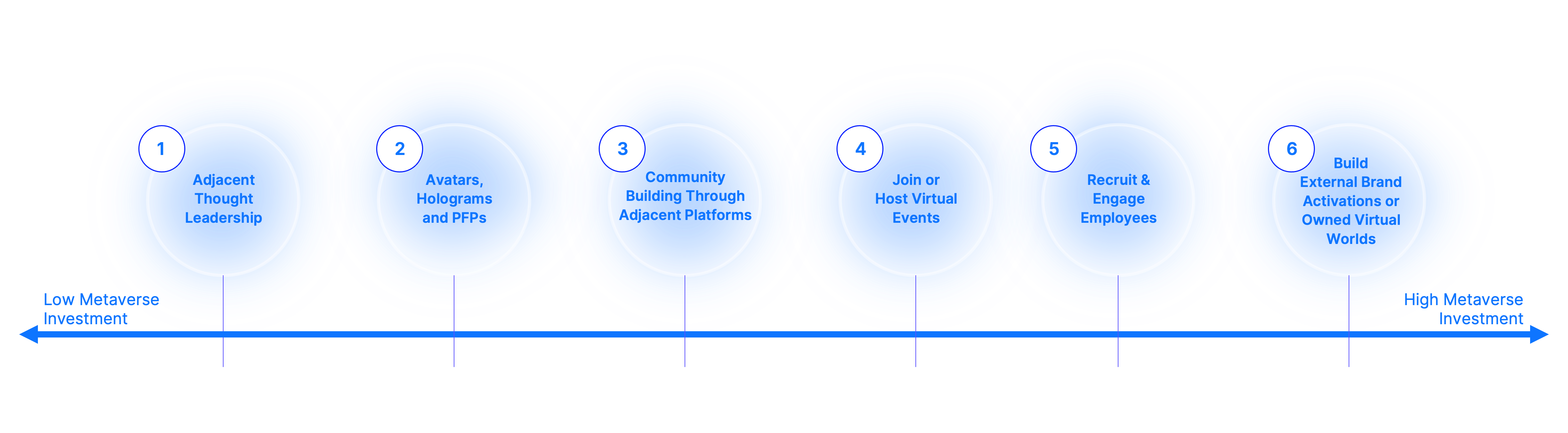
In this report, you’ll understand what the Metaverse might have in store for executives, including:
- Data on executive perceptions of the Metaverse and opportunities within it
- How executives can engage with their audiences in the evolving ecosystem
- How to prepare executives to participate in and approach opportunities in Metaverse spaces
- How Edelman can help executives and their teams navigate the Metaverse ecosystem
We offer various workshops and opportunities for companies to immerse themselves in the Metaverse, including platform demos, immersion sessions, design-thinking workshops, and the development of Metaverse strategy. When working with executive teams, we marry our digital growth expertise and long-history of digital innovation with Edelman’s leadership position in C-suite counsel, executive trust and thought leadership.
Matt Collette is Managing Director, Global Digital Growth.
Marcia Newbert is the Executive Vice President of Corporate Digital in the U.S.
Type: Insight DetailWeb Summit, first and foremost, is a behemoth. If you’re not familiar with the world’s largest innovation conference, it’s just that. 70,000 people descend on the Altice Arena in Lisbon, Portugal, and the conference’s five custom-built pavilions in search of investors, the latest advancements in technology, and new ideas to take back to their teams across the globe.
Despite its name, it’s not really a Web summit, it’s not even a tech summit. Web Summit is a playbook for how to do business today and how to be at the forefront of what’s next. As such, I walked away with one glaring takeaway: the urgency for change (of any kind) has become penultimate.
No matter what stage or speaker stood before you in blue and purple discotheque lighting, one couldn’t help but sense an undercurrent of urgency. On the Creatiff stage there were desperate pleas for purpose, on the PandaConf stage (the cheeky, irreverent name for the marketing stage), assurance that AI was friend, not foe, and on the Corporate Innovation stage, 15-year-olds doing their darndest to convince the audience to abandon the status quo and do things differently. It was surprising to encounter so much genuine altruism at a gathering typically lauded for its platform to pitch and self-promote.
The theme of the week was stark, as it was simple: Don’t Get Left Behind. While it’s humanly impossible to make it to every session (25+ tracks with 16 sessions/day over 3 days), these were the three most impactful “to-dos” I walked away with:
1. Embrace Gen Z. Embrace Gen Z. Embrace Gen Z.
The power of Gen Z is well covered territory at Edelman. We’ve spent the last year researching this generation’s spending power, and influence over all other generations, and came to Web Summit to showcase what it’s really like to have Gen Z in the C-Suite. In June, we appointed the world’s first ZEO, Harris Reed, to run our Gen Z Lab, a consortium of 150+ Gen Z employees from around the globe to advise clients on engaging their generation authentically.
A proponent for change, Harris told Edelman’s Global Chief Brand Officer Jackie Cooper during the “Here Come the ZEOs” session that brands need to embrace Gen Z, or they’re going to miss the boat, “we are the generation that wants change now.” Jackie acknowledged that in her day-to-day conversations some brands and marketers are still hesitant to engage this generation for fear of being canceled; when asked about this, Harris said that those “assumptions are the problem.”
According to Harris, it’s about asking questions, “The conversation around cancel culture is no longer productive.” Instead he believes that companies should be looking to their Gen Z employees to help keep them accountable, in order to prevent future backlash. In his words, “You can’t get canceled if you’re working with the individuals that you’re creating change for.”
2. Create Positive Impact at Any Cost (even if you have to automate it)
Anyone that’s been to a conference in the last 5 years has heard the word “purpose”. It’s the buzzword du jour, with each utterance becoming more and more passé. At Web Summit, one agency took to the stage to make the case that because of its ubiquity “purpose” had become too fluffy, and performance-minded businesses’ have turned their nose up at it. In its place, they offered Positive Impact.
I applaud the change in nomenclature — it’s hardcore and feels much more tangible (and measurable) than purpose. I was, however, struck by their suggested mode of delivery. An automated tool that translates client briefs into brand purpose strategies. The client is asking for an idea that will increase sales of its sports retail business. Here are four potential strategies that trojan-horse brand purpose into the scope based on pre-selected categories. The audience was rapidly taking notes and photographing the speaker’s slides.
To me, this example demonstrates how desperate our industry is to affect change. We understand our important role in the equation to push clients to do more, to be better. For some though, Purpose hasn’t been convincing enough and as we head into a recession, will become a harder sell. So, we’re taking any means necessary, rebranding purpose as impact, leveraging cutting-edge technology, spending hundreds of thousands of dollars, trojan-horsing purpose into sales strategies, whatever it takes to get brands on board.
3. Our “Intentions” Aren’t Getting Us Anywhere, so Practice Unintentionality
Brian Collins, the founder of the brand experience design company of the same name, came to Web Summit to evangelize “unintentionality”. On stage he theorized, “The opposite of courage is conformity, and our intentions have led us toward convention.” Thus he advised practicing “unintentionality”.
To illustrate this point, the audience was asked to draw two portraits of the person sitting next to us. The first one, with our dominant hand. The second upside down, with our non-dominant hand, and without lifting the pen from the page. Everyone in the audience had more heart for the second drawing, seemingly because (according to Collins) we were released from our expectations to perform. His was a commentary on the standard process yielding the standard result. If its drastic change we desire, it’s likely mere “intentions” won’t get us there. Shake up the process, do things upside down without your dominant hand and see what it yields.
The urgency for change, for a different way is apparent, but even with AI, it's no less daunting. Here’s my advice: start small. Pick one project to experiment with, one project in collaboration with your Gen Z employees, one project where positive impact is the sole KPI, one project to try a different process. Document everything. Share what you learn, and with any luck, you’ll get permission to do it again.
Kelsey Rohwer is Senior Vice President, Global Brand Marketing.
Type: Insight Detail- Type: Flexible Landing Page