


Colombia has elected a new president for a single four-year term, as reelection is constitutionally prohibited. This year’s electoral cycle unfolded in three main stages: legislative elections and inter-party primaries in March, the first presidential round in May, and the runoff election in June.
The process began on March 8 with the election of the new Congress for the 2026–2030 term, as well as three inter-party presidential primaries. In the Senate the Historic Pact, the current governing party, with a progressive ideology, consolidated its position as the most-voted political force, followed by the Democratic Center, a right-wing party and the main opposition force to the current government, and the Liberal Party. This outcome shaped a fragmented Congress with significant implications for the governability of the next administration.
The primaries were won by Paloma Valencia (right), Claudia López (center), and Roy Barreras (left), while Iván Cepeda consolidated his position as the sole candidate of the Historic Pact. The first presidential round, held on May 31, included 13 candidates and did not produce an outright winner. Abelardo De La Espriella, a right-wing candidate, obtained 43.74% of the vote, followed by Iván Cepeda, the left-wing candidate aligned with the current government, with 40.91%. These results showed that traditional political structures did not perform as strongly as in previous elections. In Colombia, when no candidate secures an absolute majority in the first round, the two candidates with the highest number of votes advance to a runoff election, which determines the new president.
The runoff took place in a highly polarized political environment. Electoral authorities and observation missions, including the OAS and the European Union, publicly reiterated the reliability of the process. On June 21, Colombia recorded the highest turnout in a presidential runoff since the mechanism was introduced: 26,344,960 votes cast, equivalent to 63.59% of the electoral roll. According to the preliminary count, Abelardo de la Espriella prevailed with 12,959,542 votes, or 49.66%, against Iván Cepeda, who obtained 12,708,712 votes, or 48.70%. The preliminary margin was 250,830 votes, equivalent to 0.96 percentage points.
Election Results: A Deeply Divided Electorate
| TURNOUT | VOTERS | MARGIN | STATUS |
| 63.60% of 41.4M eligible voters | 26.3M votes cast | 0.96 pp 251,854 votes | Completed |
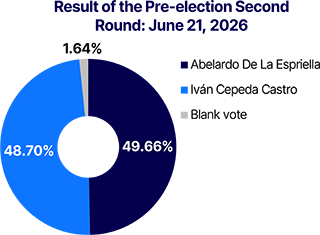 According to the preliminary count from the National Civil Registry (with 99.99% of polling stations reporting), Abelardo De La Espriella received 12,959,542 votes (49.66%) and Iván Cepeda Castro received 12,708,712 votes (48.70%). The remainder corresponds to blank votes. This is a preliminary result: the legally valid figure will only be known once the official tally is completed.
Source: National Electoral Council and National Civil Registry, official count completed on June 25, 2026.
On Wednesday, June 24, the CNE’s National Canvassing Commission officially declared De la Espriella and his running mate, José Manuel Restrepo, elected for the 2026–2030 term. With the official canvass completed, De La Espriella received 12,960,166 votes, while Cepeda obtained 12,708,312, resulting in an official margin of 251,854 votes. Compared with the preliminary count, De La Espriella gained 624 votes, while Cepeda’s total decreased by 400.
The result confirms that both campaigns significantly expanded their vote totals between the first and second rounds, in a context shaped by both the redistribution of May’s electorate and higher voter mobilization. De La Espriella rose from 10,361,499 votes in the first round, equivalent to 43.74%, to 12,960,166 in the final canvass, adding 2,598,667 votes. Cepeda grew even more in absolute terms, increasing from 9,688,361 votes, or 40.90%, to 12,708,312, adding 3,019,951 votes. This growth was partly driven by higher turnout, which rose from 57.88% to approximately 63.6%, an increase of about 5.7 percentage points between rounds.
Geography of the Vote
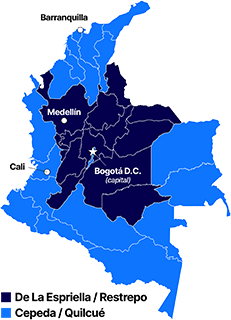 Voting patterns reveal a pronounced regional divide rather than a uniform national shift. Support for De La Espriella was concentrated in the central Andean corridor, Antioquia, the Coffee Region (Caldas, Quindío, and Risaralda), the two Santander departments, Boyacá, Cundinamarca, Tolima, Huila, Meta, Casanare, Arauca, and Guaviare, departments that account for much of the country’s industrial, agro-industrial, and services activity. Support for Cepeda was concentrated on the periphery: the Caribbean coast, the Pacific coast, the capital Bogotá, and the southern border and Amazonian departments, historically more rural regions, with higher relative poverty and a stronger presence of Afro-Colombian and Indigenous communities.
Methodological note: simplified territorial classification by macro-region (not an exact department-by-department margin), based on aggregated preliminary count results released by the National Civil Registry and reported by Edelman Colombia.
Regional trends: in Antioquia, a De La Espriella stronghold, the candidate received 2,185,834 votes (64.4%); in Bogotá, the capital and the city with the most voters in the country, Cepeda outpolled De La Espriella by 2,235,514 votes to 1,933,243 (a narrow margin given the capital’s historical lean to the left); and in Amazonas, in the far south, Cepeda won with 61.9% of the vote.
Regional trends: in Antioquia, a De La Espriella stronghold, the candidate received 2,185,834 votes (64.4%); in Bogotá, the capital and the city with the most voters in the country, Cepeda outpolled De La Espriella by 2,235,514 votes to 1,933,243 (a narrow margin given the capital’s historical lean to the left); and in Amazonas, in the far south, Cepeda won with 61.9% of the vote.
Who Will Govern: President-Elect and Vice President-Elect
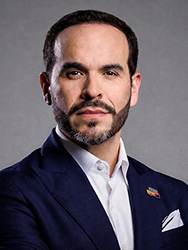 Abelardo De La Espriella
PRESIDENT-ELECT 2026–2030
Born in Bogotá on July 31, 1978 (47 years old), and raised mainly in Montería, Córdoba, De La Espriella holds a law degree from Universidad Sergio Arboleda, with specializations in criminal law and administrative law, and a master’s degree from a Spanish university. He holds triple citizenship: Colombian, American, and Italian.
He built his public profile as a high-visibility litigator in widely covered judicial cases and is the founder of a law firm based in Colombia and Miami. He has also ventured into the liquor, fashion, and media businesses. An outsider to traditional politics, he is known by the nickname “El Tigre” (“The Tiger”), is leader of the Defensores de la Patria movement, and received early, public, and repeated backing from US President Donald Trump.
He will take office as President on August 7, 2026, succeeding Gustavo Petro, for the 2026–2030 term.
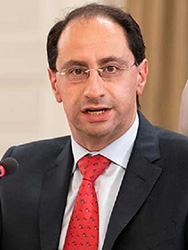 José Manuel Restrepo Abondano
VICE PRESIDENT-ELECT 2026–2030
Restrepo is an economist from Universidad del Rosario, with a master’s degree in economics from the London School of Economics, executive management studies at INALDE, and a doctorate in Higher Education Institution Management from the University of Bath (United Kingdom).
He has built his career between academia and public administration: he served as rector and vice-rector of Universidad del Rosario, rector of CESA and Uniempresarial, and most recently rector of Universidad EIA, a post he resigned in March 2026 to join the vice-presidential ticket.
Under the government of Iván Duque (2018–2022) he served as Minister of Commerce, Industry and Tourism and later as Minister of Finance and Public Credit. His arrival in the vice presidency is widely read, including by credit rating agencies and the business sector, as a signal of technical continuity in the new government’s macroeconomic management.
Institutional Framework: Public Order and the Registry’s Challenge
Public Order
Voting on Sunday, June 21, proceeded normally across the country, according to the National Police and the National Civil Registry. Authorities reported 2,815 citizen complaints through the official electoral complaint system, including 2,643 in Colombia and 172 abroad, as well as 78 additional reports through the government’s anti-corruption reporting channel. Only three arrests were directly linked to the electoral process, while authorities also reported 73 unrelated arrests under a separate public-security operation and 863 citations for behavior disrupting public order.
The picture changed that same night, once the preliminary count results became known. In Bogotá, unrest was reported in the Usme and Kennedy districts, including an attempted attack on a police station, with the temporary closure of 22 TransMilenio stations affecting roughly 183,000 users. In Cali, the Puerto Rellena / Puerto Resistencia area saw barricades set on fire, at least four traffic enforcement cameras destroyed, and damage to the MÍO transit system; authorities reported one fatality whose direct connection to the unrest is still being verified and offered a reward of 200 million pesos for information on those responsible. The mayor’s offices of Bogotá and Cali, together with the Valle del Cauca Governor’s Office, declared the situation under control by the early morning of June 22.
The Registry’s Institutional Challenge
Colombia’s electoral system separates two functions: the National Civil Registry organizes the vote and releases the preliminary count, a fast but legally non-binding figure; the Judicial Branch (judges and notaries) and the National Electoral Council (CNE) carry out the official tally and declare the winner.
Against that backdrop, a specific institutional tension persists: outgoing President Gustavo Petro has publicly questioned the National Civil Registry’s technical integrity for months, and on election night again alleged on social media that the agency had removed traceability mechanisms from the E-14 form lookup portal. National Registrar Hernán Penagos and the agency responded point by point: the timestamps of when files were digitized and downloaded are recorded in the files’ metadata and in internal logs, and the hash verification mechanism remains active, both to certify document integrity and to protect the platform from automated attacks; both are auditable by campaigns, oversight bodies, and observation missions.
This is not an isolated episode: the dispute between the Government and the National Civil Registry over how the forms are filled out dates back several months. It also takes place against a considerable institutional backdrop: more than 1,150 accredited international observers and more than 15,000 national observers, around 850,000 polling station officials and 400,000 electoral witnesses, with monitoring from the OAS, the European Union, The Carter Center, and Colombia’s Electoral Observation Mission (MOE)—none of which has reported evidence of result manipulation.
The First 100 Days: Five Priorities Shaping the New Administration
Abelardo De La Espriella’s victory marks the start of a political transition in which the new government will need to send early signals of governability, economic stability, and execution capacity. During the first 100 days, the attention of markets, investors, and political actors will focus on five priority fronts.
1. Restoring fiscal and market confidence. The first issue will be the sustainability of public finances: the new government will need to present a credible strategy to reduce the deficit, comply with the fiscal rule, and preserve the confidence of investors, credit rating agencies, and multilateral organizations. The composition of the economic team, with José Manuel Restrepo as a signal of technical continuity, and its first fiscal policy messages will be decisive.
2. Addressing the health system crisis. The financial situation of the health system is one of the most immediate urgencies: financing for the EPS health insurers under intervention, access to health technologies, the review of the UPC (the per-capita payment unit that funds health coverage), and the coordination of the mixed public–private system. The new government’s ability to stabilize the sector will be one of the first tests of its management.
3. Building governability and advancing the legislative agenda. De La Espriella will take office with a fragmented Congress and no automatic majority. Building political agreements will be key to advancing economic reforms, reviewing initiatives inherited from the previous government, and ensuring institutional stability. The makeup of the governing coalition will be one of the main indicators of political strength at the start of the administration.
4. Resetting security and international relations priorities. The new government will face pressure to show early results on security and the fight against drug trafficking and territorial control. At the same time, it will seek to rebuild and deepen the relationship with the United States, reinforced by Donald Trump’s public backing during the campaign, on trade, security cooperation, and foreign investment, in a regional context marked by geopolitical tensions.
5. Regulatory review of Petro’s legacy. The incoming administration will need to decide how to handle a significant set of decrees and regulations adopted during the outgoing government, particularly in health, energy, the environment, and labor. The review, modification, or eventual repeal of these measures will be closely watched by the private sector and markets as one of the first signals of the real scope of the new government’s policy changes.
For companies operating in Colombia, the most useful indicators at this stage will be fiscal decisions, the final composition of the economic team, the first regulatory decisions in strategic sectors, and signals about the relationship between the new Government, Congress, and the private sector.
Stakeholder Reactions
Preliminary results from the presidential runoff triggered swift reactions from political actors, business associations, regional leaders, and international stakeholders. While several sectors acknowledged Abelardo De La Espriella’s victory and conveyed messages of support for the incoming administration, some voices from both the government and the opposition called for awaiting the final official count or raised concerns regarding aspects of the electoral process.
Collectively, these reactions offer an early indication of the administration’s sources of support, potential areas of scrutiny, and forthcoming governability challenges.
International Reactions
“I have spoken with President-elect Abelardo De La Espriella to congratulate him on his electoral victory. The US administration looks forward to working closely with his government to strengthen cooperation on regional security, address irregular migration, and deepen economic ties between our countries.”
Marco Rubio
US Secretary of State
“I congratulate Abelardo De La Espriella, President-elect of Colombia, on his electoral victory. This marks the beginning of a new phase aimed at strengthening security and prosperity in the country.”
José Antonio Kast
President of Chile
“I congratulate Abelardo De La Espriella on his victory and extend my best wishes as he assumes leadership of his country. Panama reiterates its commitment to strengthening bilateral relations in areas of cooperation and development.”
José Raúl Mulino
President of Panama
“I spoke with Abelardo De La Espriella to congratulate him on his historic victory. The Colombian people have spoken, and the institutions responsible for organizing the election demonstrated a high level of professionalism and effectiveness.”
Bernie Moreno
Republican US Senator