


Edelman Canada Multi-Year Accessibility Plan and Policies

The Accessibility for Ontarians with Disabilities Act, 20015 (AODA) is a Provincial Act with the purpose of developing, implementing and enforcing accessibility standards in order to achieve accessibility for people with disabilities and others with accessibility needs.

Find out more

About Us

Find out more

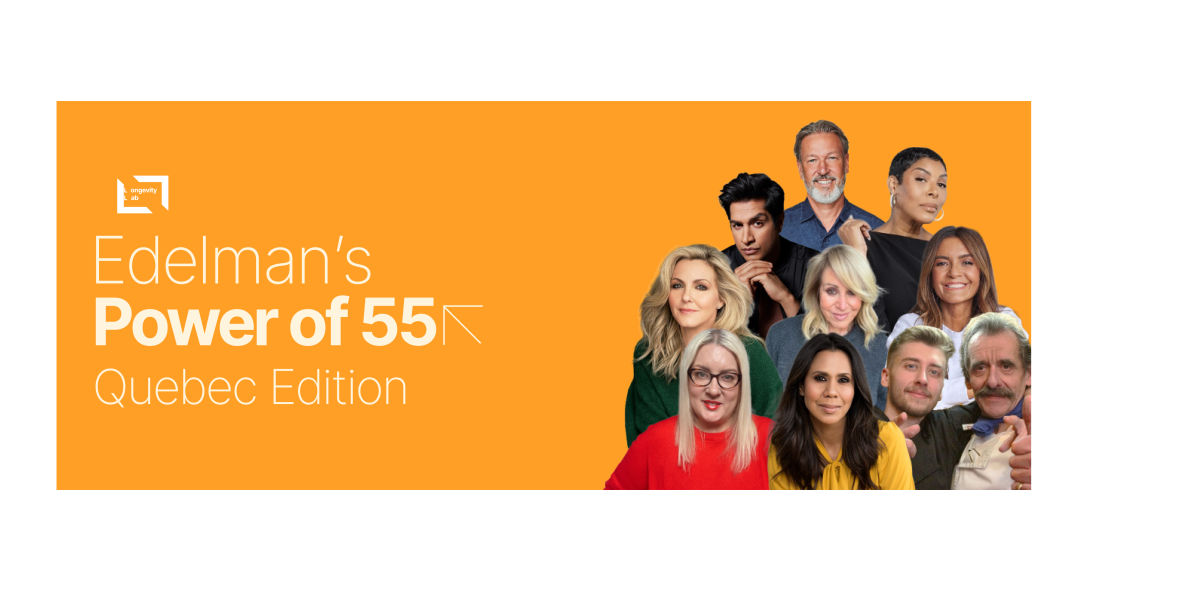
Edelman Canada's Power of 55, the Québec Edition (ENG)

Discover Edelman’s Power of 55 – a curated list of trusted 55+ creators shaping longevity marketing and helping brands reach today’s high-spend older consumers.

Find out more

MONTRÉAL, QC (April 20, 2026) — Edelman’s Longevity Lab today announces the Québec launch of The Power of 55, a dynamic, ever evolving list of content creators in their fifties and beyond who are changing the face of influence and delivering measurable brand value. Following an initial international rollout, the initiative now officially enters the Québec market.

In an economy increasingly driven by influence, one thing remains constant. Trust is the foundation of authentic connection. Globally, Edelman has observed the impact of creators in their fifties through the launch of its Power of 55 global ranking last November. Edelman’s Longevity Lab has demonstrated that influence does not decline with age. On the contrary, it grows through experience, credibility, and the strong relationships creators build with their communities.

Today, Edelman is proud to bring this initiative to Québec, spotlighting a curated group of Québec based creators aged 50 and up who shape conversations within their communities and beyond, and who hold significant influence over consumers aged 55 and above.

This launch comes at a critical moment for marketers. Consumers aged 55 and over now control more than half of global spending and are projected to spend $15 trillion annually by 2030. Yet, less than 10 percent of marketing budgets are allocated to this audience. Key to unlocking this economic power is activating this generation’s social influence. The Power of 55 was developed to help brands quickly and credibly address this commercial blind spot with trusted, brand‑safe creators who are ready to activate.

“Marketers aren’t just underestimating this audience. They’re overlooking them entirely,” says Jackie Cooper, Global Chief Brand Officer at Edelman and co‑founder of the Edelman Longevity Lab. “The Longevity Generation, of which I’m a part, is digital, discerning, and at the peak of its spending power. The more we explore this space, the more we realize how undervalued it has been. There is far more economic and cultural influence here than most brands recognize. With The Power of 55, we’re giving brands a simple and credible on‑ramp into this audience and its broader halo effect.”

“The Edelman Longevity Lab has shown that influence does not diminish with age; on the contrary, it grows richer through experience, credibility, and the connections forged with diverse communities. “Today, we are proud to launch this initiative in Quebec, featuring a list of Quebec content creators aged 50 and older who are shaping conversations within their communities and exerting significant influence on consumers aged 55 and older,” said Martine St-Victor, General Manager of Edelman’s Montreal office. “We’re living in the golden age of longevity”, she added.

Edelman’s Power of 55 creators were selected for their credibility, cultural resonance, and performance across platforms. In Québec, the list highlights Isabelle Racicot, Ricardo, and Véronique Cloutier. Internationally, it also includes creators such as Crazy Auntie Ann in the United Kingdom, Jennifer Valentyne in Canada, Jannik Diefenbach in Germany, Makrye Park in South Korea, Olajumoke Adenowo in Nigeria, and Granny Guns in the United States. The list covers a wide range of categories including wellness, fashion, health, food, travel, and lifestyle.

Each creator on the list was evaluated using Edelman’s proprietary Trusted Creator Score. This methodology blends AI‑powered analysis with expert human review to assess content quality, platform behavior, audience alignment, and brand safety. The result is a low‑risk, high‑impact group of creators with established credibility, category authority, and proven influence across sectors such as health, finance, wellness, and lifestyle.

“These aren’t simply creators. They are trusted advisors, subject‑matter experts, and cultural contributors,” says Sara Rezaee, Head of Creator Marketing for North America at Edelman. “They speak from lived experience with authenticity and consistently outperform younger creators in engagement, particularly among the 55‑plus audience that brands have long overlooked.”

The Power of 55 is part of the continued expansion of Edelman’s Longevity Lab, an offering designed to help brands future‑proof their strategies through trusted engagement with a 50‑plus audience. As with Edelman’s Gen Z Lab, the Longevity Lab combines human insight, creator marketing expertise, and cultural intelligence to help brands move from generational insight to action.

“This isn’t about visibility, but about value, especially in today’s economic context,” Cooper concludes. “Brands that partner with Power of 55 creators won’t just reach a high‑spending audience. They’ll earn trust, strengthen relevance, and generate real commercial outcomes.”

For more information or to access The Power of 55, visit edelman.com or edelman.ca.
 

The 2026 Edelman Trust Barometer confirms a defining shift in how trust operates: it is no longer expanding outward — it is contracting inward. 

This year’s data shows that on average, 7 in 10 people globally are insular in their daily lives. They are turning toward smaller, values-aligned inner circles to determine what to believe, who to support, and where to engage. If someone — or some brand — does not share their values, sources, approaches to societal problems, or their background, they are simply not invited in. 

For decades, scale was the dominant strategy. Reach signaled relevance. Visibility implied credibility. The larger the audience, the greater the assumed impact. 

Insularity disrupts that equation. 

In an environment where individuals increasingly rely on their inner circles, broadcasting louder does not build trust. It often reinforces skepticism. Mass messaging struggles to penetrate communities that have become more discerning about who belongs and who does not. 

Trust is no longer built in the crowd. It is earned in the circle. 

This is where Creators play a defining role. 

Creators are not simply content distributors. At their best, they are brokers of trust. They cultivate communities over time, grounded in shared values, lived experience, and ongoing dialogue. Their influence is not derived solely from scale, but from the communities they’ve built. 

In an insular environment, proximity matters more than popularity. That distinction is critical. 

As trust becomes more values-based, alignment outweighs audience size. A Creator with a highly engaged niche community can often drive more meaningful action than a personality with broad but shallow visibility. Consider a simple example: I am far more likely to follow a Creator with 30,000 followers whose values align with mine and who shares my interests than a Creator with millions of followers whose worldview feels misaligned. The smaller Creator may have less reach but within their community, trust runs deeper. 

However, the role of Creators in this moment goes beyond simply operating within insular communities. They also have the power to responsibly expand them. 

When brands partner with Trusted Creators, they are not merely renting reach, they are being introduced to new audiences. And that introduction carries weight. 

Creators can help brands enter conversations they would not otherwise be invited into. More importantly, they can help bridge perspectives. While communities may be insular, they are not immovable. Trusted voices within them can introduce new ideas, new information, and even new brands without triggering the resistance that often accompanies corporate messaging. 

In this way, Creators can help break echo chambers rather than reinforce them. 

But this requires intention. 

If brands approach Creators as transactional amplification channels, they risk deepening insularity. Communities can detect inauthentic alignment quickly. Borrowed credibility is fragile. 

If, however, brands approach Creators as strategic partners trust can in fact expand. 

The 2026 Edelman Trust Barometer underscores a defining reality: influence has become more intimate. Authority is increasingly mediated through trusted individuals and communities. 

In an insular world, the brands that win will not be the loudest. 

They will be the ones invited in — and the ones introduced by the Creators who already hold trust. 

For organizations navigating this shift, the question is no longer whether to invest in Creator Marketing, it's how to do that with trust at the core of each campaign 

If you are looking to build effective Creator Marketing strategies in this new trust landscape, reach out. At Edelman, we have more than 250 Creator experts globally who live and breathe this space every day and can help you navigate this fast-moving space in a strategic manner to drive scale and impact. 

For years, Gen Z has been largely disengaged from traditional media, instead prioritizing social platforms, short-form video, and real-time content. As a result, media relations have often taken a back seat in communications strategies aimed at reaching this audience.

But that thinking is now due for a reset. While Gen Z may not be tuning in to traditional outlets, they’re reading the results. As AI-powered search tools pull directly from news sources to generate summaries, a generation long assumed to be media-agnostic is now consuming headlines, reporting, and context—often without realizing it. This shift gives earned media a new seat at the table in Gen Z engagement strategies.

AI is Gen Z's new information hub

According to a 2024 report by Media Technology Monitor, 38 per cent of Gen Z Canadians (aged 18 to 26) have used generative AI tools such as ChatGPT, the highest adoption rate of any age group. A 2025 survey by Toronto Metropolitan University’s Social Media Lab found that of the Canadian Gen Z adults (aged 18–24) who have used generative AI tools, 91 per cent of them use it for study, 82 per cent for leisure, and 77 per cent for work. In other words, AI has become a go-to for how they learn, play, work, and most critically, get their information.

As they increasingly turn to these tools, trusted editorial content is resurfacing through the AI-generated outputs they consume. AI systems act as curators, elevating content from outlets they deem authoritative. And since trustworthy content is the foundation of AI answers, securing earned media coverage in those credible outlets has therefore become essential to reaching Gen Z.

The Trust Gap Shaping AI Engagement 

This shift is taking place in a broader context of deep mistrust. According to Gen Z & Grievance: An Edelman Gen Z Lab Special Report, two-thirds of Gen Z globally worry that government, business leaders, journalists and reporters are intentionally misleading them. And yet, those are the very sources AI systems rely on to generate answers. For communicators, the impact of this development is profound: to shape what Gen Z sees, believes, and shares in AI-powered environments, your message must live within the sources these systems trust most—because that’s what will shape their reality.

AI-powered systems now deliver synthesized answers, rather than presenting a list of hyperlinks like traditional search engines. These models are trained on extensive libraries of credible sources, including journalism, academic research, and encyclopedias. Instead of relying on keyword matches, they emphasize quality and trustworthiness by prioritizing reliable editorial content. As a result, answers often reflect narratives shaped by traditional media, even when users never visit the original sources.

In many cases, users only see a brief, AI-generated summary with no attribution. If a response is informed by a Forbes article or CNN segment, the original outlet may go unrecognized. While some platforms provide links, most users won’t click through if the summary feels sufficient.

Why Earned Media Matters More Than Ever 

This means the role of media relations in reaching Gen Z is expanding. Gen Z might not read a full-page profile or watch a panel discussion, but they will absorb the takeaways through a podcast excerpt, an Instagram carousel, or a smart assistant’s response – all of which are increasingly being shaped by AI. Additionally, because these tools often resurface the same credible content repeatedly, instead of a one-time impression, a quote or insight can live on as part of AI’s responses to related queries further amplifying the impact.

As Gen Z continues to turn to AI for trusted information, the role of traditional media takes on a new kind of relevance. Content from trusted editorial sources now shapes the answers Gen Z receives, even if they never visit the original outlet. For communicators, this makes earned media coverage a priority that can no longer be overlooked. If your messaging doesn’t appear in the ecosystems that AI tools trust, it risks being left out of the conversation altogether.


About the Edelman Trust Barometer Flash Poll: Trust and Artificial Intelligence at a Crossroads

The Edelman Trust Barometer Flash Poll: Trust and Artificial Intelligence at a Crossroads was produced by the Edelman Trust Institute in addition to the annual Edelman Trust Barometer. The Flash Poll surveyed 5,000 respondents across 5 countries between October 17 and October 27, 2025. It is the firm's first study dedicated to the question of Trust and AI.


About Edelman 

Edelman is a global communications firm that partners with businesses and organizations to evolve, promote and protect their brands and reputations. With 6,000 employees across over 60 offices, Edelman develops communication strategies that build client confidence and stakeholder trust. The firm boasts an array of accolades, including PRWeek's Agency Dynasty of the Past 25 Years and Global Agency of the Year (2023) and Cannes Lions Independent Agency of the Year for the Good Track (2024 & 2022). Recognized as a standout agency by AdAge (2023) and honored with multiple Cannes Lions, including Titanium, Grand Prix and seven Gold Lions since 2021, Edelman consistently sets the industry standard. Since our founding in 1952, we have remained an independent, family-run business. Edelman owns specialty companies Edelman Data x Intelligence (research, data), Edelman Smithfield (financial communications), and UEG (entertainment, sports and lifestyle). 


Cette nouvelle édition annuelle québécoise du Baromètre jette un regard neuf sur l’état de la confiance envers les grandes institutions — entreprises, médias, gouvernements et ONG — et la façon dont le public espère qu’elles collaborent pour faire progresser la société, innover et résoudre les enjeux les plus épineux de notre époque. Voici dix faits saillants de l’édition québécoise du Baromètre de confiance Edelman 2022:

  1. La confiance envers nos institutions fait un retour aux niveaux prépandémiques – Malgré les turbulences des deux dernières années, la confiance à l’égard des grandes institutions s’est révélée relativement stable et élevée. Ainsi, 61 % des Québécois affirment faire confiance aux ONG, 63 % aux entreprises, 60 % au gouvernement et 59 % aux médias. La moyenne, appelée indice de confiance, se situe donc à 61 %, bien au-delà du Canada, à 54 %.
  2. Les employeurs sont la figure jugée la plus digne de confiance et la plus crédible – À une époque où une confiance modérée règne envers l’ensemble des institutions, « mon employeur » mérite la confiance de 78 % des répondants québécois. En fait, les communications de l’employeur représentent la source d’information la plus crédible (67 %), tout juste derrière celles du gouvernement (70 %), mais devant les médias traditionnels (64 %) et les médias sociaux (35 %), ce qui illustre l’importance capitale de la relation employeur-employé.
  3. Les Québécois entretiennent des inquiétudes sociétales tenaces – La population du pays continue d’être préoccupée par plusieurs enjeux sociaux et politiques, notamment les pertes d’emplois (78 %), les changements climatiques (72 %), les cyberattaques (71 %), la perte des libertés citoyennes (55 %), et le racisme et les préjugés (51 %).
  4. L’optimisme économique recule, menacé par les incertitudes quant à la viabilité du système actuel – Seulement 43 % des Québécois estiment que leur situation financière familiale sera plus favorable dans 5 ans, un faible pourcentage qui traduit un pessimisme économique marqué. De plus, la moitié des Québécois (50 %) jugent que le capitalisme dans sa forme actuelle cause plus de tort que de bien.
  5. Les médias québécois résistent à la crise de confiance envers les sources d’information – Quand vient le temps de s’informer, les Québécois se tournent vers les médias traditionnels (62 %) et les moteurs de recherche (58 %) principalement. La méfiance est toutefois marquée envers les médias de marque (42 %) et les médias sociaux (27 %).
  6. La majorité des Québécois doutent de l’honnêteté et de la transparence des leaders institutionnels – Malgré un indice de confiance élevé à 61 %, plus de la moitié des Québécois croient que les journalistes (56 %), et les dirigeants d’entreprise (57 %) tentent délibérément de les tromper. Les élus gouvernementaux font l’objet de craintes similaires (53 %). De plus, les élus et les chefs d’entreprise sont jugés dignes de confiance par seulement la moitié des Québécois (52 % et 42 %, respectivement).
  7. La virulence du débat public est source de tensions sociales – La moitié des Québécois (55 %) considèrent que leurs concitoyens sont incapables de mener un débat constructif et civilisé en cas de divergence d’opinions. Bien que le Québec se situe en deçà des moyennes mondiale (64 %) et canadienne (59 %), il s’agit néanmoins d’un seuil critique.
  8. Les Québécois s’attendent à ce que les dirigeants d’entreprise incarnent le changement – Quelque 58 % des Québécois désirent que le dirigeant de leur entreprise prenne position sur les enjeux controversés qui leur tiennent à cœur, tandis que 78 % veulent que les dirigeants d’entreprise se prononcent sur les politiques publiques ou l’atteinte du bien commun. Les Québécois réclament que les dirigeants d’entreprise participent au débat public et contribuent à élaborer les politiques concernant l’emploi et l’économie (74 %), la technologie et l’automatisation (70 %) et les inégalités salariales (70 %).
  9. Les dirigeants d’entreprise devraient façonner les politiques, non pas la politique – Bien qu’ils s’attendent à ce que les dirigeants d’entreprise prennent part aux débats publics sur les principaux enjeux sociaux, seulement le tiers des Québécois (32 %) souhaitent les inclure dans la discussion entourant le choix des prochains dirigeants politiques. Il existe donc une frontière claire entre les sphères commerciale et politique, à un moment où les dirigeants d’entreprise sont plus engagés que jamais.
  10. Les entreprises sont sommées d’en faire plus pour faire progresser les enjeux sociaux – Peu importe l’enjeu – et par une importante marge –, les Québécois souhaitent que les entreprises s’engagent davantage. Par exemple, 61 % des répondants croient que les entreprises n’en font pas assez dans la lutte contre les changements climatiques, contre seulement 9 % qui estiment qu’elles en font trop. Le rôle des entreprises et les attentes de la population envers celles-ci n’ont jamais été aussi clairs, et les dirigeants doivent reconnaître que leur responsabilité sociétale est fermement enracinée dans l’esprit des gens.


Baromètre de confiance 2022


LE LEADERSHIP SOCIAL AU CŒUR DU MANDAT DES ENTREPRISES

Nous étudions la confiance depuis plus de 20 ans, et croyons fermement qu’il s’agit de la devise la plus précieuse dans la relation que toutes les institutions — entreprises, gouvernements, ONG et médias — bâtissent avec leurs partenaires et leurs concitoyens.

Cette deuxième année de pandémie mondiale a mis les institutions à l’épreuve comme jamais auparavant. Les résultats du Baromètre de confiance témoignent d’une hausse des attentes des Canadiens envers les dirigeants d’entreprise, qui sont sommés d’être les porte-étendards des grands enjeux sociaux et politiques; de craintes sociales persistantes à la source d’un certain pessimisme économique; et d’une importante quête de vérité en réponse à la montée de la désinformation.

Regagner la confiance de la population est la clé de la stabilité sociale, et permettra de restaurer la capacité des quatre grandes institutions à fonctionner normalement et à répondre aux défis de société actuels. Les entreprises doivent reconnaître que leur responsabilité sociale est fermement ancrée dans l’esprit des gens, qui souhaitent qu’elles s’impliquent davantage dans notre société.

Téléchargez le
rapport 2022

La confiance au Canada, en quelques faits saillants

  1. La confiance envers nos institutions fait un retour aux niveaux prépandémiques – Malgré la turbulence de la dernière année, la confiance à l’égard des grandes institutions s’est révélée relativement stable, n’ayant connu aucun changement, voire une légère baisse depuis 2021. Ainsi, 55 % des Canadiens affirment faire confiance aux ONG (aucun changement), 54 % aux entreprises (aucun changement), 53 % au gouvernement (baisse de six points) et 52 % aux médias (baisse de deux points). Or, la confiance envers presque toutes les institutions a enregistré un recul drastique depuis le mois de mai 2020.
  2. Les employeurs sont la figure jugée la plus digne de confiance et la plus crédible – À une époque où une certaine méfiance règne envers l’ensemble des institutions, « mon employeur » continue de faire classe à part, méritant la confiance de 76 % des répondants canadiens. En fait, les communications de l’employeur représentent la source d’information jugée la plus crédible au pays, surpassant le gouvernement national, les médias traditionnels et les médias sociaux, ce qui illustre l’importance capitale de la relation employeur-employé.
  3. La majorité des Canadiens doutent de l’honnêteté et de la transparence des leaders institutionnels – Environ deux tiers des Canadiens croient que les journalistes et les reporters (61 %) et les dirigeants d’entreprise (60 %) tentent délibérément de les tromper. Les élus gouvernementaux font l’objet de craintes similaires (58 %). De plus, les élus et les chefs d’entreprise sont jugés dignes de confiance par moins de la moitié des Canadiens (43 % et 36 %, respectivement).

    Téléchargez nos    
    10 faits saillants    


The Edelman Trust Barometer Special Report: Institutional Investors identifies critical issues shaping investment criteria and how companies can build trust with the investment community.

The 2021 report reveals that Canadian investors believe that companies that deliver strong environmental, social and governance (ESG) initiatives and related disclosure by Canadian issuers deserve a premium valuation. However, the majority now look at ESG through a critical lens and have a lack of confidence in companies’ ability to deliver on their ESG or net zero commitments. The 2021 report also provides important perspective on topics such as shareholder and employee activism and the recent rise of the retail investor.

The Edelman Trust Barometer Special Report: Institutional Investors is a supplement to the Edelman Trust Barometer, which is released annually at the World Economic Forum each January. This year’s report surveyed 700 institutional investors, including financial analysts, chief investment officers and portfolio managers across seven markets (Canada, U.S., U.K., Germany, the Netherlands, the Middle East and Japan). The report is launched annually in Canada by Edelman Smithfield.

It’s been an incredible year, hasn’t it? Challenging, eye-opening, and, as we witness anger and disruption in the capital and at border crossings, frustrating. What we’ve collectively lived through during the COVID pandemic challenges the very idea of who we are as Canadians. It should also clarify how important it is that we pause and reflect on where we need to go. 

This week, Edelman Canada will release new Trust Barometer data on trust in institutions and in the systems that make our society work. We’ve been studying trust for over 20 years, and we know from experience how critical trust is to our current experience and to our future success. We hope you’ll join us as we discuss the results.

As we wait for that moment, it’s a good time to consider where we’ve been.
Over the past five years, we’ve measured a gap in trust between the informed public and the mass population, with the mass population trusting the four main institutions nine-points less in 2021. 

Our data has also shown a consistent erosion in trust in sources of information and an increase in concerns around fake news. In 2021, our data showed that 49 per cent of Canadians believe journalists and reporters are purposely trying to mislead people. 

The 2021 report also showed that only 1 in 5 Canadians has good information hygiene. The fact that only 20 per cent of Canadians regularly read news, avoid information echo chambers, verify information and do not amplify unvetted information, still shocks me. 

The result: an incredible amount of unvetted information circulating is leading to widespread misinformation and a continued degrading of trust in information sources. Thinking about last year’s data point in the current context should challenge us – we saw disruption coming.

While some of the Trust datapoints are bleak, our annual Trust report has provided a clear roadmap for how business can not only respond, but effectively lead in today’s turbulent landscape. The data are clear. Business is expected to help solve society’s problems. CEOs need to lead. Companies need to recognize and nurture their relationship with their employees. 

With that context, we’re ready to share this year’s results with you. Please join us on February 16 at 1pm ET – register here.

We know the results will help to inform our current experience, but the more important question is how will we all, especially as business leaders, respond?

Megan Spoore is an Executive Vice President and National Practice Lead, Corporate Affairs as well as the General Manager for Edelman Calgary.
 

Subscribe to Canada