

twitter

Japan’s Upper House election on July 20, 2025, marked a turning point in Japan’s political landscape. Minor parties, such as Sanseito and the Democratic Party for the People (DPP), gained visibility by channeling public frustration. Sanseito’s nationalist-populist rhetoric and the DPP’s economically pragmatic message illustrate divergent, yet reactive, appeals to voters alienated by mainstream politics. This memo breaks down the election results, profiles key emerging parties, explores the policy implications for foreign companies, and offers strategic guidance for navigating Japan’s increasingly pluralistic political terrain.


Key Takeaways for Business

  • Rising Populism: Increased anti-foreign rhetoric may gradually weaken bipartisan support for foreign investment and open markets.
  • Policy Volatility: Fragmentation increases risks of legislative gridlock and slower reforms—expect greater unpredictability.
  • Diversify Engagement: Go beyond the LDP—engage with emerging parties, regional leaders, and reform-minded officials.
  • Defense & Energy Opportunities: Cross-party support creates chances in cybersecurity & dual-use tech; supply chain resilience, as well as nuclear, LNG, and renewables.
  • Local & Digital Strategies: Focus on pilot programs with innovation-driven local governments in healthcare, mobility, and infrastructure.


Election Results

Ruling Coalition Falls Short in Upper House Election

Japan’s ruling coalition, comprising the Liberal Democratic Party (LDP) and its junior partner, Komeito, failed to retain its majority in the July 20th Upper House election, marking a significant political blow to Prime Minister Ishiba’s administration. 

Held every three years, Japan’s Upper House renew half of the 248-member chamber under a staggered system designed to maintain institutional continuity within the National Diet. Ahead of the vote, the ruling coalition controlled 75 of the uncontested seats, requiring at least 50 of the 125 contested seats to preserve a majority. Ultimately, the coalition fell short, securing only 47 seats—39 for the LDP and 8 for Komeito—three shy of the threshold.

Though the Upper House does not select the prime minister, these mid-term elections are widely seen as referendums on the governing party’s performance. This year’s contest was broadly viewed as a litmus test for Prime Minister Ishiba’s leadership, set against the backdrop of surging living costs and the emergence of populist challengers. The results signal a growing erosion of public confidence in the ruling bloc, and underscore mounting voter discontent over economic pressures, perceived policy inertia, and a widening disconnect between government and citizenry.

Addressing the nation after the exit polls closed on Sunday night, Ishiba told NHK he “solemnly” accepted the “harsh result.” In a subsequent interview with TV Tokyo, he reaffirmed the government’s foreign policy direction, stating: “We are engaged in extremely critical tariff negotiations with the United States... we must never ruin these negotiations. It is only natural to devote our complete dedication and energy to realizing our national interests.” Despite speculation from within the LDP and the media that he might resign in the wake of the disappointing outcome, Ishiba signaled his intention to remain in office, stressing the need for leadership continuity amid sensitive diplomatic negotiations.

The Rise of Minor Opposition Parties

In the 2025 Upper House election, several smaller parties gained traction and heightened visibility. While their overall seat counts remain limited, their growing appeal highlights shifting voter sentiment and rising disillusionment with both the ruling coalition and traditional opposition parties. Sanseito jumped from just one contested seat to 14, and the Democratic Party for the People (DPP) expanded its contested-seat count from 14 to 17. These rapid gains underscore a deepening political fragmentation and reflect an electorate increasingly seeking viable alternatives to the mainstream.

Emerging from a grassroots movement propelled by YouTube and digital activism, the party appeals to voters disenchanted with both the political establishment and conventional opposition forces. Its messaging blends nationalist identity politics with deep institutional distrust, emphasizing themes such as “protecting Japan,” “restoring pride,” and “putting Japanese citizens first.” Rather than offering a detailed policy platform, Sanseito leans on emotionally charged narratives that resonate with socially conservative and economically insecure segments of the electorate.

The party’s meteoric rise has been driven by a savvy digital strategy, particularly through fringe social media platforms and online influencers, which has allowed it to circumvent traditional media channels and amplify anti-elite, anti-foreign sentiment. Its core issues include skepticism toward immigration, foreign land ownership, and globalism—framed less as technical policy concerns than as threats to cultural sovereignty. While its voter base remains relatively narrow, Sanseito’s growing prominence and capacity to mobilize disaffected conservatives point to a broader transformation in Japan’s political landscape. Its ascent reveals a populist undercurrent that neither the LDP nor progressive parties have successfully absorbed—and one that may reshape the tone and contours of national discourse, regardless of the party’s legislative footprint.

Democratic Party for the People (DPP)

Positioning itself as a “policy-first” alternative to both the ruling LDP and Japan’s fragmented progressive opposition, the DPP has successfully tapped into the anxieties of economically burdened, working-age voters. It emphasizes practical economic solutions—including wage-led growth, targeted tax relief, and reforms to the so-called “annual income barrier” that disincentivizes dual-income households—while avoiding the ideological rigidity of both political spectrums.

On national security and energy, the DPP distinguishes itself by advocating a pragmatic reinterpretation of Article 9 and supporting the use of nuclear power as part of a balanced energy portfolio. Its message resonates with voters who are frustrated with soaring living costs and disillusioned with both establishment inertia and radical alternatives. However, the party’s rapid expansion also raises concerns about its internal cohesion and long-term durability. Past scandals and instances of policy inconsistency remain notable vulnerabilities, and the DPP’s future credibility will hinge on its ability to sustain a reform-oriented identity without sliding into opportunistic populism or ideological ambiguity.

Political Engagement on the Rise—With Social Media Cutting Both Ways

A significant uptick in voter turnout accompanied the growing visibility of minor opposition parties in this election. Participation reached 58.51%, a 6.46-point increase over the previous Upper House election in 2022, and marked the first time in 15 years that turnout has surpassed the 55% threshold (The Japan Times).

Digital platforms played an instrumental role in driving this heightened engagement, acting as conduits for political information, grassroots mobilization, and amplified candidate visibility. However, the campaign period also exposed the double-edged nature of social media: while it democratized access to political discourse, it also enabled the rapid proliferation of false or misleading content, raising concerns about electoral integrity and information hygiene in Japan’s digital public sphere.

A Snapshot of the Increasingly Multiparty Landscape

Political spectrum

A left-to-right ideological map showing how Japan’s major parties align on core political values:

Position on key policy issues

A side-by-side comparison of party stances on taxation, inflation relief, defense, energy, social policy, and selective marital surnames—key issues shaping post-election policymaking:
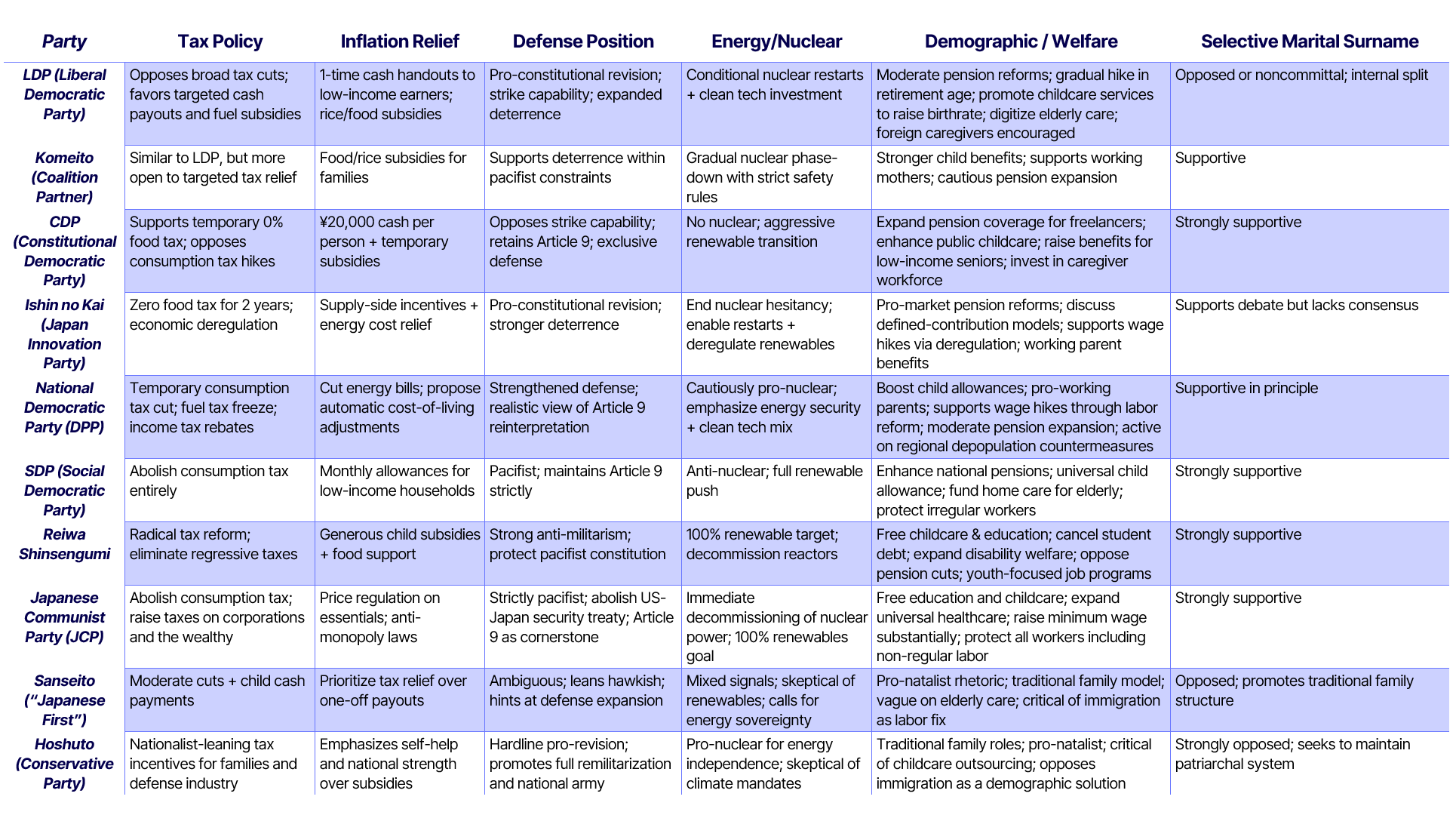
 

What Does It Mean?

Short-Term: Impact on Ishiba and the LDP

A weakened mandate and immediate political headwinds

The ruling coalition’s failure to retain its majority in the Upper House represents both a symbolic setback and a tangible constraint for Prime Minister Ishiba. While he has stated his intention to remain in office, the outcome lays bare internal divisions within the LDP and is likely to heighten pressure from rival party factions. With political momentum curtailed, Ishiba’s capacity to advance an assertive policy agenda—particularly on fiscal reform, national security, or constitutional revision—has been significantly diminished.

Policy gridlock looms—in both chambers

The coalition’s setback in the Upper House is further compounded by the fact that the LDP no longer commands a standalone majority in the Lower House. This dual vulnerability significantly heightens the risk of legislative paralysis. Even routine policy matters may now require delicate coordination with opposition forces such as the DPP or Ishin no Kai—whose policy agendas often diverge from the government’s. 

As the administration becomes increasingly dependent on political deal-making, its shrinking capital and fragile mandate are likely to result in key initiatives being delayed, diluted, or derailed. Within the ruling party, Ishiba’s leadership could become more defensive and reactive, focused less on advancing reform and more on navigating internal dissent and political survival. 

Long-Term: Populist Realignment and the Anti-Establishment Undercurrent

Beyond the seat counts, the deeper story of the 2025 Upper House election lies in the continued erosion of public trust in Japan’s traditional political establishment. Voters increasingly gravitated toward alternative voices—most notably Sanseito and the DPP—not due to shared ideological vision, but because these parties offered a rupture from entrenched political narratives that have consistently failed to address the public’s mounting concerns: economic insecurity, demographic strain, and a growing sense of social disconnection.

  • Sanseito leverages identity politics, nationalism, and anti-globalist sentiment. Its rhetoric echoes that of far-right populist movements in Europe and the US, appealing to voters who feel that Japanese sovereignty, cultural heritage, and traditional values are under siege.
  • The DPP, while less ideologically polarizing, adopts a pragmatic form of populism focused on economic grievances—advocating policies such as fuel tax cuts, wage growth, and enhanced family support, particularly aimed at working-age voters and regional constituencies.

Despite their ideological differences, both parties respond to the political void: they give voice to voters who feel neglected, economically squeezed, and politically unheard by a governing class absorbed in factional maneuvering and risk-averse consensus-building. Mainstream parties, especially the LDP and Constitutional Democratic Party (CDP), have struggled to deliver messages that address this sense of precarity and disenchantment.

In this sense, the 2025 election reflects a broader global trend—a realignment in which political legitimacy is shifting away from traditional party machines toward outsider narratives that promise clarity, resolve, and a departure from incremental politics. Japan’s populist wave may appear more muted than its Western counterparts, but its emergence is no less consequential.


Policy Implications for Businesses

A new current in Japanese politics is clearly emerging. In the 2025 Upper House election, rising opposition parties made notable gains by tapping into public discontent and disrupting the established political order. Their ascent signals a growing receptiveness to populist rhetoric, greater policy unpredictability, and a more fractured legislative landscape—developments that carry far-reaching implications for businesses, investors, and policymakers seeking to navigate Japan’s shifting political terrain.

Immediate Market Reaction: “Triple Sell-Off” Averted

Bond Yields Rise on Fiscal Expansion Concerns

On July 22, Japan’s domestic bond market saw the benchmark 10-year government bond yield rise to 1.535%, a 0.010 percentage point increase from the previous week. The uptick reflects investor concern that the ruling coalition’s failure to retain a majority in the Upper House may pave the way for expanded fiscal spending, including tax cuts or direct cash transfers, in response to pressure from emerging opposition demands (Nikkei).

Tokyo Stocks Stabilize as Political Uncertainty Eases

Also on July 22, Japan equities showed signs of stabilization, with the Nikkei 225 projected to rebound by approximately 200 points, hovering near the 40,000-yen threshold. Although the ruling coalition lost its majority in the Upper House, the outcome was viewed as less disruptive than initially feared. Prime Minister Ishiba’s decision to remain in office helped ease investors’ concerns over immediate political instability, reducing downward pressure on equities (Nikkei).

Yen Firms Briefly, but Policy Uncertainty Weighs

The yen strengthened modestly in the immediate aftermath of the Upper House election, briefly appreciating into the upper 147-yen range against the dollar. However, the currency soon drifted lower as markets reassessed their fiscal and political risks. While the ruling coalition’s loss was milder than expected, concerns remain about potential fiscal loosening, pressure on credit ratings, and unresolved US–Japan tariff negotiations. Amid persistent uncertainty regarding the government’s stability and policy direction, the yen remains susceptible to renewed depreciation (Nikkei).

Risks for Foreign Businesses

The 2025 Upper House election has amplified political rhetoric critical of foreign capital and ownership, fueled mainly by the rise of populist and nationalist parties such as Sanseito and Hoshuto. While neither party is expected to exert direct influence on policymaking in the immediate term, their growing visibility is reshaping the public discourse and could foster bipartisan consensus around foreign investment. Overtime, this shift may narrow the political and regulatory space for pro-investment policies, especially in sectors perceived as sensitive to national interest or cultural identity. 

Key Risks

  • Increased Scrutiny of Foreign Ownership: Calls for tighter regulations on foreign land, property, and media ownership may gain traction, especially in politically sensitive areas such as Okinawa, Hokkaido, and near military installations.
  • Hostility Toward Foreign Labor Policies: Pushback against immigration may complicate the expansion of foreign-backed service sectors that rely on multilingual or migrant labor (e.g. tourism, hospitality, elder care).
  • Regulatory Nationalism: Sanseito’s rhetoric on “economic sovereignty” could influence future proposals around digital platforms, cross-border data flows, and procurement rules—even without formal legislative authority.
  • Reputational Risk: Foreign companies may face reputational friction in local communities, especially if portrayed as contributing to inflation, land speculation, or cultural dilution.
    Mitigation Considerations

Mitigation Considerations

  • Local Engagement: Strengthening relationships with local governments, communities, and Japanese SMEs can provide buffers against nationalist framing.
  • Narrative Framing: Emphasizing long-term contribution to regional revitalization, technology transfer, and employment stability can help counter negative narratives.
  • Policy Monitoring: Increased vigilance is recommended around proposals related to land use, digital security, and inbound FDI review mechanisms.

Opportunities for Businesses

Political Fluidity

Japan’s 2025 Upper House election has diminished the ruling LDP’s dominance, unveiling a more fragmented and fluid political environment. While this development raises familiar concerns over policy paralysis, it also signals a weakening of entrenched power structures and presents new opportunities for businesses to engage more strategically and selectively within Japan’s evolving political ecosystem. 
For decades, many companies have defaulted to a risk-averse, LDP-centric approach to political engagement. While maintaining close cooperation with the LDP remains essential, the emerging landscape requires a more diversified engagement strategy, including proactive dialogue with other political actors. This growing fluidity creates space to: 

  • Collaborate with reform-oriented policymakers who are advancing innovation and economic revitalization
  • Engage with local governments that are actively seeking external partnerships to address demographic and economic challenges
  • Connect with a rising generation of political leaders who bring fresh perspectives and a strong interest in global best practices

This is not merely a tactical opening—it marks a structural shift. As Japan undergoes a generational transition, both political and economic powers is gradually dispersing from entrenched legacy networks toward a more pluralistic and reform-driven ecosystem. Companies that recognize and adapt to this shift will be well-positioned to influence emerging policy coalitions and spearhead regionally driven pilot initiatives in priority areas such as healthcare, mobility, education, and digital infrastructure. In this new landscape, agility, local engagement, and political diversification will be key enablers of long-term strategic impact.

Converging Priorities: Defense and Energy as Strategic Business Frontiers

While Japan’s political landscape is becoming increasingly fragmented, national security and energy resilience stand out as areas of shared urgency among both the ruling LDP and key emerging parties. This cross-party alignment—though not uniform—offers a relatively stable foundation amid broader political volatility, creating meaningful openings for business engagement in strategically significant sectors.

Japan is ramping up defense spending and accelerating the modernization of its security posture. This includes enhanced public-private collaboration in areas such as cybersecurity, aerospace, and dual-use technologies. As Japan deepens security cooperation with key allies, businesses capable of contributing to interoperability, supply chain resilience, and advanced systems development will find growing and sustained opportunities.

On the energy front, policy is shifting in response to geopolitical tensions, supply chain disruptions, and long-term sustainability imperatives. The government is reactivating nuclear power plants, expanding LNG import capacity, and boosting investment in renewables and grid modernization. Concurrently, regulatory reforms are being introduced to support this rebalancing, opening new space for firms with expertise in energy security, transition technologies, and infrastructure resilience.


Media Coverage

Ishiba and the LDP’s Political Future

Media coverage highlighted the ruling party’s weakening grip, with calls for Ishiba’s resignation surfacing alongside broader concerns over the LDP’s ability to navigate Japan’s increasingly fragmented political landscape.

Populist Undercurrents and Rightward Shift

Both Japanese and international coverage emphasized the rise of populist forces and Japan’s alignment with global rightward political trends.


Materials presented by Edelman’s public & government affairs experts. For additional information, reach out to Yuichi.Kori@Edelman.com 

Overview

Yesterday, Rachel Reeves delivered her second annual Mansion House Dinner speech to representatives from the City of London’s financial services sector—just two weeks since her tearful appearance on the Frontbench of the Commons the morning after a key government bill had been gutted by its own backbenchers.

That day the City saved the Chancellor, with the bond markets showing just how important fiscal constraints to government spending are and the value of maintaining a Chancellor deemed prudent. Yesterday was not just a moment for a political rebound, but also a day for a blizzard of reforms.

Many of these policy changes came in the form of the government’s new Financial Services Growth and Competitiveness Strategy (2035), otherwise known as the “Leeds Reforms.”

Much of the speech emphasized announcements which could already be found in the comprehensive 76-page Strategy, summarized below. Some notable omissions were mortgages, with reforms in that area announced separately by financial services regulator the FCA—confirming that loan-to-value ratios would be increased to 4.5 times a buyer’s salary and thereby widening access to Nationwide’s “Helping Hand” mortgage for first-time buyers.

Also notable for its omission was a rumored change to incentives to save into a cash individual savings account (ISA). This had been campaigned against by parts of the media and the investment industry alike on the basis that rather than encouraging people to invest they would be more likely to hold cash in a less tax-efficient structure.

Finally, despite hopes we would learn more about further planned pensions reforms, neither the speech nor the strategy addressed this. 


Financial Services Growth & Competitiveness Strategy: Key Policy Announcements 

The new strategy sets out a long-term vision to re-establish the UK as the global destination of choice for financial services firms by 2035. It can be seen as a response to stagnating economic growth, a moribund UK IPO market, as well as rising international competition among financial centers. The strategy therefore focuses on unlocking capital, boosting innovation, and enhancing global competitiveness.

Key Objectives: For the UK to become the global hub for financial services investment, innovation, and growth; double the average growth rate of net financial services exports; and strengthen regional financial services clusters by 2035.

Six Core Pillars

1. Delivering a Competitive Regulatory Environment: Includes faster regulatory approvals, streamlined regulation, bank capital framework reform, ringfencing regime review, and support for innovation.

  • Faster authorizations: FCA and PRA deadlines for firm approvals cut by up to 33%
  • Streamlined compliance: Major reforms to the Senior Managers & Certification Regime and Financial Ombudsman Service
  • Capital efficiency: Tailored Basel 3.1 implementation and MREL reforms to free up capital for productive investment
  • Ringfencing review: Potential to unlock new commercial banking opportunities.

2. Harnessing the UK’s Global Leadership: Covers bilateral trade and investment agreements, concierge services for international firms, and transition finance.

  • Berne Financial Services Agreement: Mutual recognition with Switzerland sets a precedent for future deals
  • Office for Investment: Financial Services—New concierge support for international firms entering the UK
  • Emerging market focus: Strategic dialogues with India, China, and the Gulf to open up capital markets and insurance sector opportunities
  • No UK Green Taxonomy: Shift of focus to transition finance and voluntary carbon markets
  • ESG ratings providers regulation: New framework to improve transparency and reduce greenwashing
  • British Business Bank: GBP 4 billion of additional capital for clean energy and IS-8 (eight priority growth) sectors.

3. Embracing Innovation and Leveraging Fintech Leadership: Establishes a Scale-Up Unit, promotes AI and digital identity adoption, pledges to advance Open Finance, and covers reforms to payments including exploring a digital pound.

  • Scale-Up Unit: FCA and PRA to support high-growth Fintechs with tailored regulatory engagement
  • Open Finance roadmap: Smart Data Accelerator and digital ID rollout to improve customer onboarding and AML compliance
  • Payments reform: Stablecoin regulation, Distributed Ledger Technology-based settlement, and digital pound exploration.

4. Building a Retail Investment Culture: Reforms advice and guidance, includes Long-Term Asset Funds in ISAs, reforms capital markets and pensions to unlock investment.

  • ISA reform: Long-Term Asset Funds (LTAFs) to be included in Stocks & Shares ISAs from April 2026
  • PISCES exchange: New private markets platform to support scale-up capital
  • Prospectus and listing reforms: Simplified rules to attract IPOs and secondary listings.

5. Skills and Talent: Expands visa schemes, launches a Global Talent Taskforce, introduces a Skills Compact, develops an AI skills strategy, and promotes flexible training.

  • Visa liberalization: Expanded Global Talent and High Potential Individual routes
  • AI skills strategy: Sector-wide upskilling to support digital transformation
  • Diversity targets: Renewed push for gender parity and inclusive hiring.

6. Regional Growth and Clusters: Identifies 11 financial services clusters across the UK to unlock economic potential via infrastructure investment and innovation programs.

  • Infrastructure investment: GBP 15.6 billion for transport upgrades (e.g. TransPennine, HS2, metro extensions) to improve connectivity
  • Targeted support: Office for Investment: Financial Services and British Business Bank’s Cluster Champions to promote regional investment
  • Innovation & talent: GBP 187 million TechFirst program and FCA’s Sprint initiative to boost Fintech and AI capabilities in clusters
  • Case study: Glasgow’s International Financial Services District is hailed as a successful public-private collaboration, attracting major firms like Barclays and J.P. Morgan.

Implementation and Monitoring: Annual progress reports will track metrics such as export growth, productivity, household investment, and regional Gross Value Add growth. 


Investor Reaction

“This isn’t a return to a ‘big bang’ moment, but rather a large number of incremental changes aimed at unlocking long-term growth,” noted Mike Coop, CIO, EMEA, at Morningstar Wealth.

“The rollback of limits, easing of restrictions, and encouragement of personal investment will no doubt come as a boost for banks, insurers, wealth, and asset managers,” he added. “These changes signal a clear shift away from the tight controls and risk-averse philosophy that have defined the post-2008 era.”

Ben Wright, Co-Head of UK Investment Banking at Berenberg, observed that “recently, we’ve placed too much reliance on the Mansion House speech to deliver a silver bullet.”

“Realistically, there is no single measure that will instantly drive a flood of London listings or a wholesale re-rating of the market, but the action announced by the FCA to cut listing costs and the Treasury’s ongoing efforts to reduce red tape are genuinely meaningful. By systematically removing these barriers, the government and regulators are taking tangible steps toward unlocking the market’s potential.”

Sharing his views in an op-ed for Financial News prior to the new financial services strategy being released, Matthew Beesley, Chief Executive of Jupiter Asset Management, called for reforms to daily pricing—to allow investors greater access to an “illiquidity premium” through public markets funds within an ISA wrapper.

According to Beesley, reaping the benefits of long-term investing need not be restricted to those willing to invest in private markets—whereas the Treasury decided to only include LTAFs in ISAs as part of the latest reforms.

Finally, The Pensions Management Institute (PMI) noted its disappointment that the Chancellor failed to mention Phase 2 of the Pensions Review. “We must break down product silos and build a lifetime savings framework that reflects how people actually live—balancing pensions, ISAs, housing, and emergency savings,” said Helen Forrest Hall, PMI’s Chief Strategy Officer. 


Political Implications

Westminster journalists relentlessly focus on the ups and downs of Cabinet popularity and the definitions of what a “working person” is in the context of pre-election commitments. Is it too much to say that they are all wrong? It is at least plausible to say that the Westminster Lobby has massively missed the Chancellor’s point.

The latest measures are a significant rollback of the framework put in place after the Financial Crisis and a step forward to encourage proportionate risk-taking by regulators, consumers, and firms. Most importantly, they are a recognition by a Labour Chancellor that the UK is reliant on effective financial services to support the wider economy.

The Chancellor has been incredibly consistent in this before and since the election. These measures are an iterative step forward on work begun by Jeremy Hunt and accelerated by her. The risk-averse culture of “steady as she goes” from the regulators is being turned around—no longer tolerated by politicians across the House.

The political question is whether this will make enough of a difference. It is clearly an essential part of the government’s wider reform agenda, including planning reform, infrastructure, and industrial strategies. These all need financing. But the fiscal challenges the Chancellor faces are huge. In the Autumn Budget, she is going to have to confront the government’s short-term financing needs—inevitably through higher taxes—against the need to boost the economy’s long-run productivity and growth.

Delivering her long-run plan for reform of the economic wiring is, in many ways, the easier part for the Chancellor. Sitting in Mansion House last night, she was the only person who also had to think about the political challenge of getting Labour MPs to vote for difficult decisions to balance the books. That’s the really hard bit. 


Materials presented by Edelman’s Public & Government Affairs experts. For additional information, reach out to Luisa.Porritt@EdelmanSmithfield.com or Wes.Ball@Edelman.com

Context: A Quiet Mindset Change in How Europe Buys 

The European Parliament has now taken its position on the future of public procurement, setting the tone for a sweeping reform of how Europe allocates its EUR 2.5 trillion in annual public contracts—roughly 15% of EU GDP. Once a compliance-heavy, price-focused process, procurement is being reimagined as a strategic lever for economic resilience, sustainability, and industrial innovation. 


What the Parliament’s IMCO Report tells us 

In his landmark report on the Single Market, former Italian Prime Minister Enrico Letta urged a more European, more strategic approach to procurement. His thinking helped shape Commission President Ursula von der Leyen’s 2024–2029 Political Guidelines, which call for an overhaul of procurement rules to better serve Europe’s industrial, social, and environmental priorities.

That overhaul is now underway. The European Commission is finalizing an evaluation and preparing an impact assessment, with legislation expected by late 2026. To influence this process, the Internal Market and Consumer Protection Committee (IMCO) adopted its own initiative report on July 7. While non-binding, the report shows the Parliament’s thinking ahead of the reform and the position it will likely take once the legislative process starts. 


Diagnosing the Flaws of “Price-Only” Awards 

IMCO’s diagnosis is clear: the current procurement framework has too often favored the cheapest bid over value, quality, and innovation. This has weakened Europe’s ability to use public procurement as a lever for strategic autonomy.

The report urges the Commission to reduce market fragmentation by harmonizing procurement rules across Member States. It calls for greater SME participation, more resilient supply chains, and wider uptake of variant bids, particularly in construction and infrastructure. 


Key Recommendations for Strategic Procurement 

Parliament outlines several concrete actions:

  • Move beyond price-only awards by strengthening the use of MEAT (Most Economically Advantageous Tender) criteria.
  • Introduce price review clauses in contracts to accommodate inflation and commodity price fluctuations.
  • Digitize procurement procedures using interoperable platforms, with specific attention to SME access.
  • Encourage, but not mandate, the use of social and environmental criteria to promote sustainability.

These proposals received cross-party support from political groups within Parliament, including ECR, EPP, Renew, and the Greens. The report is set for adoption at the September Plenary. 


Sector Spotlight: Agri-Food, Utilities, & Biotech 

Though the final text avoids naming specific sectors, earlier drafts cited healthcare, energy, and security as candidates for targeted procurement models. The final report leaves room for tailored sectoral adaptation, while promoting strategic procurement models that prioritize long-term value and resilience.

  • Agri-food & local sourcing: Parliament highlights procurement's role in food security and sustainable diets, encouraging sourcing of EU-origin products.
  • Utilities & infrastructure: The report acknowledges the unique challenges faced by electricity grid operators, proposing streamlined rules for large-scale investment.
  • Biotech sector: IMCO promotes innovation-led procurement models, calls for stronger IP protections, promotes joint procurement, and invites biotech firms to share best practices. 


What This Means for Suppliers & SMEs 

The direction is clear: procurement will be more strategic, digital, and value-based. For businesses supplying services, infrastructure, or innovation-driven goods, this shift could affect:

  • How contracts are awarded
  • What counts as “value” in bids
  • The role of sustainability criteria
  • Whether local and EU-based supply chains are favored
  • How SMEs compete in cross-border tenders

The Parliament’s openness to best practices from industry offers a window for sector engagement. The focus on intellectual property protections is especially relevant for companies in tech, health, and life sciences. 


Next Steps & How to Engage 

The Commission is now preparing its proposal, expected in Q4 2026. This moment presents a critical opportunity for industries to shape the outcome. The most compelling contributions will likely draw from proven procurement models within each sector, surface persistent barriers that prevent SME access and cross-border participation, and showcase how variant bids have improved flexibility and value in complex tenders. Likewise, the increasing relevance of intellectual property protection in innovation-led procurement demands a thoughtful, evidence-based case from firms that rely on proprietary technologies. 


Materials presented by Edelman's public & government affairs experts. For additional information, reach out to Francisco.Herrera@Edelman.com.

On June 4, 2025, the European Commission published its European Water Resilience Strategy (EWRS). The document sets out a common direction for Member States, civil society, and businesses, placing water resilience at the heart of the EU competitiveness and sustainability agenda. It includes over 30 actions, mostly aimed at governments, but with implications for sectors including agriculture, energy, and industry.

The European Commission’s goal is clear: build a more water-resilient Europe. But with limited new legislative or regulatory plans, the question is: How can businesses engage meaningfully with this strategy? And where should they start?

In our view, there are three key areas of interest for companies as they assess their role in Europe’s emerging water-smart economy: 


1. Show business can act responsibly without being told how 

The European Commission wants to increase private investment in water resilience. However, it has not explicitly told businesses how to do so. Previous leaked drafts included a water use hierarchy, which prioritizes in decreasing order: reducing water demand, increasing water efficiency, increasing reuse, and increasing supply. The final EWRS included no such hierarchy, leaving businesses with limited guidance. 
 

“The EWRS sets the tone for how the water efficiency imperative will shape Europe‘s future economy. Businesses that proactively reduce demand, improve reuse, and invest in shared solutions won‘t just mitigate risk—they’ll also build trust and increase their resilience."


― Sabine Wiren-Lehr, Edelman Public & Government Affairs Brussels


Absent formally approved guidance, the hierarchy still offers a useful guide for companies planning investments. 

The EWRS acknowledges two major realities: the investment gap to fix Europe’s water cycle is large, and progress depends on collaboration across sectors. Yet, the strategy offers little guidance for business. The exception is a new binding sustainability target for data centers, which could signal future sector-specific rules.

The strategy instead introduces an aspirational 10% efficiency target for Member States and supports platforms like the Water-Smart Industrial Alliance and the European Water Academy. These are unlikely to help companies identify where to invest or what to prioritize. Funding tools like the EIB Water Programme and the Water Investment Accelerator focus mostly on public-sector loans and large-scale public-private partnerships. Smaller firms and cross-sector groups are left with few clear entry points.

Since the EWRS does not link water-related investments to the EU Green Taxonomy, there is also no clear fit with ESG frameworks. In these circumstances, the water use hierarchy is the best guide businesses have. 

Our insight for companies: You can still use the water use hierarchy: reduce demand, increase efficiency, reuse, and replenish. Make this a guiding principle for your water-related investments, even though the EU will not make it law. Don’t wait for more rules. Start aligning investments now. 


2. Pollution control presents opportunity, risk, and uncertainty, all at once

Tackling water pollution is another focus of the strategy. It highlights PFAS, microplastics, and nutrient runoff as key concerns, especially for the agri-food sector, which may face increased scrutiny.

The EWRS proposes new public-private partnerships for clean-up research and innovation, targeted for launch by 2027. It remains unclear who qualifies and how businesses can participate. There is a clear opportunity for companies to step forward and shape the agenda.

The Commission will rely on Member States and existing laws to manage water pricing or pollution cost recovery in the strategy. The strategy also stops short of broader extended producer responsibility (EPR), beyond the existing Urban Wastewater Treatment Directive. Instead, it proposes a study of EPR’s costs and implications for sectors like pharmaceuticals and cosmetics.

These are mixed signals: responsibility for dealing with pollution using the polluter-pays principle is not harmonized or shared, and it may fall more on national governments and thus vary by market. This creates some uncertainty for businesses and reduces their influence over how funds are spent. 

Our insight for companies: Consider engaging early. Businesses, especially in agri-food, can connect with the Commission and national trade bodies to influence the design of public-private partnerships. This is the time to assess your reputational and regulatory exposure. 


3. Remember that efficiency alone won’t solve shared water risks 

The EWRS heavily promotes water efficiency, urging companies to improve their internal water use. This is a necessary step. However, business water risks from scarcity, pollution, and flooding are shared across sectors and regions. They cannot be managed in isolation.

The Commission committed to engaging with Member States to accelerate river basin action, but the Strategy does not provide incentives or structures for basin-level collaboration for business. Its calls for restoring the water cycle through nature-based solutions are welcome, but there is no clear direction to businesses navigating the choices between grey and green infrastructure.

Water governance remains centered on implementing the Water Framework Directive, which puts Member States and water authorities in the lead. This could result in fragmented approaches across the EU, making it harder for companies operating in multiple markets to act consistently or effectively. 

Our insight for companies: Go beyond internal efficiency. Join or initiate collaborative action in your river basin. Tools like the Alliance for Water Stewardship offer structured models to manage shared risks. 


A final thought

The EWRS signals a shift in Europe’s approach to water, but it leaves businesses with limited guidance. Companies that move early by adopting clear water use priorities, engaging in policy shaping, and collaborating locally will be better placed to manage risks and shape future regulation. If you would like support identifying where your operations face water risks or how to engage constructively with the EWRS agenda, our EU Water Policy Team can assist. 


Materials presented by Edelman's public & government affairs experts. For additional information, reach out to Sabine.Wiren-Lehr@edelman.com or Clement.Cardon@edelman.com

UK Government Publishes 10-Year Health Plan for England 


Context: A defining moment for the NHS 

Since its inception, England’s public healthcare system (NHS) has been the lodestar of British political identity—a totem of national pride. Given the unique place it holds within the British psyche and the position it held as the number one priority for voters in the run-up to last year’s election, Prime Minister Kier Starmer made building an NHS fit for the future one of his five missions for government. Having then opted to provide the NHS with a significant uplift in its budget at the recent Spending Review, Starmer has consciously made the success or failure of the 10-Year Health Plan for England a key defining feature of his premiership.

The challenges are immense. Ballooning waiting lists, chronic workforce shortages, and creaking infrastructure are just the symptoms. Beneath them lies a system that is outdated in parts and inflexible in others, and growing uncertainty about whether increased funding can ever match the scale of expectation people have for the NHS. Starmer’s NHS reform agenda—rooted in digitization, preventative care, and capital investment—is in his own words both “radical and urgent.”

Prime Minister Starmer is clear in his view that this plan will take the NHS “from the worst crisis in its history, and renew it so it serves generations to come.” The real test, however, lies not in the prescription but in the delivery. 


Breaking down the plan

The choice for the NHS is stark. Continue with making tweaks to an “increasingly unsustainable model” or “take a new course and reinvent the NHS through transformational change.” The government is clear that this plan chooses the latter.

Over the course of 168 pages, the plan outlines how the government intends to “reinvent our healthcare model,” away from today’s hospital-centric system to one where patients are empowered to control their care. Seeking to ensure that the NHS is at the forefront of the scientific and technological revolution is pivotal to this reinvention.

The plan sets out how the government will reinvent the NHS through three radical shifts. The shift from hospital to community, the shift from analogue to digital, and the shift from sickness to prevention. The common thread running through each of these shifts is a clear desire by the government to “put power in patients’ hands.”

Three Radical Shifts

From hospital to community—the neighborhood health service:

  • Thousands more general practitioners (GPs) will be trained in an effort to end the so-called 8am scramble for an appointment. Two new contracts will be introduced from next year to encourage and allow GPs to work over larger geographies and lead new neighborhood providers.
  • People will be supported to be active participants in their own care by ensuring that people with complex needs have an agreed plan by 2027. There is an effort to ensure that a Personal Health Budget becomes a universal offer for all who could benefit by 2035.
  • Through the NHS App, patients will be able to book appointments, communicate with professionals, receive advice, draft or view their care plan, and self-refer to local tests and services.
  • Neighborhood health centers will be established in every community—a one stop shop for patient care and a place from which multidisciplinary teams operate. The role community pharmacies play in the management of long-term conditions will also be increased.
  • Access to NHS dentistry will be improved by increasing the number of dentists in the system through a reformed and more attractive contract.
  • The NHS constitutional standard of 92% of patients beginning elective treatment within 18 weeks will be restored.
  • Up to GBP 120 million will be invested to develop more dedicated mental health emergency departments.
  • All hospitals will be fully AI-enabled within the lifetime of the plan.

From analogue to digital:

  • Through My NHS GP App, patients will have access to instant advice for non-urgent care, use My Choices to select preferred providers, manage prescriptions via My Medicines, and book vaccinations through My Vaccines.
  • People will be able to manage long-term conditions via My Care, track and upload health data through My Health, and access additional support with My Companion. They will be able to oversee their children’s care using My Children, coordinate care for loved ones through My Carer, and provide feedback on services received—all in one integrated system.
  • Introduce single sign-on for staff and scale the use of technology such as AI scribes to liberate staff from their current burden of bureaucracy and administration.

From sickness to prevention:

  • Deliver on the Tobacco and Vapes Bill to ensure that children turning 16 this year can never legally be sold tobacco. Halt the advertising and sponsorship of vapes and other nicotine products.
  • A moonshot will be launched to end the obesity epidemic. This includes restricting junk food advertising targeted at children, banning the sale of high-caffeine energy drinks to under 16-year-olds, and reforming the soft drinks industry levy—none of which are new announcements.
  • Mandatory heath foods sales reporting for all large companies in the food sector will also be introduced. Using that reporting, the government will set new targets to increase the healthiness of sales in all communities and work with the Food Strategy Advisory Board on how to sequence the introduction of this policy. Targets will be mandatory but companies will have the freedom to work out how to achieve the target, whether through reformulation, changing their layout, introducing new healthy products, or adjusting customer incentive and loyalty schemes.
  • Access to weight loss medication will be expanded through the NHS on a “pay-for-impact” basis.
  • Harmful alcohol consumption will be targeted through the introduction of new standards for alcohol labeling. The no and low alcohol market will also be supported.
  • Increase uptake of human papillomavirus (HPV) vaccinations among young people who have left school, to support the aim to eliminate cervical cancer by 2040. Lung cancer screening will also be fully rolled out for those with a history of smoking.
  • A new genomics population health service, accessible to all, will be established by the end of the decade. A newborn genomic testing and population-based polygenic risk scoring will also be implemented. 


Analysis: Delivery must be felt on doorsteps 

The government came to power nearly a year ago with a clear mandate: to revive the NHS and create a healthcare system fit for the future. Public frustration with the NHS stemmed from widespread and persistent failings across the system. Patients were facing unacceptably long waits for GP appointments, hospital treatments, and ambulance services. Cancer care in the UK continued to lag behind international standards, outcomes for cardiovascular conditions were deteriorating, and staff morale had reached an all-time low. The Health Secretary used his first statement in office to boldly declare that “the NHS is broken,” setting the stage for public expectations about how this new government would define what is broken—and how it intends to fix it.

The 10-Year Health Plan sets out how the government intends to deliver transformational change across the NHS—something successive administrations have struggled to achieve. Yet despite holding a commanding majority, the stakes have never been higher. The government’s ability to retain public support—and ultimately win re-election—partly depends on making visible, meaningful progress on improving the NHS.

That progress will be measured not in headlines, but on doorsteps—by whether people genuinely feel the difference in their day-to-day care. It means ending the postcode lottery, being able to see a GP when needed, getting hospital appointments sooner, and—crucially—moving beyond media soundbites about falling waiting lists for the first time in 17 years to ensuring patients receive proper follow-up care when they need it. It also demands better care in the community—not just shorter waits, but lasting, meaningful improvements that patients can rely on.

New governments typically have time to deliver on their priorities—but this one faces mounting pressure after a tumultuous 12 months in government, despite the next election not set to happen until 2029. Political scientist Sir John Curtice has pointed to an “unprecedented” decline in popularity, underscored by last week’s publication of YouGov’s first Multilevel Regression and Post-stratification poll since the last election. While not a forecast, the model—based on thousands of respondents and demographic data—suggests the Reform Party could win the most seats if an election were held this year. Support for both Labour and the Conservatives has dropped to less than half of the national vote.

Labour doesn’t have the luxury of waiting for voters to feel the benefits of “transformational change” by the next election. Improvements need to be tangible and felt much sooner. While four years is a long time in politics, this is one of the many issues which could prove make or break for the government—depending on whether it can implement and deliver on today’s ambitions. Not least because this is the number one flagship policy that, if done right, could draw a clear and favorable dividing line with Reform for voters.

Reform’s political momentum is not without vulnerabilities and central among them is the NHS. While the party insists it will keep healthcare free at the point of use, Nigel Farage has repeatedly questioned the sustainability of the current funding model. In the past he has suggested exploring alternatives, including insurance-based systems, and has expressed skepticism about the efficacy of increased investment in the NHS.

These remarks provide Labour with a potent line of attack. Farage’s stance could alienate voters who view the service as a cornerstone of British society. As Reform seeks to capitalize on public discontent, its ambiguous stance on the NHS may become a liability, challenging its appeal to a broader electorate.

If the plan lands—if waiting times fall, morale rises, and the digitization of the NHS succeeds—it may cement the image Starmer wants to create of himself. That is someone who wants to reposition himself as the reformer-in-chief, the steady hand at the tiller, and the heir to Blair—all of which feels somewhat like wishful thinking after yet another political misstep and U-turn this week. Failure on an issue where Labour has traditionally held an advantage—and one that remains a top priority for voters—could prove politically fatal.  


Materials presented by Edelman’s Public & Government Affairs experts. For additional information, reach out to Siobhan.Hill@Edelman.com

Five Facts to Know: EU Life Sciences Strategy 

The European Commission has launched its most ambitious life sciences blueprint yet. The “Choose Europe for life sciences: A strategy to position the EU as the world’s most attractive place for life sciences by 2030” (The EU LSS) outlines a bold roadmap to make the EU the world’s leading hub for innovation in biotech, healthcare, food systems, and green manufacturing by 2030.

With a reinforced coordination of Commission services and deep stakeholder engagement, the LSS connects regulation, investment, research and innovation (R&I), and public trust in one strategic vision. For companies and institutions working in and around health and science, it’s a major moment and a call to align early. Here are five fast facts you need to know: 


1. The EU is going all in on innovation

The LSS significantly scales up support for R&I to position Europe at the forefront of global health and biotech innovation. This includes:

  • New incentives for long-term, multi-country clinical trials and rare disease research
  • Strategic investment in Advanced Therapy Medicines Products (ATMPs)
  • Strengthened bioclusters and Centres of Excellence across Member States.

With Horizon Europe, public-private partnerships, and targeted pilot funding, the EU is aiming to close the gap between research and real-world application. 
 

“The EU Life Sciences Strategy is a clear signal that Europe wants to lead on innovation, on its own terms. For companies and institutions in this space, this is the moment to engage not just with policy, but with purpose. It’s not only about getting to market faster; it’s about aligning with Europe’s vision of science that serves people, planet, and prosperity.”


― Jamie Wilkinson, Managing Director Europe Health, Edelman Public & Government Affairs


2. A new Biotech Act is on its way 

To compete globally, the Commission will introduce an EU Biotech Act, a major regulatory harmonization effort. The goals are to:

  • Cut red tape across fragmented Member State pathways
  • Accelerate approval timelines for novel foods, diagnostics, and medical devices
  • Make it easier for startups and SMEs to bring innovations to market.

This Act will be central to scaling biotech and life sciences in Europe. It will be flanked by regulatory sandboxes, AI-powered advisory tools, and close monitoring of the clinical trial regulation. 


3. AI + data = health innovation 

The LSS places big bets on digital transformation. With healthcare expected to account for over one-third of global data by the end of 2025, the Commission is acting to:

  • Launch a Life Sciences R&I Data Assembly
  • Improve access to interoperable, large-scale, high-quality datasets
  • Tackle legal fragmentation to boost AI uptake in drug discovery and diagnostics.

Combined with the European Health Data Space and a forthcoming AI in Science Strategy, the LSS gives data-driven innovators a serious leg up. 


4. Public procurement gets a green makeover 

Innovation won’t just be funded, it’ll be purchased and deployed. The EU will commit approximately EUR 300 million to support procurement of cutting-edge life science solutions in areas like:

  • Cancer care  
  • Next-generation vaccines
  • Climate adaptation technologies.

The LSS also links-up with the Clean Industrial Deal and bioeconomy efforts, signaling that green biotech is no longer niche, it’s the new strategic norm. 


5. Public trust is a strategic priority  

The Commission acknowledges that innovation means little without trust. The LSS puts forward robust measures to combat misinformation, increase transparency, and ensure ethical oversight, including:

  • A new repository of tools for risk and science communication
  • Expanded use of citizen science and societal engagement pilots.
  • As tech and science move faster, trust becomes a cornerstone, not a side issue, in European policy. 


Why this matters

The EU’s Life Sciences Strategy is more than a roadmap, it’s a strategic repositioning. For life science organizations, health innovators, and sustainability leaders, it creates: 

  • A clearer and faster path to market and funding
  • Stronger alignment with policy and procurement priorities
  • Greater pressure to build public trust and transparent narratives. 

Stakeholders who engage early, on compliance, communication, and coalition building, will be best placed to lead in the LSS era. 


Materials presented by Edelman's public & government affairs experts. For additional information, reach out to Jamie.Wilkinson@Edelman.com

New Industrial Strategy for the UK 

Rachel Reeves and Keir Starmer promised to change Britain to achieve the fastest growth in the G7. Over the last few months, the Government has unveiled several major set piece policies that they hope will set the UK’s economic and strategic direction and deliver on their election promise to “kickstart economic growth.”

The multi-year Spending Review, announced on June 11, sets departmental budgets and public spending priorities, determining how resources are allocated across the government. Today’s Industrial Strategy sets out the Government’s coordinated efforts to specifically target public spending in the areas that will deliver industrial growth. The UK has been without a formal Industrial Strategy since 2017. The Government has stated that the announcement corrects this and aligns the UK with most other modern, developed economies.

The Government has positioned this announcement as a significant step in its long-term economic strategy. 


What has been announced 

“The world is in a new era.” Those are the opening words of the Government’s Industrial Strategy. To ensure that the UK is well-placed to benefit from the technological advances which are “profoundly reshaping” our economy, the Government argues that a new relationship between business and government is required.

This new relationship will be characterized by a “more muscular approach to government” which is prepared to “back British businesses, invest in our comparative advantage, and take punts in pursuit of growth and productivity.” So what does this “more muscular” approach look like in reality? Here are some of the key announcements.

The centerpiece of the Industrial Strategy is a new British Industrial Competitiveness Scheme. Launching in 2027, this initiative aims to reduce electricity costs by up to £40 per megawatt-hour for more than 7,000 energy-intensive businesses, including those in the automotive and aerospace sectors. Eligibility for this scheme will be confirmed following a consultation, which the Government promises to launch soon.

Continuing its focus on addressing the high-energy costs facing businesses, the Government has also pledged to strengthen the British Industry Supercharger by increasing the discount on electricity network charges for the most energy-intensive industries, from 60% to 90% beginning in 2026, benefiting key sectors such as steel, chemicals, and glass. These measures aim to enhance competitiveness, protect skilled jobs, and enable long-term industrial investment.

Looking across the holistic Industrial Strategy document and the five Sector Plans published, another key pillar to the Government’s approach is enhancing skills and expanding access to talent in high-growth sectors. To address workforce needs, the Government will build on the rollout of shorter-duration and foundational apprenticeships through the Growth and Skills Levy and introduce new Levy-funded short courses in priority areas such as AI, digital, and engineering.

Building on this, the Government is creating a new Global Talent Taskforce, reporting to the Prime Minister’s Office and the Treasury, which will provide a concierge service for top global talent and leverage the UK’s international networks to position the UK as a leading destination for high-skilled individuals. The initiative is accompanied by a £54 million Global Talent Fund to attract around 10 world-class researchers and their teams, covering relocation and research costs over a five-year period.

There is also a clear focus on the transformative role that technology can play in driving economic growth. As well as highlighting previously announced commitments, including the £2 billion for the implementation of the AI Action Plan and the £187 million for tech skills, the Industrial Strategy confirms that £19 million will be spent on a new Semiconductor Centre and the launch of a “Connections Accelerator Service” to speed up grid connections for data centers.

Support for business is also being bolstered through a renewed focus on attracting capital to the UK. The Strategy expands the mandate of the National Wealth Fund (NWF), enabling its £27.8 billion in funding to be deployed more strategically to drive growth in the UK’s frontier industries. The NWF will prioritize investment in Clean Energy, Digital and Technologies, Advanced Manufacturing, and Transport, with an expanded remit to support Defence, Life Sciences, and the Creative Industries, ensuring globally competitive finance is available across key sectors.

The Strategy does not adopt a one-size-fits-all national approach but instead places a strong emphasis on unlocking the economic potential of UK city regions and industrial clusters. Place-based interventions include the creation of a £600 million Strategic Sites Accelerator (with funding starting from 2025/26) to increase the supply of investment-ready land; a £500 million Local Innovation Partnerships Fund to support high-potential clusters; and a £500 million Mayoral Recyclable Growth Fund to enable mayors, particularly in the North and Midlands, to support local investment projects. These efforts are supported by strengthened partnerships with the British Business Bank, the National Wealth Fund, and the Office for Investment, providing more targeted, regionally responsive investment support throughout the UK.


What does it mean 

Today’s Industrial Strategy has been a long time in the making. A key manifesto commitment, it has formed a central part of the party’s plan for Government since before last year’s general election. As expected, growth and investment take center stage, with the Government claiming the Strategy will “make the UK the best country to invest in and grow a business.” While recognizing the volatility of recent international events, it also highlights the possibilities of the future, highlighting in particular Life Sciences, Clean Energy and Artificial Intelligence. Above all, it strikes an optimistic tone as it champions the UK’s position to take advantage of these opportunities and sets out this Government’s achievements in restoring the country’s international standing, bringing political stability and achieving success in recent trade deals.

The foreword, co-signed by the Prime Minister, the Chancellor and the Business Secretary, is noteworthy for its precis of the Government’s approach. It references seizing “the opportunities this new world offers to deliver security, renewal and higher living standards” and calls for a new relationship between business and government, where “government provides the strategic certainty that allows businesses to do what they do best: create wealth.” The trio calls for a “more muscular approach to government” that backs British business, invests “in our comparative advantage” and, perhaps most interestingly, takes “punts in pursuit of growth and productivity.” The foreword reiterates the Government’s commitment to tackling over-regulation, stating that this has led to a country “too regulated to take advantage” of new opportunities. It is a concise summary of the approach of this Government, ostensibly hitting its stride after a tumultuous first year in power, and one that recognizes the challenges ahead but relishes the opportunities to deliver for the country.

Recent world events bring a new dimension to today’s publication, with the Prime Minister telling the BBC that the strategy aims to “stabilize” and help “mitigate” challenges to the UK from abroad. Indeed, the opening line of the foreword puts this front and center. It says, “The world is in a new era. It is more volatile, with new threats to our security and living standards.” It appears to be a recognition from Government of the importance of investment and strategic certainty at home, in the face of global turmoil.

The announcement making the most headlines is the commitment to reduce energy costs for thousands of businesses by up to 25% beginning in 2027 and to streamline grid access for major investment projects. It demonstrates the Government’s understanding of the challenges British businesses have faced over many years, including energy bills and long waits for grid connections—something the Strategy identifies as a barrier to the competitiveness of British firms.

The Government is deeply aware of the more difficult relationship it has had with business since taking office almost a year ago, not least because of measures announced in last autumn’s budget. The Industrial Strategy places partnership with business at its core, making clear only the vital role the Government believes business has to play in the country’s future but also the value it places on its relationship with businesses across the country. Its authors claim this strategy marks “a new era of collaboration between government and high growth industries,” something the Government hopes it can take forward into the years ahead.

In the face of global uncertainty and ongoing political pressure at home, today’s Industrial Strategy marks the end of many months of work for the Government and is a key milestone in its long-term project. Its claim that the Strategy is “robust, strategic, and unashamedly long-term” is laudable, and something often missing from the country’s political debate. 


What happens next 

The Industrial Strategy is a 10-year plan to transform the UK economy. Politics, however, does not work on these timeframes. Those in Number 10 and HM Treasury know that the economic benefits might take time to feed through, but they need to see “cranes in the sky” well before the next election. In the face of short-term policy promises from their opponents, it remains to be seen how much of this publication will move the dial and what difference it will make by the time the country goes to the polls in four years’ time.

Furthermore, while businesses have almost universally welcomed the Strategy, the government still has work to do to reassure industry after a tax-raising budget and new worker protections. Attention has already turned back to where taxes may rise, if—or more likely when—this is required by the Autumn Budget. Global events, including tariffs and new developments in the Middle East, may further dent the economy and curtail the ambitions outlined in this Strategy. Whatever the challenges, the Government knows it has to deliver the change it promised. 


Materials presented by Edelman’s Public & Government Affairs experts. For additional information, reach out to Jonathan.Mitchell@Edelman.com

Comissões 2025 – Assembleia Legislativa de São Paulo

Na última semana, a Assembleia Legislativa de São Paulo (ALESP) finalizou a eleição das presidências e vice-presidências das comissões permanentes para o biênio 2025-2026. A Edelman analisou a composição das comissões da ALESP para o biênio 2025–2026, identificando tendências de continuidade, distribuição partidária e perfis estratégicos que devem influenciar os rumos das políticas públicas em áreas importantes como saúde, segurança, infraestrutura, meio ambiente e direitos sociais. O relatório completo traz o perfil individual de cada presidente, com dados sobre sua trajetória, áreas de atuação e articulações políticas.

Baixe Agora

LatAm Weekly Roundup — June 13, 2025

In recent days, Uruguay resumed consular relations with Venezuela to support its local community without fully restoring diplomatic ties. In Bolivia, Evo Morales was criminally charged with terrorism, escalating internal political tensions. President Dina Boluarte’s signing of the High Seas Treaty drew criticism over potential threats to maritime sovereignty in Peru. Brazil is experiencing a landmark moment with Jair Bolsonaro's trial in the Supreme Court over an alleged coup attempt. Cristina Kirchner’s conviction was upheld in Argentina, barring her from the upcoming elections. In Colombia, a political event was shaken by an attack on Senator Miguel Uribe, while the president announced a referendum on labor reform. In Mexico, President Claudia Sheinbaum faced intense criticism from the U.S. over immigration protest remarks, triggering a diplomatic clash with Washington.

For more insights, read the full report here in ENGLISH, SPANISH, and PORTUGUESE:

Download now

UK Spending Review 

By the Numbers

  • Overall spending up by 2.3% in real terms over the remainder of the Parliament
  • GBP 120 billion in additional investment between 2025/26 and 2029/30
  • NHS receives GBP 29 billion real terms increase in annual resource budget by 2028–29, rising to GBP 226 billion, representing 3% average annual real growth
  • Defense spending to rise to 2.6% of GDP by 2027, with a target of 3% in the next Parliament
  • GBP 30 billion nuclear investment package, including GBP 14.2 billion for Sizewell C and the full GBP 8.3 billion allocation to Great British Energy over the course of the Parliament 


Why this Spending Review matters 

For all governments, Spending Reviews are a key event in the political cycle. It is the moment when the government allocates spending across departments. In doing so, it sets out what it cares about and the trade-offs it is willing to make to meet those priorities. On Spending Review day, the government can put tax to one side and just focus on the allocation of public money. And the government can control the narrative. For Budgets and Spring Statements, the Office of Budget Responsibility (OBR) will provide its own objective assessment. In contrast, the Spending Review is free from any OBR commentary.

Politically, today is a particularly important moment for this Labour government which has largely been on the backfoot since taking power nearly a year ago. Few Labour MPs would disagree that it has been a difficult initiation with decisions like winter fuel now accepted as political mistakes, paid for at the local elections. Whatever the very real challenges it has faced, the public voted for change last July and now want to see that delivered. Today is a moment for Chancellor Rachel Reeves to tell the story of what that change looks like, what this government is for, and what the country will look like over the next three years.

It is also a reset moment and a chance to demonstrate what the purpose of the fiscal restraint last autumn was for. The decisions made in the autumn were not popular but might be accepted by the public if the government can show that they were taken for a clear purpose. Today’s Spending Review is perhaps the last chance for the government to do that. And the sums of money being allocated are not insignificant—the government has set out how it will spend over GBP 600 billion of the public’s money. Ultimately, the timeframe means this Spending Review sets the platform for Labour’s next election campaign.

The Chancellor has today made a particular virtue of capital spending as the means to boost the productive capacity of the economy to enable growth. Restraint in many areas of day-to-day departmental spending is to allow GBP 113 billion in capital spending over the next four years. That this fiscal expansion will lead to economic growth, however, is by no means guaranteed. It is a gamble, and the investment has to go into the right projects that will generate the economic returns that people can see and feel—and soon. Even if successful, capital investment like this will take time to feed through into economic growth, so the next two fiscal statements at least may still be difficult.

On the other hand, limits on day-to-day spending does affect the functioning of government and public services and will be felt in a number of areas. This Spending Review also leaves many issues unaddressed. In the coming three years, local authorities may face significant financial difficulties, some universities claim to be in a similar position, and social care remains unaddressed. These challenges may become unavoidable. The danger is that by the Budget, the Treasury will have to fund the winter fuel payment reversal, and the Chancellor may also have Cabinet colleagues, such as the Home Secretary, seeking to reopen their settlements if they prove unsustainable.

Attention has already turned to where taxes will rise if—or more likely when—this is required by the autumn. Even if the UK secures its own exemptions, there is likely to be further impact from the US tariffs. This is not the Chancellor’s fault, but it will be her problem as it could further erode her fiscal headroom. If this happens, she will have to return to Parliament to find more money. This is likely to be either from welfare cuts, which is politically difficult, or from departmental cuts, equally challenging for her Cabinet colleagues. This is set out in more detail in the analysis section below. 


What has been announced 

Today’s Spending Review marked the end of months of negotiations between government departments and the Treasury. While overall spending is up by 2.3% in real terms over the remainder of this Parliament, within this envelope there are some clear winners and losers.

Investment into the UK’s energy security featured prominently throughout the Chancellor’s speech, with Ed Miliband’s Department for Energy Security & Net Zero appearing one of the biggest winners from today’s announcements. Significant investment in nuclear and the Warm Home Plan featured prominently, alongside the allocation of the full GBP 8.3 billion to Great British Energy over the course of this Parliament. The Chancellor also committed to investing in Carbon Capture, Usage and Storage. Elsewhere, Peter Kyle’s Department for Science, Innovation and Technology also did well with GBP 22.6 billion per year for R&D by 2029–30, a real terms increase.

Defense spending will also rise, increasing to 2.6% of GDP by 2027 with ambitions to reach 3% in the next Parliament with significant capital investment. The most eye-catching item is the GBP 15 billion allocated for the UK for a sovereign nuclear warhead program while other big spending commitments include over GBP 4 billion to develop autonomous platforms, GBP 6 billion for munitions procurement and production, and at least GBP 7 billion on renewing military accommodation.

For the Department of Health, too, there was welcome news, with the NHS receiving a GBP 29 billion real terms increase in its annual resource budget by 2028–29, rising to GBP 226 billion, representing 3% average annual real growth. NHS capital budgets will rise by GBP 2.3 billion in real terms, with over 20% growth from 2023–24 to 2029–30—supporting hospital building, digital upgrades, and primary care. NHS reform priorities include investment in technology and AI, introducing a single patient record system and funding to bring back the family doctor model through increased GP training, alongside the delivery of 2% productivity growth per year, unlocking GBP 17 billion in savings.

Elsewhere, other public services will also benefit from increased investment. Local government, overseen by Angela Rayner, will receive GBP 3.4 billion more in grants by 2028–29 (vs 2024–25), a 3.1% real terms annual increase in core spending power. In addition, new devolution settlements and integrated funding packages are intended to empower local leaders while the new Local Growth Fund will launch with 10-year capital settlements for selected city regions in the North and Midlands. Some of the UK’s most deprived communities will benefit from additional regeneration and public realm funding and the Green Book’s investment criteria will be amended to better reflect opportunities outside London and the South East.

Schools will see a GBP 2 billion real terms uplift, delivering a 1.1% average per-pupil annual real growth with the School Rebuilding Programme investing GBP 9.6 billion over four years to rebuild 500 schools. Increased skills and training funding will support 1.3 million 16–19-year-olds. And following last week’s announcement, the Chancellor reiterated the government’s commitment to expanding Free School Meals to all children with a parent on Universal Credit by 2028–29—costing GBP 410 million per year and lifting 100,000 children out of poverty.

Whilst the Home Office will see its day-to-day budget fall, police spending power will increase by an average 2.3% per year in real terms over the Spending Review period. Use of migrant hotels to house asylum seekers will end by 2029, saving GBP 1 billion per year. The justice system will receive GBP 7 billion for 14,000 new prison places by 2029–30 and GBP 700 million per year for probation reforms by 2028–29.

Notwithstanding relative department winners and losers, all departments face having to find efficiency savings with administrative budgets across all departments cut by 16% in real terms by 2029–30, saving GBP 2.2 billion annually. The government has big hopes that innovation, including widespread AI adoption can do a lot of the heavy lifting here, with the GBP 3.25 billion Transformation Fund, first announced at Spring Statement 2025, driving efficiency in public services and modernizing the state. 


Analysis: The Labour perspective 

Renewal is the one-word summary of today’s Spending Review announcement. As with BBC Springwatch broadcasts this time of year that document the transition from winter’s dormancy to reawakening, the Chancellor is keen, after being criticized for her gloomy economic prognostications, to strike a more positive note about Britain’s economic future—from economic dormancy to economic growth.

In two key speeches before the election Reeves set out her economic approach. Her Mais Lecture and Securonomics speech focused on “Stability; Investment; Reform.” Labour is delivering more political stability. The investment principle was today’s focus.

But there is little doubt that she is a weakened political figure—unpopular in the country, and with much-reduced political capital in Parliament. Nevertheless, this Spending Review doesn’t really deviate from the plan, with its focus on the big infrastructure challenges of the country.

Partly to address her own political weakness, the Chancellor is keen that this is seen as a Labour Spending Review: the choices she has made favor the priorities Labour values such as health, education, and improving public services.

Leveling up is back—by another name. Treasury is being told to evaluate the benefits of capital spending differently in the fabled Green Book, channeling infrastructure investment to under-resourced areas—a big win for Labour’s metro mayors like Andy Burnham, Steve Rotheram, and Tracy Brabin who now expect more government spend to be unlocked for the North.

And it’s why there was a series of announcements about improving the town centers and local environments so that people can really feel the change this government is making.

But events like this are always about trade-offs. There are always losers. The Chancellor is no longer politically invulnerable, and people question her judgement. The Treasury team are learning political lessons. The political handling ahead of today has been more adept: more pitch rolling with colleagues and a drumbeat of eye-catching, major announcements that set the scene and the story for the Spending Review.

But concerns remain for Labour politicians about how her plans are funded and whether proposed welfare cuts—disability benefits, the two-child benefit cap—remain in place. Emboldened by the winter fuel rethink, MPs will continue to campaign hard on these issues. And though keen to trumpet an overall budget growth of 2.3% in departmental budgets, Treasury documents show big spending challenges for most government departments, and it is left unsaid as to where the axe will inevitably fall.

The reality is that economic renewal, unlike on Springwatch, takes years and not weeks. This Spending Review is a big bet. And changing course is not an option if Labour continues to stay behind in the polls and focus groups continue to have negative views about Labour’s top politicians and their ability to deliver change. 


Analysis: The Opposition response 

“This Spending Review is not worth the paper it is written on…this is a spend now, tax later review…because the [Chancellor] knows she will need to come back here in the autumn with yet more taxes.” These were the opening remarks as Mel Stride, the Shadow Chancellor, delivered his scathing assessment of the Chancellor’s spending plans.

Stride took aim at how the Labour Party was claiming before the General Election that their plans for government involved barely any additional spending or borrowing, but now, the Chancellor was “parading her largesse” as she announced “hundreds of billions in additional spending over this Parliament.”

This line of attack was coupled with claims that the Chancellor’s “deluge of taxes and regulations has left business confidence at record lows” and how due to the decisions she has made, the country has no fiscal fire power left to respond to “even the smallest changes in the bond markets.”

Stride also pressed the Chancellor to see whether she could confirm that there would be no additional borrowing to pay for her winter fuel allowance U-turn, and if that was the case, whether she can explain how it will be paid for without raising taxes.

It is clear from speaking with senior Conservatives immediately afterwards that the majority thought Stride did well. One in particular told us: “Stride’s job is to be the face of our Party’s efforts to regain economic credibility, and his speech today was a good step in the right direction towards achieving that.”

Following the fallout of the Liz Truss mini-budget and the scale of the defeat the Conservatives suffered last year, no individual speech can achieve that stated aim. But it is clear that Stride is leading the effort within the Shadow Cabinet to try and ensure that restoring the Party’s credibility on the economy is their number one priority.

Away from the Conservative Party, Richard Tice, responding on behalf of Reform, also took aim at what he described as “completely out of control” government spending. He added that the Chancellor may want to learn some lessons from the ten Reform-led councils which have, he claimed, identified “hundreds of millions of pounds” worth of savings. With Zia Yusaf returning to Reform to head up Reform’s Musk-inspired DOGE unit aimed at identifying efficiency savings, we can expect to hear a lot more arguments like this from Reform politicians as they seek to demonstrate that they can be trusted with elected office. 


Materials presented by Edelman’s Public & Government Affairs experts. For additional information, reach out to Mohammed.Hussein@Edelman.com

Subscribe to Twitter