
twitter

The term “ultra-processed foods” (UPFs) has recently attracted increased attention from scientists, media, civil society and governments. Once nutrition jargon, the term now appears in media and official announcements almost daily. Why is that so? What is at stake in those discussions? How could “UPFs” reshape the discussions on food systems and health, and what can the food and beverage sector do about it? Ultimately, growing concern and discussions about “UPFs” reflect an erosion of public trust in food, and further damage this trust. Food and beverage leaders who transparently explain food processing, engage with credible experts, and drive evidence-based reformulation will be ahead of the curve and will more easily navigate an increasingly polarized landscape. 


Hard-to-process health data 

Trust in the food and beverage industry and its practices are the common factor in discussion of UPFs—and this trust is marked by contradiction. Edelman’s latest Trust Barometer shows that overall trust in the food and beverage industry has steadily increased from 67% in 2020 to 73% in 2025, making it one of the most trusted industries globally. However, global consumer acceptance of food processing is low and tainted with skepticism. Over the past year alone, 53% of consumers reported viewing UPFs less favorably than they used to, and 43% have shifted opinions, underlining the pace of change. Despite this growing aversion, consumer understanding of UPFs is low and most cannot identify them in supermarket aisles. General confusion underpins consumer avoidance.

Consumers’ heightened sensitivity to “UPFs” has also raised the interest of various stakeholders, whose action is further eroding overall trust in the food and beverage sector. Media headlines are eye-catching. Communications campaigns are mistakenly guiding consumers to avoid food processing by choosing food options perceived as more “natural.” Scientists and publishers are riding the UPF wave and increasingly writing on the issue. Public authorities within and across countries disagree whether food processing is a sound basis to target dietary changes and whether there is already sufficient evidence linking processed food consumption and NCDs.

Trust is local, and so are the discussions on food processing. Data shows that trust in food processing varies across demographics and regions. Skepticism and avoidance score highest in Europe, while Asian consumers tend to be more open to food innovation. Older consumers are more skeptical and avoidant, while younger consumers are more open and likely to accept the role that processed foods can play in a balanced diet if formulated well. 


Where is this headed? Food for thought 

Three key trends in the current UPF debate are worth noting, as their evolution will be key in determining the longer-term trajectory of the issue:

  • Defining UPFs. Questions have been raised about the robustness of the NOVA classification, with calls for a more precise scientific definition to inform policymaking. Whether UPFs and their key markers are defined in terms of nutrients (e.g., fat, salt & sugar), ingredients (e.g., additives) or attributes (e.g., palatable, addictive), or a combination of these will have substantial bearing on public perceptions and policy options. But stakeholders disagree about the shape of the definition, as illustrated by various research projects and policy initiatives in recent years. WHO’s upcoming UPF definition and planned UPF dietary guidelines (expected by around 2027) could help build common ground to cut across disagreements. Yet WHO may not achieve global consensus on either, since the US is leaving WHO and is currently working on a federal-level definition, which should subsequently underpin the recommendations of the “Make America Healthy Again” (MAHA) Commission.
  • Health vs. affordability. Modern food processing has provided people with more affordable and shelf-stable products, enabling them to cut their grocery spending. This implies a tension between health equity and food accessibility: policies aiming to reduce the share of processed foods in diets risk exposing lower-income groups to more food and nutrition insecurity, unless fresh produce is simultaneously made more affordable. This tension might increasingly shape upcoming discussions given the background of a lingering cost-of-living crisis.
  • Rising UPF-related litigation, especially in the US. In the recent Martinez case in Pennsylvania, a young adult sued several companies alleging their products caused non-alcoholic fatty liver disease and type 2 diabetes. The judge dismissed the claim for failing to identify specific foods, amounts consumed and a direct causal link. Yet the amended case is already being re-filed, and similar suits will surely emerge, building on the lessons of the Martinez case. The risk such cases pose to food producers would rise further if WHO’s International Agency for Research on Cancer proceeds with its planned assessment and classifies UPFs as carcinogenic. Class actions targeting UPFs in the US would likely ripple out into global negative perceptions. 


UPFs—a tough nut to crack 

The heated debate over UPFs is exposing the food and beverage industry to reputational, regulatory and litigation risk. Navigating this increasingly hostile landscape calls for business to make strategic shifts.

What companies can do:

  • Communicate more clearly and forcefully about health and other benefits of food processing, especially to more open-minded consumers. The vast majority of consumers have heard of “UPF” but are still ignorant about what the term means. There is room to educate consumers and increase their understanding and acceptance that food processing can fit into a healthy diet. It is also important to communicate about the other benefits of food processing (e.g., shelf stability, convenience).
  • Drive reformulation to assuage concerns, especially of the ingredients consumers perceive most poorly. Most major companies have been on a “clean label” drive for some time. The UPF-avoidance trend that is taking shape among significant sections of the consumer base no doubt strengthens the case for accelerating that journey. The recent announcements on the voluntary phasing out of synthetic dyes in the US will likely have ramifications for other markets. Clean label drives should, however, be done sensitively, without casting doubt on ingredients that are proven safe.
  • Unlock opportunity in partnership with credible experts and NGOs. Although business is most trusted, industry messaging alone lacks authority. Co-messaging with experts and NGOs who are seen as moral authorities in food and health can help close the credibility gap for business.

Simply demonizing food processing or UPFs is simplistic and counterproductive, but so is failing to pay more attention to the health impact of unbalanced diets. UPF does not stand alone; it is inextricably intertwined with environmental, scientific, economic and political issues. Only engagement with all stakeholders can build trust, reduce confusion and reduce the likelihood of sub-optimal policies. The onus is on the food industry to drive that engagement and communications effort; it is very much in its interest to do so, as left unattended, the current debate will only result in the increasing stigmatization of its most loved brands and products. 


Materials presented by Edelman’s Public & Government Affairs experts. For additional information, reach out to Clement.Cardon@Edelman.com
In the early hours of October 10, 2025, Peruvian President Dina Boluarte was removed from office by the Congress of the Republic. Pursuant to Article 115 of the Peruvian Constitution, the presidency was assumed by José Jerí, President of Congress. Since the general elections have already been called, there will be no early elections, and Jerí will complete the presidential term on July 28, 2026.

For the past couple of months, Boularte had been under investigation for months over various allegations, including bribery and involvement in a deadly crackdown on protestors in 2022. Boularte has denied all allegations and refused to attend the vote where Congress approved her removal, citing “permanent moral incapacity.”

Following the vacancy of President Dina Boluarte, José Enrique Jerí Oré, President of the Congress of the Republic and first in the presidential line of succession, was sworn in as President by constitutional succession. Jerí ran for Congress representing Lima in the 2021 parliamentary elections and secured a seat after the disqualification of former President Martín Vizcarra. As a legislator, he served as spokesperson for his party and chaired the Budget Committee (2023–2024). On July 26, 2025, he was elected President of the Congress of the Republic. 


Timeline of events 

  1. Following the attack against the musical group “Agua Marina” in Chorrillos, public outrage escalated quickly. Congress echoed this sentiment and initiated an impeachment process against the president.
  2. Over the course of the afternoon, four motions for impeachment against President Boluarte were filed.
  3. Around 10 p.m., all four motions were admitted for debate by the full Congress.
  4. According to procedure, President Boluarte was summoned for 11:30 p.m. She did not attend, nor did her lawyer appear before the plenary. Subsequently, the impeachment motion was voted on.
  5. Therefore, in a marathonic and expedited session that began on Thursday, October 9, and ended in the early hours of Friday, October 10, President Dina Boluarte Zegarra was removed from office with 123 votes in favor, 0 abstentions, and 0 votes against.
  6. After midnight, Dina Boluarte delivered an unusual televised address from the Government Palace, in which she summarized her administration’s supposed achievements. The entire Cabinet of Ministers was present during the address.
  7. A motion of censure against the Congressional Leadership was introduced but failed.
  8. Immediately afterward, a special session of Congress was convened. By presidential succession, the President of Congress, José Enrique Jerí Oré, assumed the presidency of the Republic.


Background: Peru—a country with chronic Presidential instability 

Dina Boularte became the latest in a long line of removed Peruvian leaders. In the 21st century, seven presidents have been brought to trial or faced legal challenges related to allegations of corruption or human rights abuses. In the past, the mechanism of presidential removal was used on the following Presidents:

  • Alberto Fujimori (November 2000): After resigning by fax from Tokyo (Japan), the Peruvian Congress declared the presidency vacant on grounds of moral incapacity on November 21. Congressman Valentín Paniagua Corazao assumed the presidency after the resignation of both vice presidents and the censure of the Congressional Board led by Martha Hildebrandt. Since Fujimori had already called for general elections, the electoral calendar proceeded as planned.
  • Pedro Pablo Kuczynski—PPK (March 2018): Following the release of recordings revealing a vote-trading scandal in Congress, Kuczynski’s removal appeared imminent. He resigned on March 23, 2018, before the vote took place. He was succeeded by First Vice President Martín Vizcarra.
  • Martín Vizcarra—Dissolution of Congress (September 2019): Amid a power struggle over the appointment of Constitutional Court justices, Vizcarra dissolved Congress, citing a “de facto denial” of a vote of confidence. Congress attempted to suspend Vizcarra and swore in Vice President Mercedes Aráoz, without success. Aráoz later resigned, and Vizcarra remained in office.
  • Martín Vizcarra (November 2020): Vizcarra was impeached over alleged corruption during his tenure as governor of Moquegua (2011–2014). He was succeeded by Congressional President Manuel Merino, whose brief tenure sparked nationwide protests that left two dead. Merino resigned after five days, and Congressman Francisco Sagasti became president to complete PPK’s original term.
  • Pedro Castillo (December 2022): Facing an impeachment vote, Castillo attempted to dissolve Congress and initiate a “national reorganization.” After being rejected and detained, he was removed by Congress on grounds of rebellion and succeeded by Dina Boluarte. 


Who is Dina Boluarte? An unpopular President sustained by a Congressional “pact” 

Dina Boluarte was Pedro Castillo’s running mate in the 2021 general elections. Initially a candidate for the second vice presidency, she became the sole Vice President after the disqualification of Perú Libre’s leader, Vladimir Cerrón, by the National Jury of Elections (JNE). She also served as Minister of Development and Social Inclusion during most of Castillo’s administration.

After Castillo’s failed coup attempt and removal in December 2022, Boluarte assumed the presidency. The move triggered nationwide protests that left 50 civilians dead, mostly in the southern regions where Castillo’s ouster was seen as illegitimate. Boluarte remains under investigation by the Public Prosecutor’s Office, though most constitutional complaints against her have been dismissed by Congress.

Her government has been deeply unpopular. According to an Ipsos poll in September 2025, only 3% of Peruvians approved of her presidency, while 96% disapproved. Her administration’s stability depended entirely on her transactional relationship with Congress, which found her government useful for advancing its agenda without meaningful executive oversight. 


Why Now? Citizen insecurity and government indifference as key triggers 

Extortion in Peru has increased 478% since 2019, severely affecting transport workers, merchants, and business owners, particularly in Lima, La Libertad, Piura, Lambayeque, and Callao. Homicides have also surged dramatically—according to SINADEF, 2025 is the most violent year since 2017, with 575 murders recorded between July and September, the highest quarterly figure in a decade. This trend began under Castillo and continued during Boluarte’s presidency.

In the week leading up to Boluarte’s removal, two key events fueled public outrage:

  • October 6, 2025: Lima and Callao saw a massive transport strike protesting rising murders and extortions of drivers—already over 45 victims since 2024. The strike involved blockades, clashes with police, and school closures. The government, particularly Boluarte, downplayed the protests, worsening public anger after she suggested citizens avoid answering calls from unknown numbers to prevent extortion.
  • October 8, 2025: The popular band Agua Marina, known for its criticism of extortion, suffered an attack during a concert in Chorrillos, Lima. The incident sparked widespread outrage and catalyzed the impeachment process. 


What happens next?

Under Article 115 of the Peruvian Constitution, in the absence of vice presidents, Congress President José Jerí Oré (Somos Perú) has assumed the presidency of the Republic. As a result, Congress First Vice President Fernando Rospigliosi Capurro (Fuerza Popular—Fujimorism) has taken over as President of Congress, ensuring continuity in the country’s leadership structure without the need for new elections.

The current electoral process remains active, so no early elections are required. President Jerí Oré will serve out the remainder of the term, which ends on July 28, 2026. This transition follows constitutional procedures and aims to maintain political stability during the ongoing electoral cycle. 


Materials presented by Edelman’s Public & Government Affairs experts. For additional information, reach out to Jose.Cabrejos@Edelman.com

Prime Minister Keir Starmer wrapped up a two-day, high-level trade delegation to India yesterday in which he met with PM Narendra Modi and addressed CEOs at the Global Fintech Fest in Mumbai. It was another strong performance for “UK Inc.” and for the PM’s foreign affairs agenda, bringing announcements of investment and trade to the UK. The visit was also a platform for a re-invigorated global offering for the UK, branded as India’s “gateway to going global.”

The Joint Statement, released as Starmer headed back, detailed significant agreements across numerous sectors for investment as well as deeper collaboration. Much builds on important and strategic agreements made in the past couple of years, as well as the July 2025 free trade agreement inked at Chequers during Modi’s summer visit to the UK. There are clearly benefits to both parties, but palpable too is India’s imminent global role and influence. At the forefront of the dynamic is recognition that the West has not truly prioritized India until very recently. The West and India have now upped their engagement when faced with notable and existential threats from China, but these are early days in a very storied past. India is undoubtedly listening but owes favor to none but itself. 


A Buyer’s Market 

Appreciation for changed global realities was clear between the lines and overtures of the British trade delegation’s visit. In Mumbai this week Starmer spoke of Britain and India being “natural partners” and Narendra Modi, Prime Minister of Bharat (no longer “India,” as official program documents made clear), praised the “new energy” in their nations’ relationship. Both see a natural confluence in specific and substantive areas of interest for trade and investment. Yet in speaking at the Global Fintech Fest alongside Starmer, Modi spoke more on India’s tech sector success then he did on the UK’s potential role in supporting it. The Premiers’ respective political priorities were clear.

In a buyer’s market the UK’s pitch was strong and on point. “If you want to create great jobs, great growth and succeed, we’re rolling out the red carpet. We want to see leading Indian firms flourishing in the United Kingdom, taking their business global and British firms selling into India, growing and thriving here too,” Starmer proclaimed. The results were immediate. UK Inc walked away with 10,600 new UK jobs, £1.3 billion in investments, while UK firms also promised £3.6 billion investments for projects in India. This went well beyond the clank of whisky bottles and the rustling of higher education robes, audible in the 125-strong business delegation that Starmer flew in on British Airways.

Tech, defense and critical minerals are clearly at the forefront of deepening and planned collaboration in which echoes of the UK–US tech and economic prosperity deals may be evident. Moreover, the UK’s voiced support for India gaining a seat in the United Nations Permanent Security Council was almost certainly as much a value-add to the trade proposals as it was recognition of India’s future. 


Future Facing Footholds 

The British trade delegation’s visit is clearly intended to consolidate British businesses’ growing foothold as well as to demonstrate both the value and potential of the bilateral Comprehensive Economic Trade Agreement (CETA). Signed in July this year it is yet to receive Parliamentary approval in both nations. For the UK, still recalibrating post-Brexit, the trade deal has been deservedly presented as “the best agreement ever secured by any country with India.” Yet India is not moving slowly and its deepening integration in global value chains will soon demand that other trade deals be inked. Hence the UK is moving fast to secure a share of the world’s fourth largest economy, and one that is projected to become the third largest by 2028.

There is a good basis for growth. India is the UK’s 11th largest trade partner to 2025 in a relationship worth a combined £44.5 billion per year, with UK imports from India holding the balance at £26.6 billion. Under current projections, the trade deal is set to increase UK GDP by £4.8 billion each year and add £2.2 billion to wages and benefit communities right across the country, the British Government reported in announcing the deal this summer. It is expected to raise bilateral trade by £25.5 billion per year, with UK exports to India projected to grow by nearly 60% as tariffs broadly tumble from an average of 15% to 3%.

Both governments are taking a long-term view to the partnership. Key opportunities are being framed by strategic roadmaps that account for India’s clear trajectory and potential. While tariff reductions help, UK services and business will be eyeing needed changes to India’s regulatory bottlenecks to open market access gates. The OECD’s Services Trade Restrictiveness Index still scores India poorly, well below the OECD average, and despite a marginal improvement from last year. Yet this is not an unknown and CETA, once approved, should reduce red tape and technical barriers for firms through digital and paperless trade. 


Britain on Brand 

While whisky, salmon and chocolate are never far from official UK trade narratives on improved market access, it is the UK’s higher education institutions that have helped Britain fly the flag abroad for generations. India’s demand for such education is voracious and directly proportional to its aspirations. Thus it was no surprise that 13 universities were part of the trade delegation with two British universities, the University of Lancaster and the University of Surrey, given approval this week to open new campuses in India. They join the University of Southampton, which opened a campus in Delhi earlier this year, and others including Aberdeen, Belfast, Bristol, Coventry, Liverpool, York will open campuses from as early as next year.

Also flying high and far are the UK’s defense credentials. Modi has long lamented India’s dependency on foreign arms imports to equip its forces. Domestic arms production has ramped up under his government and the UK is now leaning in to deepen its already extensive support for India’s defense ambitions. Framed as a 10-year Defence Industrial Roadmap with a joint innovation industrial partnership, the intent is for UK defense expertise to support “co-design, co-development and co-production” of arms and systems. The Leaders also agreed to expand bilateral exchanges between the armed forces of India and the UK through joint exercises, training and capacity building.

There are of course some direct sales benefits too. A £350 million contract for UK-manufactured Lightweight Multirole Missiles (LMM), nicknamed Martlets, and built in a Belfast-based Thales factory was announced as part of the trip. These missiles, which the UK is also supplying to Ukraine, are commonly used for air defense and can strike various types of military platforms. Also signed was an implementing agreement to advance collaboration on electric-powered engines for naval ships.

Inescapable in dialogue on defense are Critical Minerals. Agreed this week too has been Phase II of the UK–India Critical Mineral Supply Chain Observatory under the 2024 UK–India Technology Security Initiative (TSI), building upon the establishment of the Critical Minerals Industry Guild that was set up in August this year. The Observatory will provide a mechanism for sharing data on critical minerals supply chains and flows; and launch innovation pilots in partnership with the UK’s Centre for Process Innovation. The guild will promote collaboration across the full value chain of critical minerals: from mining and processing to recycling, technology development, financing, and trade. 


Deep Pockets 

AI, quantum computing and telecoms were all highlighted as areas of collaboration, which build upon last year’s agreed Technology Security Initiative (TSI). Yet it was India’s monumental and broadly highly successful digital ID program, Aadhaar, that stole most of the attention on the back of Starmer’s proposal to introduce a similar digital ID for all in the UK. Responding to media questions, the Prime Minister made it clear that the example of schemes in several countries including Estonia showed how this policy could work. But there can be no doubt that Aadhaar’s success in a nation as large and diverse as India has captured both the attention of policymakers as well as tech leaders.

Indeed, Modi has in turn been keen to highlight how Made in India solutions are now finding global relevance. Starmer is onboard, selling the UK as India’s “gateway to going global.” “We want the UK to be your number one partner of choice for finance and fintech,” he told tech CEOs, emphasizing UK investments in digital infrastructure, data-sharing and data adoption as an “AI superpower” with a deep liquid pool of capital.

This will be attractive to Indian business and investment. Yet it also runs squarely into restrictions on visas and the UK’s immigration debates. En route to India, Starmer made it clear that no changes to policy were to be expected on UK visa rules for Indians. The Indian Government has however pursued improved studying and working visa rights as part of any deal. It is a demand unlikely to fall by the wayside in future dialogue.

Speaking to media in Mumbai the Prime Minister expressed confidence that the UK–India agreement helps to offset the imposition of US tariffs by providing businesses with stability and certainty. Having secured an announced £1.3 billion in investment that creates 10,600 UK jobs during this visit Starmer has been keen to emphasize the evident and immediate benefits to UK Inc. Asked on what the UK’s ambitions may be for China, the last country to which such a large trade delegation was sent under Theresa May in 2018, the Prime Minister reiterated Britain’s policy of “cooperating where we can and challenging where we must.”

It is clear that cooperation with India is also a must for the UK. 


Materials presented by Edelman’s Public & Government Affairs experts. For additional information, reach out to Oliver.Fall@Edelman.com

Starmer strengthened. Burnham burned out. Conference actually stabilized. Nobody wanted a leadership blood bath. This is the conference that nobody had predicted a week ago.

Amongst delegates, activists and corporate attendees, the general feeling that Conference has been fairly steady so far and less gloomy than everyone was expecting prevails. And many say this is just what the party needed. Even Business Day—a challenge after last year—ran pretty smoothly and people seemed much happier with it.

That being said, conference seems quieter than expected. There is less business representation compared to last year, and most are staying for less time. Tuesday is normally party night, but will there be as many party-goers?

Another pre-conference concern was that Reform would be the ultimate beneficiaries, given the extent that they are “living rent-free in Labour heads” and would dominate discussion. However, this fear does not seem to have been entirely founded, although they remain a part of the conversation here in Liverpool, they haven’t been the sole focus.

It does however remain the case that this Labour Government needs to better articulate how its vision for the country translates into delivery. The Prime Minister tried to use his speech to define whose side the Government is on. That is now clearer, and as such this speech should be viewed as a success on its own terms. What is not yet so clear is how that definition translates into what people will feel—about him, about his government and about the future of the country. 


The Prime Minister’s speech

Like the rejuvenated Oasis later referenced in his speech, this might be the moment that Keir Starmer got his swagger back. All week Keir Starmer’s team have worried about the sore throat he’s been nursing. Not so today. He found his voice in a rallying cry to the nation.

This was his story of an optimistic, positive vision that called for unity in a mission of national renewal, pushing hard against what he called “the politics of grievance.”

After months of uncertainty about his approach to the rising tide of far-right inspired protests and Nigel Farage, the Prime Minister came out strongly to define this as the politics of division that “hates Britain.”

In a list that stretched from England’s successful Lionesses on the football field to the community activist who opened a library to the man who scrubbed racist graffiti off the walls of a Chinese takeaway, the Prime Minister contrasted what he called the “best of Britain” with those who talk down Britain—a very clear reference to Nigel Farage and his other political opponents.

The idea that renewal has to be paid for and that responsible economic policy is key was spelt out. He conceded that business had been asked to bear a lot of the burden in tax rises. But he said that without strong fiscal rules, the hit to economic stability would hurt everyone in the country. While this was a thinly veiled attack on Andy Burnham’s failed leadership bid, it was also a warning to Labour MPs and the wider Labour movement that the answers to the country’s problems couldn’t be solved by spending alone.

This conference has had an odd sense of failing to tell the story that being government is an opportunity to make decisions and changes every day—too much focus on the difficulty and not enough on telling the story of the work of the government.

The Prime Minister put that aside to tell the story of the decisions the Labour government has already made. And in describing the future he talked about improving the places people live and the experience of public services for ordinary working people.

His two big policy announcements to illustrate this were:

  • Digitizing the NHS in a much more direct way so that people can book appointments online.
  • Setting a target for two-thirds of all young adults to be in further or higher education—a potential transformation for the skills sector.

It was also notable that the Prime Minister criticized Brexit at least five times, perhaps ushering in an end to the omerta which prevented the B-word being uttered for fear of offending those who voted to leave the EU. That decision to leave is now so unpopular that he feels liberated to criticize it and blame it (and Nigel Farage as its owner) as the source of many of the country’s problems.

It was also striking that he only, briefly mentioned the Conservatives at the end. If politics is about defining what you are for and who you are against, the Prime Minister couldn’t have been clearer: it is the populist right embodied by Nigel Farage.

Starmer’s message was that Britain stands at a fork in the road, and it can turn to Farage and his politics of grievance (“the people who told British people lies on the side of a bus”). But for these people fomenting the feeling of decline was “good for their business” but not bad for the country.

He said, Britain can reject this and remember what makes it a great country, of resolve and a land of respect, a Britain built for all.

Starmer’s solution in the speech remains the core mission of the government: to grow the economy, improve living standards and change the way we create wealth.

He said we really are all in it together, because we all have a contribution to make, including young people who “deserve respect.” In this he highlighted those who choose not to go university but want to pursue apprenticeships—and so he announced that from now on two-thirds of all young people will go into higher or further education.

Acknowledging the complaints of businesses in the room and around the country, he recognized that a lot was asked of business in the last budget. People were left in no doubt that he felt this was only a short-term measure. Because, as he said, in the long run, fixing infrastructure and public services will lift growth and create the path to national renewal.

And in some of his strongest lines, Starmer made it clear that there is a moral line in current debates which some cross.

He was clear that strong borders are part of providing the security of the nation. And that concern about illegal migration is real and legitimate. But he drew a clear line about where this could tip into racism and thuggery. “Free speech is a British value we have guarded for centuries, but inciting racist violence is criminal,” he said. He was clear that flying flags is a proud and patriotic gesture but that using it to sow division was the opposite of their purpose. And he confronted the conversations some are having that people cannot be British because of the color of their skin, or should be deported despite having a legal right to remain. He said that this kind of division conversation was the enemy of national renewal.

Starmer ended by rejecting the narrative of a broken Britain. For him it is a question of the politics of grievance versus the politics of renewal.

He has picked his side, and he will stand up to those who look at their neighbors and no longer see them as fellow partners in the project of Britain Renewed and will stand for a tolerant, decent respectful Britain, built for all. 


Reaction

Following the Prime Minister’s speech, the Edelman team on the ground in Liverpool spoke to a number of Labour insiders, MPs and business leaders to hear their thoughts. Here is a snapshot of what they had to say:

  • “That was very good—and it was what we needed. I’m still not convinced he will be our leader at the next election though.” — Former Government Minister who was sacked in the September reshuffle
     
  • “His best yet.” — Recently promoted 2024 intake Labour MP
     
  • “I could have cried—exactly what we needed.” — 2024 intake Labour MP talking about the anti-racism passages of the speech
     
  • “This was Keir making the case for a progressive social democratic alternative to the populist far right. It worked, recasting patriotism as togetherness, unity and respect for others. One speech can’t fix all the problems facing government, but it can offer the hope that people have been crying out for. This morale booster is a start, but now the government has to deliver.”  Senior Trade Union Official
     
  • “I thought it was probably what we needed.” — 2024 intake Labour MP representing a “Red Wall” constituency
     
  • “Government needs direction about what it’s for and what we’re against. Keir gave that direction today. Ministers must get on with making that patriotic, optimistic vision of renewal, real on the streets and in the towns. But they now have a mandate to push aside the blockers that have held things back for too long.” — Senior Government Special Adviser
     
  • “I thought it was a good speech. I liked it when he talked about values—which I share—but there wasn’t enough about economic growth and taking the steps to achieve it.” Senior Director, Financial Services Sector
     
  • “This is right up our street and will be a game changer for SMEs, supply chains and long-term talent pools.” — Business leader on the commitment to have 2/3s of young adults in Higher or “Gold Standard” Further Education
     
  • “There are still political fundamentals which need solving for the government—the relationship between No 10 and the PLP, and navigating the Budget—but I thought Keir put the cap on what’s been a conference that’s brought some stability…The PM at his best and most authentic.” — Trade Association Leader
     
  • “Terrible. Full of meaningless stuff.” — Senior Executive, Tech Sector
     
  • “I didn’t like the politics of grievance bit. The Democrats tried that in the US. What if people have a grievance and want to vote for it? Nelson Mandela had a grievance. It’s hurrying up on the delivery that will beat Reform.” — Trade Union Organizer 


Key Announcements

The key announcements from Labour Party Conference include:

Health

  • Reforms to general practice, with GP appointments available to book online at any time. This will be backed by an additional £1 billion for general practice and the recruitment of 2,000 more GPs.
  • Launch of an “online hospital” in 2027, dubbed NHS Online, designed to create millions of extra appointments.
  • Government support for the first-ever fair pay agreement for care workers, starting with £500,000 in improved pay across the sector.

Education

  • A commitment to ensure every primary school has a library by the end of this Parliament, framed as part of expanding opportunities for all children.
  • Introduction of a new Youth Guarantee so that every young person can access college, apprenticeships, or job support, with those unemployed for 18 months offered a paid placement.
  • Confirmation that work is under way on a youth mobility agreement with the EU, expanding opportunities for young people to study and work abroad.
  • Scrapping of the target for 50% of young people to go to university, to be replaced with a new ambition for two-thirds of young people to be in university or enrolled in “gold-standard apprenticeships.”
  • 2,000 additional free breakfast clubs next year (2026)

Crime and Policing

  • Recruitment of 3,000 additional police officers by 2026.
  • Launch of a Winter of Action, modeled on the Safer Streets Summer Initiative, with police and local businesses working together to target shoplifting and antisocial behavior on hundreds of high streets during the busiest retail weeks.

Immigration

  • Extension of the qualifying period for indefinite leave to remain from five years to ten, subject to consultation. New conditions under consideration include steady employment, consistent National Insurance contributions, no recourse to public benefits, a high standard of English, a clean criminal record, and evidence of giving back to the community, such as volunteering locally.

AI and Innovation

  • Creation of a new Women Tech Taskforce to bring together industry experts and reshape the technology sector to better support women in Britain.

Defense

  • Implementation of a new “Forces First” approach to building on MoD land, with priority homeownership for armed forces families and veterans and better-quality service family accommodation. 


Materials presented by Edelman’s Public & Government Affairs experts. For additional information, reach out to Wes.Ball@Edelman.com

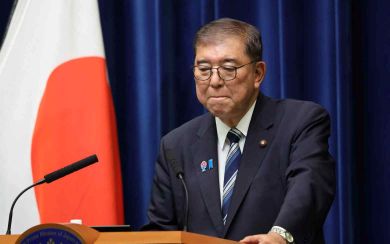
Prime Minister Shigeru Ishiba resigned on September 7, citing the conclusion of United States US–Japan tariff talks as a “natural juncture.” His departure comes at a moment of historic weakness for the Liberal Democratic Party (LDP), which in July lost its majority in both chambers of the Diet for the first time in the postwar era. The party will hold its leadership election on October 4.

While there are five candidates in the running—Shinjiro Koizumi, Yoshimasa Hayashi, Toshimitsu Motegi, Takayuki Kobayashi, and Sanae Takaichi—polls suggest the race is narrowing to a contest between Takaichi and Koizumi. Takaichi positions herself as a nationalist conservative who favors an expansionary fiscal and monetary stance, while Koizumi presents himself as a reformist emphasizing generational change and continuity with Ishiba’s fiscal discipline.

The 2025 leadership race is more about pragmatism than ideology. As a minority ruling party, the LDP’s next leader will be judged not on bold policy agendas but on their ability to unify the party and build workable ties with the opposition. Their success will determine whether Japan regains political stability or faces deeper uncertainty.

For businesses, the outlook is one of limited stability. Whoever wins will face restricted room for unilateral policymaking, resulting in broad policy alignment. Keeping an eye on the election results and the ensuing coalition developments will be crucial to understanding Japan’s political and economic future. 


Resignation of Prime Minister Shigeru Ishiba 

On September 7, Prime Minister Shigeru Ishiba announced his resignation as president of the Liberal Democratic Party (LDP) during an emergency press conference at the Prime Minister’s Office. The decision came after growing calls within the party to expedite the leadership election—effectively indicating that Ishiba had lost the confidence of his colleagues. To prevent further internal divisions, Ishiba decided to step aside.

He justified the timing by referencing the conclusion of US–Japan tariff negotiations, which was marked by President Trump’s executive order reducing tariffs on Japanese automobiles. Ishiba described this as “a natural juncture” to step down.

Although his cabinet’s approval ratings had risen after the July Upper House election, Ishiba lacked a secure base within the LDP and could not withstand pressure for early resignation. In his remarks, he reflected on the party’s disconnect with the public, noting “[how] we must always consider the gap between what the people are thinking and what the party is doing.” 


Election Schedule and Voting System 

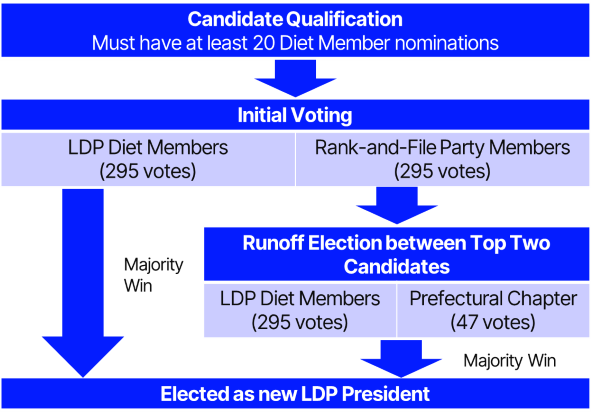
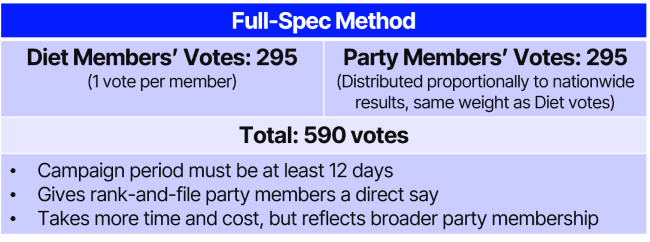
The LDP leadership race officially began on September 22, with voting and results scheduled for October 4. The party has opted for the full-spec system, the most comprehensive format of its presidential elections. 

Under this system, the contest is decided by two groups of voters:

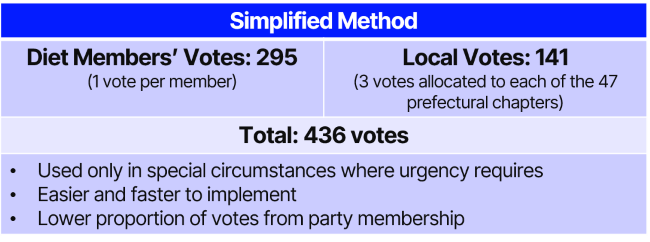
  • Diet members’ votes (295 in total), with each LDP lawmaker in both chambers holding one vote.
  • Rank-and-file party members’ votes (also 295 in total), allocated proportionally based on nationwide membership ballots.

This results in an initial pool of 590 votes. If any candidate wins an outright majority in the first round, they are immediately elected president. However, if no candidate surpasses that threshold—as is widely expected this year—the top two candidates go on to a runoff. 

In the second round, the balance shifts: party membership ballots are no longer counted proportionally. Still, they are converted into 47 bloc votes, with each prefectural chapter awarding one vote to the finalist who received the most support locally. Combined with the 295 Diet votes, this yields a total of 342 runoff votes, heavily tilting influence toward lawmakers. 
It is worth noting that the voice of rank-and-file party members does not represent the voice of LDP supporters, let alone the general public. Although the exact demographics of LDP members are not disclosed, they tend to be older and more closely connected to industry groups or local political networks. Their preferences can vary considerably from wider public sentiment. Consequently, candidates who are popular nationwide may find it difficult to translate that support into votes within the party—a pattern seen in past contests and likely to influence the 2025 race. 


Key Themes of the Race: Party Unity and Opposition Cooperation 

The 2025 LDP presidential election takes place under extraordinary circumstances. Following its historic defeat in July’s Upper House poll, the LDP lost its majority in both chambers for the first time since the postwar period. As a minority governing party, its next leader will be judged more on the ability to maintain stability than on ideology.

Party Unity under Strain

The LDP’s internal cohesion is at its weakest in decades. A series of funding scandals and controversy over ties to the Unification Church have eroded trust, while the dissolution of most factions has removed traditional mechanisms for coordination. Only the Aso faction remains intact, making personal networks more critical than ever.

At the same time, younger voters are turning away from the party, heightening calls for generational change. Ishiba’s resignation showed how even a prime minister with decent public approval can falter if they cannot unify party support or establish a clear policy identity. For the candidates, the lesson is that coordination and consensus-building now matter more than ideological purity.  

Necessity of Opposition Cooperation

In today’s minority government environment, winning the LDP presidency does not automatically ensure the premiership. The new leader must still prevail in a Diet vote, where a united opposition could, in theory, block the LDP and install its own candidate.

Even if confirmed as prime minister, governing will require coalition-building beyond the LDP and its traditional partner, Komeito. In the House of Representatives, support from at least one major opposition party—the Constitutional Democratic Party (CDP), Japan Innovation Party (Ishin), or the Democratic Party for the People (DPP)—is essential to pass budgets and key legislation. The immediate test will be negotiating the FY2025 supplementary budget and the FY2026 budget and tax reform package, which will demand compromises with the opposition.

Some within the party are also calling for broader coalition frameworks to stabilize governance, raising the possibility that candidates will be pressed during the campaign to clarify whether they would pursue partnerships with parties such as Ishin or the DPP.

Implications for Candidate Strategy

While the candidates’ stance on policy remains relevant, the election is less about grand ideological battles and more about the ability to navigate intra-party and inter-party dynamics. Crucial questions are:

  • Can the next leader unify a fragmented party?
  • Can they forge workable ties with opposition parties without abandoning the LDP’s core policy identity? 


Five Contenders 

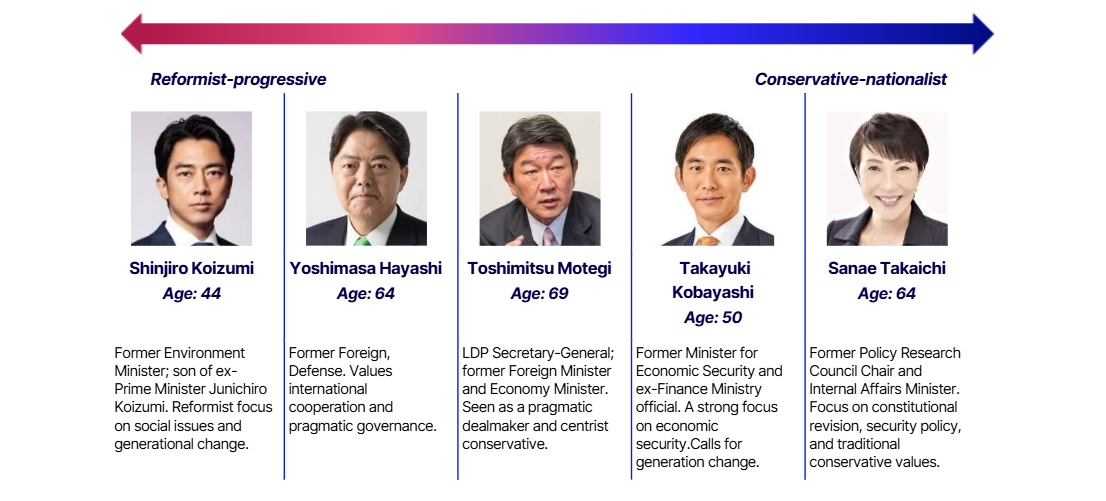
Five LDP Diet members have formally entered the 2025 presidential race: Shinjiro Koizumi, Yoshimasa Hayashi, Toshimitsu Motegi, Takayuki Kobayashi, and Sanae Takaichi. On the political spectrum, the candidates range from the reformist-progressive side to the conservative-nationalist end as below: 

All five ran in the 2024 race, but the political environment is markedly different this time. With the LDP now a minority party, candidates have softened their signature agendas. Unlike last year’s contest, which highlighted ideological divides such as fiscal conservatism versus active spending or progressivism versus traditional values, this year’s tone is more restrained. Candidates are careful to avoid deepening intra-party rifts or alienating potential opposition partners, instead emphasizing “pragmatic leadership under constraints”—the ability to unify the party and navigate multiparty negotiations rather than advance bold personal visions.

Candidate Policy Platforms

The table below outlines the major themes from each candidate’s policy announcement to date. 


Shinjiro Koizumi

Yoshimasa Hayashi

Toshimitsu Motegi

Takayuki Kobayashi

Sanae Takaichi

Economy

Mobilizes all policies to achieve around 1% real wage growth per year.

Targets 135 trillion yen in domestic investment and a 1 million yen rise in average wages by FY2030.

Proposes revising the income tax system to adjust basic deductionsin line with price and wage increases.

Dismisses cash handouts as difficult to implement.

Supports prompt abolition of the provisional gasoline tax rate.

Aims for sustained 1% real wage growth, with support for SMEs and micro-businesses.

Proposes a “Japan-style Universal Credit” to calibrate household support based on combined tax and social insurance burdens.

Reconsiders the 20,000-yen cash handout plan.

Opposes consumption tax cuts.

Proposes multi-trillion-yen “Special Local Allocation Grant for Livelihood Support” to counter rising prices.

Targets raising average annual income above 5 million yen within three years.

Cancels 20,000-yen cash handout plan.

Cautious on consumption tax cuts.

Supports abolishing provisional gasoline tax rate.

Supports flat-rate income tax cut for young and working generations.

Aims to make Japan a technology powerhousewith investments in AI, quantum, and space.

Opposes consumption tax cut as anti-inflation measure, but keeps it as an option if economic outlook worsens.

Supports abolishing provisional gasoline tax rate.

Advocates “responsible proactive fiscal policy.”

Proposes a system of tax credits with cash benefits to support low-income households.

Rejects cash handouts, calling them a policy that lacked public support.

Supports abolishing provisional tax rates on gasoline and diesel.

Social Security

Supports realizing an all-generation social security system that ensures security for every generation.

Supports building a sustainable social security system and addressing the 2040 problem as the second baby boom generation turns 65+.

Supports reducing social insurance premiums.

Supports easing the social insurance premium burden on the working generation.

Promotes lifelong dental checkups (“universal dental screening”) and comprehensive preventive healthcare to optimize medical costs and extend healthy life expectancy.

Foreign Policy and National Security

Supports steadily strengthening defense capabilities and expanding cooperation with like-minded countries—including South Korea, India, and Australia—while keeping the Japan–US alliance as the cornerstone.

Backs increasing defense spending to 2% of GDP.

Supports strengthening deterrence and response capabilities of the Japan–US alliance.

On defense spending, favors close coordination with the US to set appropriate levels and quality.

Seeks to lead international discussions on global issues such as climate change.

Prioritizes reducing US tariffs on automobiles and other products to 15%, while open to further cuts if possible.

Seeks to deepen the Japan–US alliance while enhancing autonomy.

Supports revising the National Security Strategy and increasing defense spending.

Backs tighter regulations on foreign land acquisitions and criminal penalties for disinformation by foreign actors.

Supports building up defense spending.

Aims to establish a national defense posture capable of addressing new domains such as space and cyber.

Proposes creating a “National Intelligence Bureau” to serve as command center for intelligence-related ministries.

Seeks to strengthen economic security by creating a “Foreign Investment Review Committee” to strictly screen overseas investment into Japan.

Constitutional Reform

Supports initiating amendments in the Diet and holding a national referendum, based onLDP’s four constitutional amendment items including explicit mention of the Self-Defense Forces and addition of emergency clauses.

Aims to build public understanding of the LDP’s four constitutional amendment items, including explicit mention of the Self-Defense Forces and addition of emergency clauses, and pursue initiation of amendments in the Diet.

Not addressed this time but showed will to realize constitutional amendments within three years in 2024.

(LDP)

Supports initiating constitutional amendments during term, including explicit mention of the Self-Defense Forces and addition of emergency clauses.

Asserts that, as an LDP leadership contender, the top priority is to amend the Constitution to meet the demands of the times.

Separate Surnames

Takes a proactive stance and maintains support, but stresses politics must set clear policy priorities.

Holds that issues touching on views of family and life require continued efforts to build public understanding.

Cautious, introducing a poll showing that majority favors expansion of maiden name use instead.

Cautious, favors further study on whether expanding the use of maiden names can effectively address inconveniences.

Not addressed this time but showed caution in the past, noting families could end up with siblings having different surname and arguing that burdens and risks mainly borne by women through name changes can be resolved by expanding the use of maiden names as common names. (Asahi Shimbun)

Not addressed this time. But generally opposes separate surnames and instead supports expanding the use of maiden names.

Energy


Supports the new Basic Energy Plan, prioritizing stable energy supply with safety as a prerequisite, while pursuing greater economic efficiency and environmental compatibility.

Not addressed this time, but has expressed support restarting nuclear plants that meet Nuclear Regulation Authority standards, with the understanding of local communities. (Nikkei)

Not addressed this time, but has emphasized securing non-CO2-emitting power sources, including nuclear power, as critically important.(Nikkei)

Prioritizes economic security.

Supports promotion of nuclear power.

Opposes promotion of solar power generation.

Emphasizes strengthening energy resource security.

Supports operating nuclear power plants with safety as a prerequisite and implementing simple, high-safety next-generation innovative reactors.

Strongly opposes covering Japan with foreign-made solar panels.

Party Reform

Supports thorough transparency in political funding to prevent a recurrence of “money and politics” scandals.

Calls for “rebuilding from zero” by revising the party platform to clarify the LDP’s position.

Supports reassessing the merits of the multi-member district system.

Pledges ongoing zero-based review of party discipline and financial structure.

Supports promotion of mid-level and younger members.

Cautious about abolishing corporate and organizational donations.

Calls for generational change and supports improving speed and transparency in decision-making.

Supports thorough transparency in political funding.

Seeks to build mechanisms to reflect voices of party members nationwide in policy.

Opposition Cooperation

Calls for broad policy consultations and efforts to build consensus.

Carefully assesses alignment of policies and principles while considering expansion of the coalition framework.

Emphasizes policy-based cooperation.

Holds that choosing coalition partners should not be a topic for the current leadership election.

Seeks a new coalition framework, viewing Ishin and DPP as potential partners.

Stresses importance of policy-based cooperation. Sees coalition emerging only after policy alignment.

Holds the LDP–Komeito coalition as the basic framework but is open to forming coalitions with opposition parties that share core policies.

Sources

NHK, Sankei

NHK, Nikkei, Sankei

NHK, Nikkei

NHK, Nikkei, Sankei

NHK, Senkyo.com


Recent Polls and Outlook 

Who does the public want: Takaichi or Koizumi?

Polls indicate that the 2025 LDP presidential race is shaping up as a contest between Sanae Takaichi and Shinjiro Koizumi. A Kyodo News survey conducted on September 11–12 asked who would be most suitable as the next LDP president and placed Takaichi first with 28.0 percent, followed by Koizumi at 22.5 percent and Yoshimasa Hayashi at 11.4 percent. A Yomiuri Shimbun poll on September 13–14, using the same question, showed a similar overall ranking but revealed an important nuance: while Takaichi led among the general public with 23 percent, Koizumi was the clear favorite among self-identified LDP supporters at 32 percent, well ahead of Takaichi’s 17 percent. A separate survey by Senkyo.com and JX Communications, conducted the same weekend, also confirmed the two-way race but showed methodological differences: in its telephone poll of older respondents, Koizumi led among LDP supporters (33.5 percent) ahead of Takaichi (23.0 percent), whereas in the internet poll of younger respondents, Takaichi held the advantage. Finally, a Nikkei Shimbun survey in August, which asked who would be most suitable as the next prime minister rather than LDP president, found the two essentially tied—Takaichi at 23 percent and Koizumi at 22 percent—underscoring how close the contest remains.

Who has a say in this election?

While public opinion polls act as a popularity guide, it is ultimately LDP Diet members and party members who influence this election.

Diet Members: Declining Factional Control, Rising Unpredictability

Traditionally, LDP presidential elections have been fought along factional lines, with each faction rallying its members behind a designated candidate. Factions also provided the manpower and financial resources to mobilize party members nationwide. That system has largely collapsed. In the wake of political funding scandals, five of the LDP’s six major factions disbanded, leaving only the Aso faction intact. Without these traditional power blocs to coordinate support, Diet members are freer to vote based on personal networks, regional ties, or short-term political calculations. This erosion of factional discipline not only weakens the predictability of parliamentary votes but also increases the importance of behind-the-scenes deal-making during the campaign.

Party Members: A Black Box Electorate

The second half of the vote comes from LDP party members—a group often described as a “black box” because so little is known about them. Crucially, they do not necessarily represent the broader base of LDP supporters or public opinion. According to party insiders, the rank-and-file tends to skew older, with many being men over 60. Within this group, two broad categories exist:

  • Organized members (“shokuiki”), recruited through industry associations such as medical or construction groups. These votes, which account for roughly 30 percent of the total, often move as a bloc in line with organizational preferences, though their share has been declining.
  • General members, recruited individually by Diet members and their offices. This segment is less predictable, reflecting local loyalties and the personal reach of lawmakers.

Together, these dynamics mean that the actual outcome will hinge on the interplay of Diet member calculations, Aso faction maneuvering, and the opaque preferences of party members—a combination that makes this election particularly difficult to forecast. 


Policy Implications for Businesses 

Fiscal Discipline vs. Expansion: Market Scenarios

Markets are closely monitoring the LDP presidential race, with expectations diverging between the two frontrunners. A Koizumi victory would signify continuity with Ishiba’s approach to fiscal discipline. Strategists believe this would reassure bond investors, driving long-term yields down towards 3.0 per cent, while also supporting a stronger yen, potentially appreciating to around JPY 145 per US dollar. However, equities could experience a modest correction, as Koizumi is not seen as a driver of aggressive stimulus and is likely to distance himself from the opposition’s calls for tax cuts and fiscal expansion.

In contrast, a Takaichi victory is expected to lead to a more expansionary stance, both fiscally and monetarily. Investors believe that her promises to promote growth through substantial spending, along with her backing for continued monetary easing, would drive a stock market rally. Some forecasts indicate the Nikkei 225 could rise towards JPY 48,000 by year-end, with defence, nuclear, and advanced technology sectors benefiting. However, this optimism carries risks: bond markets are cautious of further debt issuance, and currency strategists foresee more yen weakness, potentially by two yen against the dollar.

For Hayashi, Motegi, and Kobayashi, market expectations remain modest, as all three are viewed as continuity candidates with limited impact on equities, bonds, and foreign exchange. Nevertheless, the sharp reversal following Ishiba’s surprise victory in 2024 serves as a reminder that markets can shift suddenly, keeping investors vigilant to volatility until the October 4 vote.

Source: Nikkei

Policy Convergence: A Stable but Constrained Outlook

At first glance, the race between Koizumi and Takaichi suggests stark ideological divergence: Koizumi as a reformist, socially progressive figure versus Takaichi as a conservative emphasizing national security and traditional values. Yet in practice, the scope for differentiation is narrow. With the LDP now a minority party, the next leader will be forced to prioritize party unity and opposition cooperation over personal policy agendas. As a result, broad policy convergence is expected. For businesses, this means a degree of political stability despite leadership change—a contrast to the uncertainty that leadership contests might otherwise generate.

The Role of the Opposition: From Obstacle to Partner

The next LDP leader cannot govern alone. Passage of budgets, tax reforms, and industrial policies will require support from at least one major opposition party (CDP, Ishin, or DPP). This elevates opposition parties from opponents to critical gatekeepers. Companies should track not only the LDP’s platform but also opposition priorities, since the compromises struck across party lines will increasingly determine final policy outcomes. In some cases, engaging with opposition parties may complement traditional LDP outreach and help shape the eventual compromise.

Challenges and Opportunities

Fragmentation in the Diet raises new challenges for corporate strategy, but also opens new channels for engagement.

  • Broader engagement: Businesses can no longer rely solely on the LDP. Building relationships with opposition parties, local governments, and other stakeholders—as well as aligning with international frameworks where relevant—will be increasingly important to anticipate and shape policy outcomes.
  • Planning for delays: Greater legislative complexity raises the likelihood of slower decision-making and diluted reforms. Companies should prepare for longer policy cycles and strengthen scenario planning to manage uncertainty effectively. 


Materials presented by Edelman Global Advisory Japan. For additional information, reach out to Yuichi.Kori@EdelmanEGA.com

President Trump’s second State Visit to the United Kingdom was more than a ceremonial showcase of pageantry. Against a backdrop of domestic political turbulence and global uncertainty, it was a pivotal moment in recalibrating the US–UK Special Relationship for a new era of economic diplomacy, technology, and security. For Downing Street, it delivered proof that global diplomacy can directly translate into domestic benefit—creating jobs, driving investment, and reinforcing Britain’s position as America’s most capable and dynamic partner in Europe. For the White House, the visit provided both symbolism and substance: affirming America’s most enduring alliance while demonstrating that trade and technology agreements remain at the heart of President Trump’s economic vision.

While differences between the two leaders remain including over Gaza and decarbonization, the overall message was clear: the Special Relationship is being reshaped for the 21st century—anchored in trust, measured by outcomes, and powered by shared ambition.   


Edelman Public & Government Affairs US/UK Perspectives

US Perspective

During this week’s state visit, the United Kingdom worked to strengthen its relationship with the Trump administration.

At an opulent dinner Tuesday evening at Windsor Castle - his second state visit - President Trump praised the “bond of kinship and identity between America and the United Kingdom” as “priceless and eternal.”

With trade and foreign policy stakes running high, Prime Minister Keir Starmer met with Trump on Wednesday. Starmer has recently praised Trump in an effort to be in the President’s good graces as Britain looks to deepen its economic ties with the US, ease tariffs, and hold difficult conversations on Israel’s offensive in Gaza and Russia’s war in Ukraine. Starmer later described the talks as a turning point, saying, “We’ve renewed the special relationship for a new era.”

Prime Minister Starmer was proactive in pursuing a trade deal that lowered tariffs in two major industries: auto and aerospace—one of the first trade deals negotiated by the Trump administration.

On Thursday, Trump said he and Starmer had “quite a meeting” with business leaders, claiming the visit had already galvanized “$350 billion in deals across many sectors.” This week’s tech agreement will continue to solidify the US–UK trade relationship.

Starmer also emphasized security priorities, noting that the leaders had discussed “how we can build our defenses, further support Ukraine, and decisively increase the pressure on Putin to get him to agree a peace deal that will last.” He added, “And, President Trump, you have led the way here—and we will continue to stand and work together for security and for peace.”

This trip ultimately served as a carefully staged display of goodwill and shared values. While unresolved disputes on trade and foreign policy remain, the visit strengthened personal ties at the highest levels and reinforced the sense that Washington and London’s partnership will remain durable.

UK Perspective

President Trump’s second State Visit to the United Kingdom is a high-profile reaffirmation of the UK–US Special Relationship, rooted in history, but recalibrated for a new era. It is more than ceremonial—it’s strategic theatre, where every element, from the Red Arrows flyby to the private meeting at Chequers, is engineered to broadcast a message of intent to investors, allies and domestic audiences. The UK is open for business, it’s serious about driving growth through high-value, strategic alliances and it is stepping forward as the United States’ most capable, trusted, and dynamic partner in Europe and beyond.

At a time when both countries are navigating complex domestic and global headwinds, this visit underscores a shared determination to drive forward with outcomes. For the UK, this is a moment to assert itself as the United States’ go-to ally on the European stage. From trade and technology to defense and global security, the UK is utilizing this State Visit to position itself as a gateway to innovation, policy alignment, and economic opportunity in the region.

Crucially for Downing Street, this visit is structured to demonstrate that foreign policy isn’t abstract. Instead, it has material implications and benefits for people across the UK and the headline message is: economic diplomacy delivers. Whether it’s opening export markets for British manufacturers, attracting investment into regional tech clusters, or deepening collaboration that sustains jobs in key sectors, the outcomes are deliberately tangible and nationwide. This is diplomacy that has to drive real-world results, anchored in strategic relevance and measured by domestic impact. The UK Government is making a deliberate statement: global engagement and local prosperity go hand in hand.

At these moments in politics and diplomacy, personal chemistry between leaders plays a significant role. By invoking Winston Churchill’s legacy, the UK is drawing a parallel between past and present leadership in uncertain times. Both Churchill and Trump embody transatlantic ties at a personal level—Churchill through his American-born mother and Trump through his British-born mother. The private meeting at Chequers reflects more than hospitality, it’s an expression of trust, continuity, and shared vision. These one-on-one moments matter when navigating complex geopolitics and setting the tone for strategic collaboration.

The structure of this visit also marks an evolution in the UK’s diplomatic playbook: outcome-oriented, leader-driven, and intent on moving beyond traditional ceremony toward strategic delivery. Ceremonial traditions are not abandoned, but rather repurposed as platforms for influence, investment, and industrial opportunity. It signals a model of diplomacy that is transactional and transformational in equal measure—anchored in values but measured by outcomes that matter to people on both sides of the Atlantic. 


The UK–US Tech Prosperity Deal 

Signed today at the Prime Minister’s country estate, Chequers, the UK–US Tech Prosperity Deal has been the cornerstone announcement of the State Visit with business and investment replacing the pomp and pageantry seen at Windsor Castle. Yet the agreement goes beyond platitudes.  The UK is already the third largest AI market in the world, after the US and China, and larger than any other country in Europe. The convergence of UK and US talent, as well the announced investments, will accelerate economic growth and help bind the strategic alliance between both nations. Prime Minister Keir Starmer has said, “This Tech Prosperity Deal marks a generational step change in our relationship with the US, shaping the futures of millions of people on both sides of the Atlantic, and delivering growth, security and opportunity up and down the country.”

£31 billion has been committed by America’s top technology and AI firms, topping up £44 billion in existing British Government committed investment. Under the UK–US tech agreement, investment is being channeled into AI infrastructure & supercomputing, Data centers and cloud infrastructure, Quantum computing & other frontier tech, R&D, and upskilling workforces. In doing so it is being positioned by both governments as bringing “new healthcare breakthroughs, clean homegrown energy, and more investment into local communities and businesses in Britain and the United States.” The forging of joint research schemes is also being heralded as a mechanism to further the use of AI that will allow the development of targeted health treatments as well as catalyze developments in shared priority technologies like fusion energy. Enthusiasm has been deservedly high. Founder and CEO of NVIDIA Jensen Huang said, “We are at the Big Bang of the AI era—and the United Kingdom stands in a Goldilocks position, where world-class talent, research and industry converge.”

Whereas investments are being spread across the country, central to the shared AI ambitions is the announcement of a “Stargate UK” supercomputer, backed by British firm Nscale and American firms NVIDIA and OpenAI. While more modest than its $500 billion US namesake, it will be strategically vital for AI platform development and sovereign model development. As host to Stargate UK and the proclaimed “AI Growth Zone,” 5,000 jobs are expected to be created in the North East and more may follow with billions in private investment also projected.

Elsewhere, Microsoft, Google and Blackstone are headlining investments across the country. Microsoft has pledged to spend £22bn over four years for AI and cloud infrastructure, including a supercomputer, while Google is to invest £5bn over the next two years to expand an existing data center in Hertfordshire. Blackstone will spend £10 billion to build a hyperscale AI data center in Blyth, Northumberland, expected to create around 4,000 jobs, and AI cloud computing company CoreWeave is also boosting investment to £2.5bn in the past year for an AI data center in Scotland.

Less visible in the agreement, however, is alignment on regulations that will govern the digital services these investments will serve. No change or removal of the Digital services tax (DST) has been announced. This has been a sticking point in UK–US trade discussions and both governments are now reasonably expecting a resolution to be found by the time these investments and tech assets come online. Also pending is agreement on data flows, privacy, AI liability, and trade in digital services. These will be the next hurdles to be overcome in making the most of the UK–US Tech Prosperity Deal. 


A New Nuclear Generation 

The UK–US energy security agreement is ostensibly part of the UK–US Tech Prosperity Deal as it contributes to the energy infrastructure necessary to power the two nations’ technology ambitions. It evidently captured President Trump’s attention during today’s signing at Chequers. The agreement will lead to enhanced cooperation and investment on clean energy with an emphasis on nuclear, small and micro modular reactors, sodium-cooled fast reactors with integrated molten salt energy storage systems, and even the holy grail of clean energy: nuclear fusion.

Since the British government recategorized nuclear as being sustainable in 2023, large reactor projects have dominated. This agreement represents a shift in focus and scale, further enabling a dynamic and decentralized market that has already reportedly created 11,000 jobs in the past year. Language surrounding the agreement has been enthusiastic. Both the PM and Energy Secretary proclaimed the advent of “a golden age of nuclear” in the UK and what US Secretary of Energy Chris Wright has called a “true nuclear renaissance” to meet rising energy demands and fuel the AI revolution. Cooperation with the UK evidently aligns with US strategic interests too with US Secretary of the Interior Doug Burgum stating, “This is how we unleash the full power of American Energy Dominance—with innovation, strength, and key geopolitical collaboration.”

The agreement will make it quicker for companies to build new nuclear power stations in both countries, as well as clear the way for a major expansion of new nuclear projects in the UK. Framed as “the biggest backing of nuclear in a generation” that is leading to a private sector boom, the agreement is expected to drive billions in private investment and create thousands of jobs around nuclear. Eleven firms are named by the government as investing in the UK, with just two of the projects having a combined and estimated value of £51bn. 


Conclusion: Economic diplomacy delivers but challenges ahead 

The second State Visit of President Trump to the United Kingdom was more than a carefully choreographed show of transatlantic pageantry. It delivered a meaningful recalibration of the UK–US Special Relationship rooted in personal rapport, mutual economic interest, and geopolitical necessity.

Going into this State Visit UK officials had hoped for some progress on reducing Steel and Aluminum tariffs to zero—as promised by the Trump Administration earlier in the year. Optimistically, some even speculated that there might be progress towards a wider US–UK trade deal. Neither was really likely, and the impact of the Steel and Aluminum tariffs will continue to impact a UK industry that is seen as part of the critical national infrastructure, but is also on the financial brink.

The absence of domestic political fallout—including over the high-profile dismissal of Lord Mandelson—allowed the Prime Minister to stay focused on the bigger picture. And the bigger picture delivered.

The “Tech Prosperity Deal” unveiled during the visit provides a substantive economic anchor: fresh US investment in AI, nuclear power, and clean tech that aligns with the UK’s long-term growth strategy and strengthens its post-Brexit footing as a magnet for innovation. President Trump’s position on Ukraine, reinforced by pointed language—“Putin has really let me down”—signals a recalibrated US posture on European security. The leaders also managed their disagreements over Gaza and decarbonization with a surprising degree of collegiality.

All of this unfolded against a volatile backdrop. Recent violent demonstrations in London led by the far-right, internal political pressures, and the shadow of past political scandals could have easily derailed the visit. Instead, the tone was forward-looking. President Trump’s own remarks—calling the alliance “an unbreakable bond” and “a beautiful inheritance”—reflected a level of warmth and commitment that few anticipated at the outset of his second term.

And that, ultimately, may be the most significant outcome of the visit: the reaffirmation of an alliance under pressure, shaped not just by legacy but by necessity. As protectionism rises and global cooperation fragments, the UK—the smaller, more vulnerable partner—needed this reset to yield more than ceremony. It needed durable economic wins. The investments secured this week offer that.

Implementation of the announced deals will face scrutiny. Strategic alignment with an unpredictable White House will require agility. But for now, both leaders leave the table with what they came for: proof that diplomacy, when done well, still delivers. 


Materials presented by Edelman’s Public & Government Affairs experts. For additional information, reach out to Mohammed.Hussein@EdelmanEGA.com

Mumbai, 1 September, 2025 – Edelman India today announced the launch of GCC Advisory Services, a comprehensive advisory and communications offering to support Global Capability Centers (GCCs) as they establish and expand in India as innovation-led, strategic hubs for global companies. This offering is designed to help GCCs create a clear differentiation that can strengthen their India position among talent and stakeholders, whether they are looking to set up or already have a base in India.

Edelman’s GCC Advisory Services address three key imperatives, including brand building to attract talent in a highly competitive market, shaping internal narratives that unite global values with local ambition, and crafting their ‘made in India for the world’ innovation story to build reputation among various stakeholders.

“GCCs in India are shaping innovation agendas, driving digital transformation, and influencing how global businesses are building skills to power growth”, said Bhavna Jagtiani, CEO of Edelman India. “Over the last year, our team of specialists have been advising GCCs across sectors — from fintech and biotech to energy and retail. Through our full suite of our cross-functional expertise, we are able to lead these centers in building brand reputation in a dynamic environment, attracting talent, and telling their story focused on innovation and growth.”

Edelman’s GCC Advisory Services integrates data and insights-driven strategy with strong execution across perception audits, narrative development, talent branding, executive visibility, and stakeholder engagement. These services are designed to help GCCs create a strong value proposition and employer brand in India, as well as build credibility and relationships across internal and external ecosystems. The offering leverages communications tools to create multiple touchpoints to ultimately help them transition from being operational hubs to strategic drivers of innovation and leadership.

You can learn more about the new offering here.

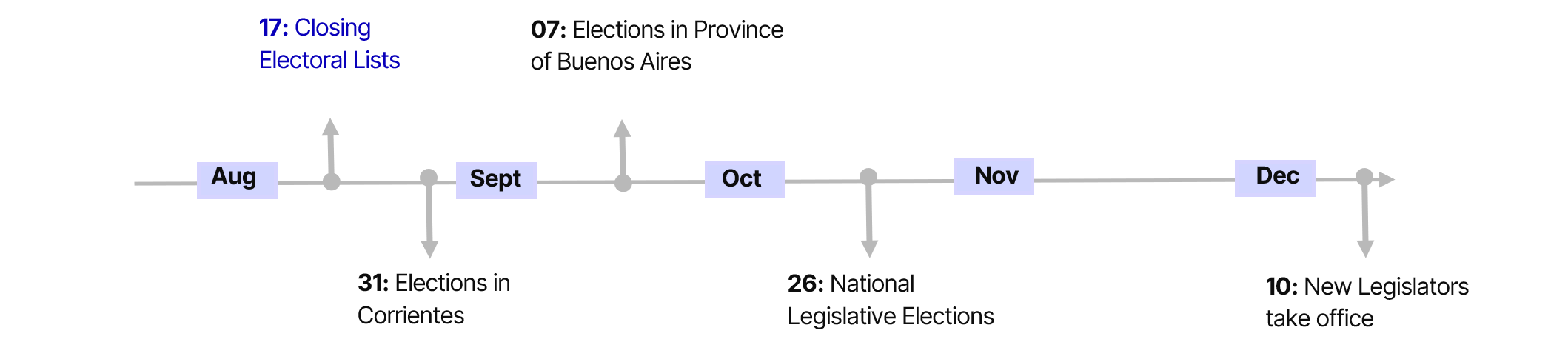
Sunday, August 17 marked the deadline for submitting candidate lists to Argentina’s electoral board, as part of the national legislative elections scheduled for October 26. The closing of candidate lists is a pivotal moment in Argentina’s electoral cycle—it defines the political battlefield for the legislative elections and signals the strategic bets each coalition is making to gain or preserve power. 

In these elections, half of the House of Representatives and one-third of the Senate will be renewed—amounting to 127 representatives and 24 national senators. With control of the House and Senate hanging in the balance, these finalized rosters set the tone for an election that will be a critical test of democratic alignment and fiscal direction, as the country navigates deep polarization, economic strain, and institutional transformation. 

The following piece provides a look at what’s at stake in the House of Representatives and the Senate as well as a snapshot of the final list of candidates.


Overview

The ruling party, La Libertad Avanza (LLA) aims to consolidate its parliamentary power and secure an alliance of at least 85 representatives—one-third of the total—which would allow it to uphold potential presidential vetoes. President Javier Milei has already stated he will veto any laws that threaten the fiscal surplus. With candidate lists in all jurisdictions and a broader territorial presence, the government is aiming to strengthen its representation in both chambers to ensure its goal of “zero deficit.”

Within Peronism, the priority when selecting candidates was to preserve unity and avoid internal splits, with the goal of remaining the main opposition force in Congress.

At the same time, the Provincias Unidas alliance—made up of moderate governors—is looking to establish itself as a centrist option, while the PRO and Mauricio Macri have been sidelined in a new political landscape dominated by the ruling party.

As for the candidate lists, LLA, led by Milei, nominated economist and Representative José Luis Espert in Buenos Aires; Security Minister Patricia Bullrich and Alejandro Fargosi in the City of Buenos Aires; Gonzalo Roca in Córdoba; and Agustín Pellegrini in Santa Fe. Meanwhile, Fuerza Patria, the main opposition coalition, is putting forward Jorge Taiana in Buenos Aires; Mariano Recalde and Itai Hagman in the City of Buenos Aires; Pablo Carro in Córdoba; and Caren Tepp in Santa Fe.


Electoral Timeline


Key Factors of the Election

  • Renewal of Seats in the House of Representatives and the Senate: All provinces will elect national representatives, but only some will also renew their senators. In the House of Representatives, representation is proportional to each district’s population, so the number of seats at stake varies by province. This year, the provinces electing all three of their national senators are: the Autonomous City of Buenos Aires, Chaco, Entre Ríos, Neuquén, Salta, Santiago del Estero, Río Negro, and Tierra del Fuego.
  • First National Election with a Single Ballot Paper: For the first time in Argentina’s electoral history, the national legislative election will be held using a single paper ballot—a system that replaces the traditional party-by-party ballots. In this format, voters receive one sheet listing all official candidate lists and indicate their choice by marking a checkbox. The goal is to cut costs, simplify vote counting, and prevent ballot theft or shortages.
  • Polarization at the Polls: The election will be heavily polarized between La Libertad Avanza and Fuerza Patria, both of which have experienced important internal shifts. LLA struck a balance between technical and political profiles—with Espert and Bullrich as key figures—and brought in outsiders as part of a strategy to broaden its base, ultimately sidelining the PRO and exposing Mauricio Macri’s waning influence. In contrast, Karina Milei has emerged as a dominant figure in shaping candidate selections.

Within Peronism, Cristina Kirchner reaffirmed her central role as political strategist and prioritized unity as the party’s main strength, giving space to internal factions like that of Juan Grabois. His third spot on the Buenos Aires list reflects both a move to address social demands and an effort to strengthen territorial cohesion in Greater Buenos Aires (AMBA). The resulting political landscape features a more centralized and top-down ruling coalition, while the opposition seeks to stay competitive by maintaining balance among its various factions.


Who’s Fighting to Keep Their Seat in Congress

What is at stake in the House of Representatives: In the lower house, La Libertad Avanza risks only 8 of its 39 seats, as it strengthened its bloc in the 2023 presidential elections. PRO puts 23 of its 37 seats at stake, while Unión por la Patria (UxP), the largest caucus, is renewing 46 of its 98 representatives. This configuration provides the ruling coalition with a strategic opportunity to expand its weight in the House of Representatives and consolidate its legislative power.

What is at stake in the Senate: In partisan terms, La Libertad Avanza also has a major opportunity to consolidate its political power in this chamber, as none of its senators’ terms expire this year. The party with the most seats at stake is Fuerza Patria, which must renew half of its seats.


Confirmed Lists | Senators

Ciudad Autónoma de Buenos Aires 

Seats to be elected: 3 Senators

Alianza La Libertad Avanza 

  1. Patricia Bullrich: Minister of National Security.
  2. Agustín Monteverde: Economist, first experience in politics. Expected to be the bloc’s economic spokesperson.
  3. Pilar Ramírez: LLA organizer in CABA, close to Karina Milei.

Fuerza Patria

  1. Mariano Recalde: National Senator, founder of La Cámpora and former CEO of Aerolíneas Argentinas.
  2. Ana Arias: Dean of the Faculty of Social Sciences (UBA).

Ciudadanos Unidos

  1. Graciela Ocaña: Legislator for CABA.
  2. Martín Ocampo: Attorney General of CABA, close to Daniel Angelici.


Confirmed Lists | National Representatives 

Provincia de Buenos Aires

Seats to be elected: 35 National Representatives 

Alianza La Libertad Avanza

  1. Jose Luis Espert: Current national deputy and long-time friend of President Milei.
  2. Karen Reichardt: Actress, TV host.
  3. Diego Santilli: Current national deputy (PRO), promoter of the agreement with LLA.

Fuerza Patria

  1. Jorge Taiana: Former Foreign Minister during the presidencies of Néstor and Cristina Kirchner (2005–2010).
  2. Jimena López: Leader of Sergio Massa’s Frente Renovador.
  3. Juan Grabois: Social leader close to CFK. Leader of Patria Grande and the Movimiento de Trabajadores Excluidos.

Provincias Unidas

  1. Florencio Randazzo: Former Minister of the Interior and Transport under Cristina Kirchner; broke with Kirchnerism in 2015.
  2. Margarita Stolbizer: Leader of the GEN party.
  3. Emilio Monzó: Former President of the House of Representatives during Macri’s administration. Peronist negotiator.

Ciudad Autónoma de Buenos Aires 

Seats to be elected: 13 National Representatives

Alianza La Libertad Avanza

  1. Alejandro Fargosi: Lawyer, former PRO. Close to Bullrich.
  2. Patricia Holzman: Director of Fundación Judaica, former PRO.
  3. Nicolás Emma: Current national deputy, took the seat in place of President Milei in 2023.

Fuerza Patria

  1. Itai Hagman: Current deputy and leader of Juan Grabois’ Frente Patria Grande.
  2. Kelly Olmos: Former Minister of Labor under Alberto Fernández.
  3. Santiago Roberto: Former legislator, close to union leader Víctor Santa María. 

Ciudadanos Unidos

  1. Martín Lousteau: Current national senator, president of the UCR.
  2. Piera Fernández: Student leader, former president of the Federación Universitaria Argentina.
  3. Gustavo Marangoni: Former president of Banco Provincia during Daniel Scioli’s governorship.

Córdoba

Seats to be elected: 9 National Representatives

Alianza La Libertad Avanza

  1. Gonzalo Roca: Businessman. Close to Gabriel Bornoroni, head of the parliamentary bloc.
  2. Laura Soldano: Self-described “spiritual communicator.” Close to Bornoroni.
  3. Marcos Patiño: Vice president of LLA in Córdoba and head of PAMI in the province. Responds to Bornoroni.

Fuerza Patria

  1. Pablo Carro: Deputy since 2017, aligned with Cristina Fernández de Kirchner.
  2. Constanza San Pedro: Leader of Patria Grande, close to Juan Grabois.
  3. Pablo Martín Tissera: Cooperative movement leader and president of Partido Solidario Córdoba.

Provincias Unidas

  1. Juan Schiaretti: Former governor of Córdoba, main architect of Provincias Unidas.
  2. Carolina Basualdo: Mayor of Despeñaderos, close to Alejandra Vigo, wife of Juan Schiaretti.
  3. Miguel Siciliano: Aligned with Governor Martín Llaryora; currently president of the provincial legislature.

Santa Fe

Seats to be elected: 9 National Representatives

Alianza La Libertad Avanza

  1. Agustín Pellegrini: Promoted by deputy Romina Diez, close to Karina Milei.
  2. Yamile Tomassoni: Head of the central region ANSES in the province. LLA organizer alongside Romina Diez.
  3. Juan Montenegro: Legal representative of LLA and head of ANSES for the Litoral Region, also promoted by Diez.

Fuerza Patria

  1. Caren Tepp: Rosario city councilwoman for Ciudad Futura.
  2. Agustín Rossi: Former Chief of Cabinet of Ministers and former Minister of Defense.
  3. Alejandra Borgatta: Councilwoman in Villa Constitución.

Provincias Unidas

  1. Gisela Scaglia: Vice Governor of the Province.
  2. Pablo Farías: Provincial Deputy and President of the Unidos para Cambiar Santa Fe.
  3. Melina Giorgi: National Deputy (UCR).


Materials presented by Edelman’s Public & Government Affairs experts. For additional information, reach out to PublicAffairsAR@Edelman.com

After months of heightened tensions and reciprocal trade measures, China and the US have entered a tentative phase of easing in their economic relationship. The three rounds of trade talks held in Geneva, London, and Stockholm between May and July 2025 did not yield a comprehensive agreement, but they produced incremental progress: an initial 90-day tariff truce, mutual suspension of non-tariff retaliatory actions, a framework for structured dialogue, and a renewal of the truce through November 10.

These developments, while modest and limited in scope, have helped de-escalate immediate risks and created space for more substantive negotiations on key issues where consensus remains elusive—fentanyl-related tariffs, export controls on chips and rare earths, market access, and the bilateral trade gap.

The truce buys time, but not certainty. Its value lies in enabling a shift from reactive escalation to structured engagement. Yet the path forward remains uncertain, shaped by domestic political imperatives, strategic competition, and global economic volatility.

The following piece analyzes this fragile reset in China-US trade ties, highlighting the tariff truce’s short-term value, the political forces behind it, three priorities that will shape the next phase of engagement, and how multinationals in China should be preparing.  


From Escalation to Tactical Reset 

Following the Stockholm dialogue, both governments confirmed a 90-day extension of the tariff truce—20% on fentanyl-related imports and 10% reciprocal tariffs on broader goods—effective August 12. The announcement, signed by President Trump on August 11, came just hours before the deadline. While widely anticipated, the timing and coordinated messaging underscore a shared interest in preserving diplomatic space.

This extension marks a further tactical reset in bilateral trade negotiations. It follows three months of formal dialogue—Geneva, London, and Stockholm—and undisclosed engagements during those rounds that gradually shifted the tone from confrontation to cautious engagement. A pivotal moment came in early June, when President Xi and President Trump held a 90-minute call reaffirming their commitment to the “Geneva consensus,” paving the way for the “London framework.” These talks helped restore a sense of normalcy to bilateral exchanges, reintroducing predictability into a relationship previously dominated by reactive measures and rhetorical escalation.

Still, this reset is not a strategic breakthrough. It extends a narrow but meaningful window for deeper negotiations on politically charged and economically consequential issues—most notably, the 20% US tariffs on Chinese fentanyl precursors, which remain crucial for Beijing despite broader tariff reductions;  

export controls on semiconductors and rare earths, which have become key bargaining chips; and the persistent bilateral trade imbalance, which continues to fuel protectionist sentiment in Washington. These topics are not only central to the trade relationship but also emblematic of the broader contest, and their resolution will require more than procedural engagement—they demand strategic compromise.

Whether this pause leads to progress or simply delays further escalation will depend on the political calculus in both capitals and the ability of negotiators to convert procedural engagement into durable outcomes. 


Domestic Calculus 

Both Washington and Beijing are navigating complex domestic landscapes that shape their external postures. In the US, trade policy is increasingly intertwined with electoral politics and national security narratives. The administration’s tariff strategy—though disruptive—has galvanized domestic support and positioned trade as a lever of strategic competition. Recent decisions, such as permitting key EDA software firms to resume exports to China and easing restrictions on companies like Nvidia and AMD (with conditions such as revenue-sharing with the US government), reflect Washington’s dual objectives: maintaining economic leverage while signaling political intent.

China, meanwhile, is pursuing a dual-track approach that blends tactical restraint with strategic assertiveness. Following the Geneva talks, Beijing paused retaliatory measures against 17 US entities and suspended select export controls—gestures that have remained in place under the renewed truce. Additionally, after the London meeting, China’s market regulator suspended its antitrust investigation into DuPont, signaling a broader intent to de-escalate tensions and avoid deeper economic confrontation. The most consequential outcome was the establishment and implementation of a joint working mechanism for continued dialogue, which China views as a way to reduce uncertainty, compartmentalize economic and political tensions, and buy time to address domestic pressures.

The economic rationale behind the truces is clear. For China, the latest pause supports efforts to stabilize exports ahead of the US holiday season—especially in key consumer categories like electronics, apparel, and toys. The timing aligns with peak shipping windows for Christmas retail, helping Chinese exporters avoid steep tariff hikes and maintain competitiveness.

For the US, the truce provides extended breathing room to ease inflationary pressures and stabilize supply chains. By delaying tariff increases, the administration helped retailers avoid cost spikes, reduce price volatility, and plan inventories more strategically. The move also reflects a broader effort to decouple trade tensions from domestic economic management—preserving consumer confidence while leaving space for diplomatic recalibration. 


Looking Ahead

As China and the US cautiously advance their trade dialogue, three priorities are set to shape the next phase of engagement:

  • Tariffs and strategic sectors: Negotiators are focused on recalibrating tariff frameworks, with rare earths, semiconductors, and agriculture (namely soybeans) at the center. China continues to leverage its dominance in rare earths, while the US has announced broad-based tariff hikes, including a 100% duty on semiconductors and new levies on pharmaceuticals. Starting August 29, the US will also suspend duty-free de minimis treatment for low-value shipments at $800 or less, impacting cross-border e-commerce and signaling limited prospects for tariff relief. Given recent tariff agreements reached with other economies and considering the core objectives of the Trump administration’s global trade strategy, the likelihood of significant tariff reductions on Chinese goods remains low.
  • Non-trade barriers: Both sides are intensifying scrutiny over non-tariff barriers. US export controls continue to restrict Chinese access to advanced technologies, with expanded enforcement on transshipment and outbound investment. China is tightening rare earth export licensing and refining customs regulations to prevent origin manipulation.
  • National security: Clarifying the boundary between trade and national security remains critical. US tariffs linked to Chinese purchases of sanctioned Russian oil and China’s emphasis on energy sovereignty underscore the geopolitical overlay. While both sides are attempting to compartmentalize these issues, escalation risks remain if negotiations stall. 


Implications for Businesses: Agility Amid Ambiguity 

For multinational companies operating in China, particularly US firms, the current environment demands strategic agility. The tariff truce and ongoing negotiations offer temporary relief, but the risk of re-escalation remains. Businesses should stay informed, flexible, and proactive in how they engage with key stakeholders, while preparing for a landscape defined by selective cooperation and evolving rules of engagement.

For US business in China, the extension signals a temporary reprieve from volatility, but not a return to stability. Companies are advised to use this period to reassess exposure, engage with regulators, and prepare for multiple scenarios—including renewed escalation or incremental liberalization.

Multinational firms must balance short-term gains and long-term strategy. In the near term, they should optimize trade contract terms and enhance supply agility to respond to potential tariff shifts. Over the long term, they should continue to strengthen relationships with Chinese partners while advancing global diversification to mitigate geopolitical risks.

Key areas of focus:

  • Regulatory Engagement: Maintain open lines with Chinese regulators and industry associations to anticipate and adapt to policy changes.
  • Compliance and Reputation Management: Navigate heightened scrutiny, including conditions tied to export licenses and revenue-sharing mandates.
  • Crisis Prevention and Response: Establish comprehensive crisis prevention and mitigation protocols to address real-time challenges such as Unreliable Entity List restrictions, sanctions, anti-dumping (AD), countervailing duties (CVD), and anti-discrimination measures.
  • Supply Chain Diversification: Explore sourcing alternatives in emerging new markets and other low-tariff jurisdictions to reduce exposure.

The path forward lies in strategic patience and competitive positioning. While bilateral tensions persist, the relationship is not collapsing. Companies that invest in understanding policy signals, diversifying risk, and engaging constructively with both governments will be best positioned to navigate the evolving landscape. 


Appendix: Summary of the Three Round of Talks 

Geneva: Breaking the Tariff Deadlock (May 10–11, 2025)

The Geneva talks marked the first substantive engagement since the reimposition of reciprocal tariffs earlier in the year. Both sides agreed to a 90-day truce, reducing US tariffs on Chinese goods from 145% to 30% and China’s retaliatory tariffs from 125% to 10%. The agreement also suspended select non-tariff countermeasures and established a consultation mechanism for ongoing dialogue. While provisional, the consensus of the Geneva meeting broke the deadlock and signaled a mutual willingness to de-escalate.

London: Building a Framework for Managed Competition (June 9–10, 2025)

The London round built on Geneva’s momentum and produced a non-binding framework to guide future discussions. Key elements included phased tariff reductions, coordination on investment screening, and a commitment to resume bilateral investment treaty negotiations. The framework also addressed export controls, with China agreeing to streamline rare earth export licensing and the US signaling relaxation of certain high-tech restrictions. The “hard-won” outcomes agreed at London talks introduced structure and predictability into the economic relationship.

Stockholm: Extending the Truce, Expanding the Agenda (July 28–29, 2025)

The Stockholm talks yielded the most tangible outcome: a 90-day extension of the tariff truce, effective August 12. The agenda broadened to include macroeconomic coordination, rare earth exports, dual-use technology, and energy trade. This round reinforced the institutionalization of dialogue and opened the door to further progress on more complex issues. 


Materials presented by Edelman’s Public & Government Affairs experts. For additional information, reach out to Cynthia.Xing@Edelman.com

“Our country has voted decisively for change, for national renewal and a return to public service.” Those were the words Keir Starmer delivered outside Downing Street shortly after accepting His Majesty the King’s invitation to form a government.

Politics moves incredibly quickly and that speech, whilst only a little over 12 months ago, feels to many like a lifetime ago. Given the breakneck speed of politics in the 21st century, too often our focus can be fixated on the latest opinion poll or the career trajectory of individual politicians. This means that our perception of how a government is performing can be focused on the immediate and miss the bigger picture.

In this briefing, we adopt a different approach in order to cut through the noise and spin to provide a more holistic, nuanced appraisal of how Labour has performed in government thus far. We also look ahead to some of the big moments coming up for the government in the next 12 months. 


A mission-led government? 

In his first speech after Rishi Sunak set the date for the 2024 General Election, Keir Starmer was clear in saying that there were three reasons why the public should vote Labour: to stop the chaos, because it was time for change and because it had a long-term plan to rebuild Britain.

To deliver on these, the government has spoken consistently about rejecting so-called “sticking plaster politics” in favor of an approach focused on the long term, which breaks downs Whitehall silos and delivers “the most ambitious and honest programme for government in a generation.” This mission-led approach to government was intended to introduce a new way of governing in order to bring about a decade of national renewal. These missions were to focus on five areas:

  • Economic Growth
  • Making the NHS fit for the future
  • Make Britain a clean energy superpower
  • Safer Streets
  • Breaking down barriers to opportunity

In our conversations with civil servants across Whitehall, it is clear that the thing they crave most from ministers is clear direction. The missions were meant to provide this clarity to the civil service by connecting the government’s political priorities into one consistent narrative, something which could be relied upon while officials seek to coordinate delivery.

This approach is admirable. However, fundamentally rewiring how the government thinks and operates is arguably akin to turning an oil tanker around without a fully functioning control panel. It takes time and it takes determination. Labour has only been in government for a year so it can legitimately claim to not have had sufficient time, but there remains a question about how determined they are in the face of the political headwinds of the day to deliver on this long-term project.

Irrespective of the government’s guiding principles, what is clear is a growing frustration within Labour circles about the pace of reform and that the change that they are eager to deliver on seems stuck in the quagmire that is the Whitehall machine.

Many Labour MPs have told us that they feel the cause of the government’s seeming inability to “turn the tanker” can be found in shortcomings in the preparation for government work which they had previously thought had been further advanced than it proved to be, and was further set back by unhelpful distractions in the early weeks after assuming office.

Prior to the election there was broad agreement about the thrust of the missions, despite grumbles from some about a perceived lack of ambition. There was also broad consensus that whilst voters on the doorstep do not use the language of “missions” and “first steps,” the policies which underpin them do resonate and it gave the Labour Party a useful linguistic tool to describe the bigger picture which individual, often difficult, decisions laddered up to.

However, frustration remains that since entering government and despite having the missions and his oft-repeated “Plan For Change,” the Prime Minister has been unable to successfully articulate what his government is “for,” whose side they are on, and what exactly is the change that they want to deliver. 


The home front: “It's the economy...” 

Keir Starmer and Rachel Reeves have been clear in stating that without the foundations of a stable economy that is growing sustainably, the government will not be able to deliver on its missions. Their chances of re-election in 2028 or 2029 very much depend on it.

For those seeking to understand the intellectual argument underpinning Reeves’ approach, her Mais Lecture in March 2024 is a good place to start. Within this speech, which introduced “Securonomics” into our lexicon, Reeves argued in favor of a new economic approach which recognizes how the world had changed. This approach would be based on the three pillars of stability, investment and reform.

To this, Reeves argued that alongside providing stability, an active government should be focused on stimulating investment through partnership with business and reform to unlock the contribution of working people and the untapped potential through the economy. To assess the performance of the Labour government in its first year in office, we will look at each of these in turn.

Stability

From the day she was appointed as Shadow Chancellor, Reeves has made fiscal credibility her maxim. This should be seen as a reflection of the genuine fear within Labour circles during opposition about the Party being seen as weak or irresponsible on the economy, particularly in the aftermath of the Jeremy Corbyn years.

For years, Labour was hearing from focus groups with target voters that their individual policies were popular, but when they were put underneath the Party’s banner, support for them plummeted. This was due to an enduring fear amongst voters about Labour’s economic credibility and persisted despite the Conservatives’ calamitous handling of the economy. This was something which needed to be dealt with.

Upon entering the Treasury, Reeves sought to turn her rhetoric into tangible action. Labour strategists were eager to identify something which would grab the media headlines and demonstrate to voters that the Party meant what it said on the campaign trail about being trusted with the country’s finances. This is why, alongside a genuine desire to put the country’s finances on a stable footing, Labour majored as heavily as they did on the existence of a £22 billion “black hole.”

This decision set the tone for the first few months of the newly elected government. Not only was it used as the justification for controversial policies such as the increase in Employers’ National Insurance contributions and the scrapping of the Winter Fuel Allowance, but it also conversely led to questions about whether the figure itself was credible. More significantly, accusations were made that the government was talking down the economy and that the negativity was hurting the economy.

Economic growth has continued to be anemic and refuses to show any signs of being kickstarted. GDP figures are poor, borrowing is at record levels and business confidence is shaky at best. This has led to speculation about Reeves’ position and whether a perceived lack of political antennae in her team is actually the root cause of the difficult position the Party is in.

The Chancellor’s difficulties have somewhat turned into a self-fulfilling prophecy. Her spending plans have been further derailed in part by the wider economic climate, both domestic and internationally, but also by her own backbenchers who have forced rethinks in policies such as winter fuel payments and disability benefits—each of which have made the Chancellor’s task at the upcoming Budget even more difficult.

Investment

The second key pillar is investment. This is why one of her earliest announcements as Chancellor was to announce that the UK would be hosting an International Investment Summit. The premise was simple. Show international investors that Britain was under new leadership and that the government was unashamedly pro-business. This was a remarkable success, and the government was able to announce £63 billion worth of inward investment.

From the launch of the Industrial Strategy and the 10-Year Infrastructure Plan to the creation of the National Wealth Fund and the introduction of decade long R&D budgets, Reeves’ approach has been aimed at providing businesses with the long-term certainty they crave. The long-term benefits of this will take years to be felt rather than months, but the early signs from business are almost universally positive.

More broadly, the government has gone above and beyond at times to portray itself as being pro-growth and backing the “builders and not the blockers.” This was seen clearly with the decision to greenlight the third runway at Heathrow despite concerns from environmentalists and even Labour Mayor of London Sadiq Khan, and it has also been demonstrated through funding for projects like the new Oxford-Cambridge rail link and the new Universal Studios theme park in Bedford.

Long-term investment and sustainable economic growth hinges on more than fiscal incentives. It requires action across the entire business operating environment. Therefore, despite some challenges that the government continues to endure with business following last year’s Budget, her support for planning reform, investment in upgrading the electricity skills and a focus on the skills agenda are well regarded.

The government is also betting on the transformative impact that Artificial Intelligence can have in kickstarting economic growth, improving productivity, and making public services more efficient. Coupled with investment in projects like Small Modular Reactors, the government is demonstrating its desire to ensure the UK grasps the potential of the ongoing technological revolution.

Democratic politics is, however, inherently inpatient, and the political cycle does not always align well with the dividends of investment. That being said, whilst the government has had a difficult time on the stability front, it has done much better in terms of investment. They will be hoping that voters across the country will be able see, feel and touch the benefits of it by the time they head to the polls for the next General Election.

Reform

The third key pillar is Reform. Fitting squarely into the “Britain is Broken” mantra and Labour’s mandate for change, the government has shown that it is prepared to move fast and break things in a bid to fix the myriad of problems facing the country.

Through the Planning and Infrastructure Bill, the government is seeking to reform the planning system in order to accelerate the time in which it takes to build major infrastructure projects. Whilst the government has been forced to amend this Bill somewhat as a result of pressure from conservationists, it nonetheless represents a significant piece of reform.

On Net Zero, the government has passed legislation establishing Great British Energy and to enhance the borrowing powers of The Crown Estate to enable it to invest more in the UK’s green energy transition. The government has also instigated a series of reforms to the Contracts for Difference scheme to encourage greater investment into the UK’s renewable supply chain. These reforms are centered around ensuring Britain cements its role as a clean energy superpower.

Whilst controversial with some, the government will be pleased with the progress it has made on the Employment Rights Bill. Again, whilst a series of government-tabled amendments have been added to this Bill, it still represents what is being described as the biggest upgrade to employment rights in a generation. The Prime Minister remains adamant that improved rights at work are not a barrier to economic growth but actually contribute to it, with more secure work bringing increased productivity at work and consumer confidence outside it.

Recognizing that excessive bureaucracy and slow-moving regulators have often been a barrier to economic growth, the government has also taken decisive action in this space. The Competition and Markets Authority have been given a new strategic steer, regulatory bodies have been instructed to prioritize growth and all government departments have been asked to justify the existence of the quangos they are responsible for.

As with investment, the benefits of these reforms are unlikely to be felt immediately. The challenge is therefore for the government to demonstrate to ordinary voters how their reform agenda will deliver tangible benefits to their lives.

And though the government can point to a number of achievements on the domestic policy front and solid beginnings on others, concerns persist that change is not being felt fast enough and that is the anchor that threatens to be a drag on the entire project. 


The international arena 

While the government’s performance on the domestic front has often been criticized, the Prime Minister’s record on the international stage tells a different story—one marked by successes under considerable global pressure.

In an era defined by geopolitical instability, the Prime Minister has had to navigate an unusually turbulent international landscape. Faced with challenges including a volatile global trade landscape, and a shift in the approach to critical global issues such as Ukraine, the UK leader has managed this complex terrain with commendable poise and pragmatism.

Beyond Washington, the UK’s broader trade strategy has yielded meaningful dividends. Landmark agreements with the EU and India signal a new chapter in Britain’s post-Brexit economic identity. These deals are not only important for boosting GDP over the long-term and unlocking new markets, but also for restoring the UK’s international credibility after years of uncertainty and fractious diplomacy. Moreover, the government’s efforts to reset relations with European partners should not be underestimated. After years of acrimony following Brexit, a more collaborative and stable relationship with the EU is a vital component of Britain's foreign policy revival.

However, a central dilemma remains: while these international achievements may impress global observers and market analysts, they seldom resonate with domestic voters. Foreign policy victories do not often translate into electoral gains, especially when economic pressures and public services remain key concerns at home. The government’s task, therefore, is to make these global wins feel tangible for everyday citizens and to frame them as such—be it through job creation, lower prices, or investment in local infrastructure. 


The internal challenges of change 

“Country first, party second” was a mantra Keir Starmer used repeatedly in the run up to the General Election. It was intended as a demonstration of how much the Labour Party had changed from the Jeremy Corbyn years, and how it was ready to put itself back in the service of the British people and usher in a new era of pragmatic, patriotic politics.

It could also be seen as a measure of how Keir Starmer approached the role of Labour Party leader. It is no secret that he does not enjoy managing internal Labour Party dynamics, wanting his energy to be focused on doing the job of Prime Minister. Starmer is no political animal. As such, he has always been happy to effectively subcontract those elements to Labour Party figures who continue to wield significant influence.

Unfortunately for Keir Starmer, since becoming Prime Minister, it will have felt like at least half his inbox is dominated by party management issues. MPs bemoaning the unpopular decisions taken by his Chancellor; the suspension of seven Labour MPs within weeks of the election; backbench forced U-turns on the Winter Fuel Allowance and the Welfare Bill; defeats in local elections and a Parliamentary by-elections, and now suspending four further MPs for “persistent knobheadery,” an injudicious term used by “Labour insiders” which has further incensed a fractious parliamentary party.

Starmer’s seeming unwillingness to engage on the politics is becoming increasingly problematic as backbench MPs raise complaints that his political operation is too remote, only speaks to favored members of the Parliamentary Labour Party and that their role is limited to being lobby fodder. The result: parliamentary rebellions, suspensions and an unhappy party, questioning the moral purpose of its own government and increasing challenges on his authority to govern from its various wings.

Despite the commanding size of the majority and the fact that this government is quite likely only a fifth of the way through this Parliament, it is looking increasingly inevitable that more changes will be necessary for the Prime Minister to deliver on his election promises. Key longstanding advisers have left his side in recent months, with a view taking hold that the Prime Minister should be prepared to look again at his own team and make political appointments that prioritize improving relations with the entire parliamentary party. Meanwhile, think tanks are being asked to help sketch new paradigms for Labour in government, from policy to personnel to performance.

Despite a Spending Review that has pumped money into the NHS, Net Zero and Housing; despite a change to the Fiscal Rules that allow for much more infrastructure spending; despite the roll-out of economic strategies broadly welcomed by those on the receiving end; things won’t change quickly.

In the meantime, Labour leaks support to the left—angry about issues ranging from the leadership position on the situation in Gaza to cuts in welfare and foreign aid98to the right, with the Reform Party on immigration, small boats and general sense that nothing works properly in this country anymore. The reality is that these tensions—along with the alarming fall in his poll ratings—are in part a reflection of the public wanting to see change more quickly.

The question for the PM is how? Hamstrung by a faltering economy which significant structural issues, an increasingly disillusioned parliamentary party, an insurgent opposition party making electoral strides along with a potential new party emerging on his left flank and a story for his premiership that is short on both prose and poetry, it might not be long before the adjective “beleaguered” is attached to the Prime Minister—a difficult position from which to recover. 


The road ahead 

Heading into government, Labour strategists earmarked the third year of this Parliament as the pivotal one. It was viewed as long enough for some of the tough decisions they would have to make early on to begin paying dividends, but far enough away for the next General Election to change track if things were not going as intended.

Given the turbulent political times, Starmer does not have the luxury to wait that long. Whilst they are only whispers at the moment, there are nonetheless conversations ongoing about whether the Prime Minister will even be in post come the next General Election. Labour’s performance in next year’s local, Senedd and Holyrood elections is being viewed as a possible metric against which his future will be judged.

Given the scale of the challenge, there is consensus—from the Prime Minister down—that change is wanted more quickly. So why doesn’t it just happen? The question is not whether the Prime Minister understands the scale of his political problems, those at the center including the Prime Minister and Chancellor are well aware of the need to balance resolving the economic difficulties with some short-term wins. They are also well aware of the way they are viewed and the criticisms made around political management and communication.

In the short term, as we come out of the summer period expect to see staffing changes in No 10 reflecting the need to better manage their relationships with their MPs and other key political stakeholders. This will also include a greater emphasis on engaging with their parliamentary party to reduce the likelihood of future rebellions which suggest that the Labour Party have not necessarily turned the page on the chaos of the Conservative years.

We also expect to see clearer communication about the kind of country the Prime Minister wants to see—the “vision” that has been sorely lacking, with a strong focus on improving the lives of the lower-paid and language around those that “put a lot in and don’t take a lot out” of society. The government will, however, be hoping that this does not descend into a battle to define what a “working person” is and isn’t.

But further challenges to change await. The 2025 Budget will be a difficult one, economically and politically. Tax rises seem inevitable, with the question appearing to be who will be hardest hit. The prospect of community tensions through a long, hot summer fueled by the immigration debate and public services under pressure consumes Downing Street, with very real concerns about the potential for widespread disorder and how best to respond. Language around law and order will harden, with further reform of public services in response to “the new realities” also likely to feature.

The budget represents a “known known.” Potential civil unrest belongs in the “known unknowns” box. And in the “unknown unknowns” category lies possible industrial relations strife, where the inevitable demands for public sector pay rises will rub up against the harsh reality of the economic situation. Labour’s successful banking of the Employment Rights Bill is unlikely to be enough to fully inoculate it against the pay claims of those who feel they have fourteen years of pay frustration needing a release—the current dispute with British Medical Association may be a portent of battles to come.

So where does this leave the Prime Minister and his government? To paraphrase a line from the acclaimed musical Hamilton, which tells the story of how the Founding Fathers of the United States struggled to build a new nation, “Winning is easy. Governing is harder.”


Materials presented by Edelman’s Public & Government Affairs experts. For additional information, reach out to Alex.Williams@Edelman.com

Subscribe to Twitter