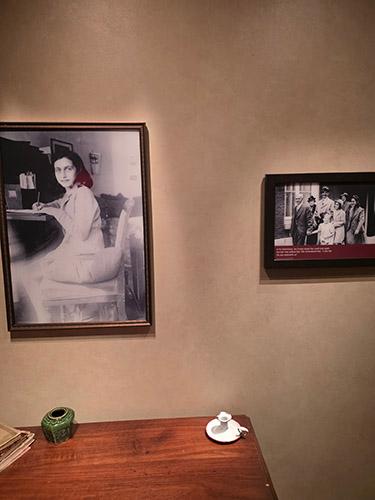

I have just visited the Anne Frank House installation at the Griffin Museum of Science and Industry (MSI) in Chicago, which will open to the public on May 1. This is the first time that the Anne Frank House in Amsterdam has allowed its precious artifacts to come to the U.S. The installation is a precise copy of the Annex built behind the original Frank family apartment in Amsterdam. I sit on the board of the museum and have been very involved in this project.
When I asked Dr. Chevy Humphrey, President & CEO of the museum, why she wanted to host this exhibit, she told me, “Julius Rosenwald, who made Sears, Roebuck and Company a dominant retailer in the U.S., was the original funder of the museum. He was Jewish, proud of his religion and determined to use his financial success to improve society. He funded the building of schools throughout the South from 1913-32 to educate African American children in towns where local school boards did more to support white students. This exhibit carries on his work, providing students with context about the Holocaust, explained by a young girl their own age.”
The Diary of Anne Frank is a collection of writings by a teenager who lived in isolation with her family for two years in Amsterdam, hiding from the Nazi SS. Thirty million copies of the book in seventy languages have been sold since it was published first in the U.S. in 1952. The Diary also became a play on Broadway, then a movie in 1958.
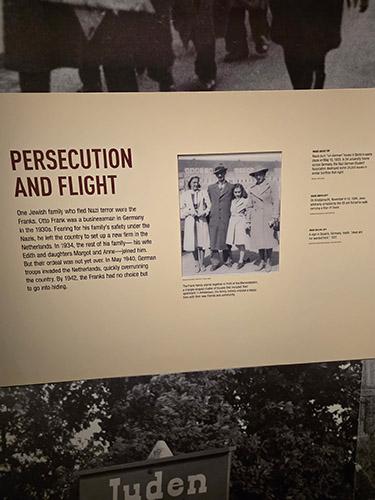
Anne Frank was born in Frankfurt in 1929 to Otto and Edith Frank. Otto Frank was a successful businessman, running a food business. With the rise of Hitler, the Franks moved to Amsterdam, living above a food processing factory. As the Nazi onslaught proceeded across Europe, he constructed an annex behind their original apartment. In 1942, the deportation of Jews from Holland began. The Franks moved into their annex, fed and clothed by loyal company employees.
This deception worked until August,1944, when two workers in the factory were forced by the SS to give up the Franks. The entire family was sent to Auschwitz. The two daughters, Margot and Anne, were later transferred to Bergen Belsen, another death camp, where they died in February 1945. Their mother died in January 1945 in Auschwitz. Otto Frank lived through the ordeal and was freed by Russian troops in late January 1945, then took six months to find his way back to Amsterdam through Odessa and Marseille, only to find himself the sole survivor.
On his return to his factory in Amsterdam, he met his secretaries, who presented him with four volumes of Anne’s diaries. Her first diary was a 13th birthday present from her parents. Her first entry was, “I hope I will be able to confide everything to you, as I have never been able to confide in anyone, and I hope you will be a great source of comfort and support.” There is an incredibly moving video of one of the secretaries, showing how she delivered the diaries into Otto Frank’s hands.
There are three objects from the house that I found deeply moving. First there was a bicycle hung on the wall alongside a backpack. It was useless for the hideaways except as a source of continuing hope for a better future. Second was a makeshift menorah, carved of wood, its candles the symbol of resistance. Third was the cut-out photos of movie stars on the wall above the beds of the two girls; the first awakening of teens to a life on the outside that they could only dream about.
Dr. Humphrey is a singular leader who understands the power of her office to influence and educate the community. She understands that the primary mission of her institution is to improve the understanding of science, enabling visitors to dream about careers in technology. But she told me, “You need an appreciation of humanities to fully appreciate science. The racial pseudo-scientific theories of the Nazis, a master race that sits above Jews and people of color or those with deep religious faith, need to be understood and rejected today. That is the message of the Anne Frank exhibit, painful truth through history.” To all my readers, please come to Chicago in the next nine months to see this all-important exhibition at the Griffin MSI.
Richard Edelman is CEO.