
It is 2026. According to Pantone, the world is retreating into safe neutrals. That phrase could also describe my beloved Watford FC’s transfer policy over the past few seasons. 

As work resumed in January, the predictions arrived. A new year, we’re told, will bring change. It always does. Sports marketing, like sport itself, is obsessed with what comes next. We analyse how younger audiences engage digitally, while older fans pay for tickets. We assess new formats and breakaway leagues. We watch athletes build followings and businesses beyond the field of play.

Yet amid all this movement, are we asking the important question: what stays the same? To coin Jeff Bezos; “you can build a business strategy around the things that are stable in time.” The same applies to brand strategy. In sports marketing, constants often matter more than the latest trend. The principles that underpin success will endure, and in 2026, five of them will continue to shape how brands operate in sport.

Sponsorship choices will remain top-down, not bottom-up 

Despite real progress in understanding sponsorship effectiveness, many deals remain shaped by personal preference at the top. Ask why a sponsorship exists, and too often the answer is familiar: “Because the CEO likes that sport.”

Important work by Rory Natkiel and others has advanced the case for evidence-led sponsorship, and the discipline is maturing. But defaults will persist. Pulling brands away from instinctive choices and towards more strategic, demonstrably effective investment remains one of the industry’s most important, and unresolved, tasks. 

Reach will remain as a low bar for brands in sport 

Sponsorship comes with commercial ambition, but also responsibility. The furore surrounding FIFA’s approach to ticket pricing for the 2026 World Cup has intensified scrutiny on how all governing bodies promote accessibility to live events, and brands willing to partner must recognise the chance for residual impact.

Edelman’s Pushed to the Limit study shows fans believe sponsors take more than their fair share from sport. In an inflationary environment, visibility alone no longer earns credibility for brands. Brands can’t lower ticket prices, but must be additive, be it making experiences better or the ecosystem stronger. As ever, brands need fans to be glad they are there. 

Engaged fans remain the real prize 

Keeping fans at the centre of decision-making is not new, but it remains decisive. The brands that succeed in sport continue to invest in deep relationships and meaningful experiences, in stadiums and niches that fandoms inhabit. In community marketing circles, success relies on turning anoraks into advocates. 

In 2019, comedian Stewart Lee called his tour Content Provider to satirise digital dystopia. In 2026, it’s no joke for brands in sport. Engaged fans spend six times more than casual ones. That has shifted competition off the pitch, as brands and rights-holders weaponise content provision to chase global fan bases that sustain sponsorship, broadcasting, and merch revenues. 

Consistency compounds value in sponsorship 

As in other areas of brand building, consistency remains undervalued in sport sponsorship. Longevity and repetition drive impact, yet sponsorship is still too often treated as a series of short-term activations. Guinness’s commitment to rugby stands out as the exception that proves the rule. 

Effective sponsorship should function like a long-running brand platform, anchored in a single idea that endures for the life of the deal. In practice, activation budgets are frequently contested, with CFOs seeking clearer proof of return. Securing the investment required for long-term creative consistency remains a battleground for brands aiming to maximise the commercial value of sport. 

Athlete welfare looms large as sport’s most overlooked risk 

The public has always been capable of compassion, but social media has stripped away the mythic armour of elite sport, revealing athletes as people first and performers second. In UK professional sport, athlete welfare remains the most significant unmanaged risk in the eyes of fans. How organisations protect, support, and listen to athletes directly shapes trust, credibility, and the relationship with fans. 

Support cannot be symbolic. Sixty-six per cent of fans believe sporting organisations neglect athlete mental health, and nearly half believe retirement transitions are poorly handled . Failures in welfare can damage brands faster and more deeply than poor performance or commercial misjudgement. 

In a year dominated by talk of change, it is these principles – familiar, persistent, and at times uncomfortable – that will continue to determine outcomes for brands in sport. 

Plus ça change, plus c’est la même chose.


Will Butterworth is Strategy Director based in London.

Context: why connectivity policy is back at the centre of EU strategy

Connectivity has moved from being a sectoral concern to a strategic foundation of Europe’s economic, security and industrial agenda. Gigabit networks, advanced 5G, cloud computing and satellite connectivity are now critical enablers of competitiveness, underpinning everything from AI deployment and industrial transformation to public services and crisis response.

This shift has been reinforced by recent high-level policy thinking. Both Enrico Letta’s report on the future of the Single Market and Mario Draghi’s analysis of European competitiveness set out a high level of ambition for the telecoms sector, calling for deeper integration, greater scale and stronger investment conditions to overcome fragmentation. 

Against this backdrop, the European Commission’s proposed Digital Networks Act (DNA) represents the most consequential rethink of EU connectivity regulation in over a decade, not as a full-scale overhaul, but as a targeted effort to streamline the framework, improve coordination and bring greater uniformity across Member States, while stopping short of the more far-reaching reforms envisaged in those reports.

Digital Networks Act

What the DNA is trying to fix

The Commission’s diagnosis is clear. Despite years of harmonisation, Europe’s connectivity markets remain fragmented along national lines, with divergent authorisation regimes, spectrum conditions and regulatory practices increasing compliance costs and limiting cross-border expansion.

This fragmentation increasingly clashes with how digital networks operate. As networks become software-driven, cloud-based and integrated with data and AI infrastructure, scale becomes a prerequisite for competitiveness. The DNA is designed to reduce structural friction and make it easier for providers to operate and invest across borders.

  • From national silos to a more integrated market: The DNA aims to reduce persistent fragmentation by consolidating key telecoms instruments into a single Regulation and introducing a single market authorisation framework, including a Single Passport, to simplify cross-border operations while preserving national regulatory oversight.
  • Fibre, spectrum and investment certainty: The proposal tackles two long-standing investment bottlenecks by establishing a coordinated transition from copper to fibre, based on national plans and conditional switch-off, and by reforming spectrum policy through longer or open-ended licence durations, enhanced EU scrutiny of assignments and stronger incentives for spectrum sharing.
  • Resilience, satellites and strategic autonomy: By formally recognising digital networks as critical infrastructure, strengthening EU-level preparedness and resilience coordination, and introducing a more centralised framework for satellite authorisation and spectrum management, the DNA aligns connectivity policy more closely with the EU’s economic security and strategic autonomy objectives, including crisis response and reduced dependence on non-EU infrastructure.

What this means for businesses

The Digital Networks Act is not just a telecoms file. It reshapes the conditions under which cloud providers, AI developers, infrastructure investors, industrial users and public authorities rely on connectivity.

The direction is clear: fewer regulatory barriers, stronger coordination and a more strategic view of networks as critical infrastructure. For companies operating across borders, the legislative process ahead will be a key moment to assess how future network regulation could affect investment decisions, service models and resilience planning.

Next steps to watch

The proposal now enters the legislative process, where Member States and the European Parliament will test the balance between EU-level coherence and national flexibility. Key areas to watch include how far harmonisation goes in practice, how spectrum safeguards are framed, and how resilience obligations are operationalised.

For stakeholders across the digital ecosystem, the coming months present an opportunity to engage early on how Europe’s connectivity framework should support competitiveness, innovation and security in the next decade.

For additional information, reach out to Diana.Angelova@edelman.com and Francisco.Herrera@edelman.com

2025 was a challenging year for corporate sustainability. Companies faced shifting regulations, volatile markets, tightening budgets, and growing scrutiny. Sustainability decision makers are keen to get ahead and understand ways to navigate risk while growing impact. So last month, I asked 20 sustainability leaders from my network—representing industries from software to food, and organizations spanning NGOs, Fortune 500s, startups, and venture capital—what they see as emerging themes in 2026. Their insights offer a glimpse into what sustainability leaders may want to pay attention to as they plan the year: 

  1. Addressing the energy impacts of AI: With AI workloads driving a doubling in global data center energy demand by the end of the decade, companies will need to source clean power early to remain in a strong position. According to Elaine Hsieh, COO and partner at VoLo Earth Ventures, we can expect to see more attention on virtual power plants (VPPs) as a practical way to add capacity quickly at grid edge. Hsieh predicted, “VPPs may surprise everyone by becoming the fastest path to unlocking new power. Governments are also expected to keep leaning into fusion, geothermal, and nuclear, treating them as important long-term energy solutions.” 
  2. Resurgence of local action and community resilience: As national momentum on sustainability fades, communities have stepped up to fill the gaps. In 2026, leaders predict an outsized opportunity to work with local and regional organizations to help build community and climate resilience. 

    “I anticipate seeing a surge in fresh, unexpected partnerships across industries to drive meaningful, rapid, and ideally intersectional, impact,” said Charlie Reed, global sustainability lead at Intuit, which has partnered with organizations such as The Farmlink Project to reduce food waste and emissions. “Outside-the-box thinking is required to make true sustainability progress, and companies may realize that their most potent sustainability lever may lie in collaborating with a small or new organization they’d not previously considered.” 

    Amy Kull Lithgow, director of development and communications at Sierra Harvest, predicts that local micro-utilities, resilience hubs, mutual-aid networks, and civic coalitions will grow rapidly, particularly in regions hit hardest by extreme weather and/or economic instability. She shared a recent example of fruit gleaning efforts in Western Nevada County in California, which prevented food waste and provided SNAP food assistance recipients with fresh apples, mandarins, and persimmons. 

  3. Risk rising on the corporate agenda: Physical risk from climate change is predicted to represent $1.2 trillion annually by 2050 and regulatory forces like CSRD will continue to shape how large companies think about climate risk. Joel Makower, chairman and co-founder of Trellis Group and strategy director at Music Sustainability Alliance, predicts risk will become more embedded across overall planning. “Rather than being siloed under sustainability, climate risk will be part of financial planning, insurance assessment, asset valuation, capital expenditure, and long-term corporate strategy.” 

    Companies must conduct detailed climate risk assessments to inform strategy and disclosure requirements as pressure from stakeholders grows. And as physical threats from climate intensify, companies and governments must urgently build resilience into value chains, infrastructure and operational plans. 

  4. Sharpening how we value nature: The last five years have ushered in more corporate attention to the risks and value associated with nature. Brian Rosevear, VP of public affairs and communications at The Nature Conservancy of Canada, believes 2026 will be defined less by high-level commitments, and more by an increase in strategic investment in the natural systems that fuel our lives and livelihoods. 

    “It's the idea of seeing nature as an investable asset,” he said. “It’s not built, and it doesn’t carry a price tag in the way pipes or power lines do, but it performs just as reliably: buffering floods, filtering water, storing carbon, cooling cities, supporting food systems. Companies may focus more on safeguarding the natural assets that directly or indirectly support their operations. Communities may rely more on natural buffers instead of costly engineered fixes. And governments may see land conservation and restoration as part of their long-term infrastructure planning.” 

  5. Continued evolution of carbon markets and a new era of transparency: Carbon markets continued to grow and evolve in 2025, and the same trajectory is expected for 2026. On the demand side, Kelley Vendeland, VP of marketing and sustainability at Energy Recovery, is tracking how rising AI-related demand for energy is intensifying competition for high-quality carbon removal credits as companies seek to balance rising emissions, a dynamic that could help accelerate maturity in the carbon market. Akin to the expected (and hoped for) quality improvement in the market, there is also an appetite for more transparency and clear differentiation in how we talk about carbon. 

    Harris Cohn, head of sales at Charm Industrial, predicts in 2026, “The climate standard setters and journalists start better distinguishing between carbon capture and storage and durable carbon removals,” delineating between carbon neutral approaches and the net negative approaches needed for net zero. Beyond carbon markets, the desire for broader transparency and authenticity continues. 

    Nima Farshchi, executive director and lecturer at the Robert H. Smith School of Business at the University of Maryland, summarizes this sentiment, predicting a future driven by good intentions and transparency. “I think any company that is willing to take a stand on sustainability is doing so out of genuine alignment and part of a conscious culture, not driven to do so out of disingenuous beliefs.” 

What do these predictions mean for communicators? We will need to spend far less time elevating high-level commitments and far more time translating complex, operational decisions into language stakeholders can understand and trust. As issues like AI energy demand, climate risk, nature investment, and carbon quality move closer to the core of business strategy, communications will need to reflect real constraints, tradeoffs, and timelines, not just ambition. Whether it’s more specific language around carbon removal or more contextualization to drive trust with local partners, it means grounding sustainability narratives in specific actions amidst a more uncertain and scrutinized landscape. 

As we set our sights on 2026 and progress into the second half of the Global Goals’ Decade of Action, it’s clear the year ahead won’t offer simplicity. But these insights could provide sustainability leaders a sharper sense of how they can move forward with more confidence and clarity, underpinned by a sharper understanding of where they can expand their impact while navigating risks.

Emily Chan is Executive Vice President, Social Impact & Sustainability.

For years, Gen Z has been largely disengaged from traditional media, instead prioritizing social platforms, short-form video, and real-time content. As a result, media relations have often taken a back seat in communications strategies aimed at reaching this audience.

But that thinking is now due for a reset. While Gen Z may not be tuning in to traditional outlets, they’re reading the results. As AI-powered search tools pull directly from news sources to generate summaries, a generation long assumed to be media-agnostic is now consuming headlines, reporting, and context—often without realizing it. This shift gives earned media a new seat at the table in Gen Z engagement strategies.

AI is Gen Z's new information hub

According to a 2024 report by Media Technology Monitor, 38 per cent of Gen Z Canadians (aged 18 to 26) have used generative AI tools such as ChatGPT, the highest adoption rate of any age group. A 2025 survey by Toronto Metropolitan University’s Social Media Lab found that of the Canadian Gen Z adults (aged 18–24) who have used generative AI tools, 91 per cent of them use it for study, 82 per cent for leisure, and 77 per cent for work. In other words, AI has become a go-to for how they learn, play, work, and most critically, get their information.

As they increasingly turn to these tools, trusted editorial content is resurfacing through the AI-generated outputs they consume. AI systems act as curators, elevating content from outlets they deem authoritative. And since trustworthy content is the foundation of AI answers, securing earned media coverage in those credible outlets has therefore become essential to reaching Gen Z.

The Trust Gap Shaping AI Engagement 

This shift is taking place in a broader context of deep mistrust. According to Gen Z & Grievance: An Edelman Gen Z Lab Special Report, two-thirds of Gen Z globally worry that government, business leaders, journalists and reporters are intentionally misleading them. And yet, those are the very sources AI systems rely on to generate answers. For communicators, the impact of this development is profound: to shape what Gen Z sees, believes, and shares in AI-powered environments, your message must live within the sources these systems trust most—because that’s what will shape their reality.

AI-powered systems now deliver synthesized answers, rather than presenting a list of hyperlinks like traditional search engines. These models are trained on extensive libraries of credible sources, including journalism, academic research, and encyclopedias. Instead of relying on keyword matches, they emphasize quality and trustworthiness by prioritizing reliable editorial content. As a result, answers often reflect narratives shaped by traditional media, even when users never visit the original sources.

In many cases, users only see a brief, AI-generated summary with no attribution. If a response is informed by a Forbes article or CNN segment, the original outlet may go unrecognized. While some platforms provide links, most users won’t click through if the summary feels sufficient.

Why Earned Media Matters More Than Ever 

This means the role of media relations in reaching Gen Z is expanding. Gen Z might not read a full-page profile or watch a panel discussion, but they will absorb the takeaways through a podcast excerpt, an Instagram carousel, or a smart assistant’s response – all of which are increasingly being shaped by AI. Additionally, because these tools often resurface the same credible content repeatedly, instead of a one-time impression, a quote or insight can live on as part of AI’s responses to related queries further amplifying the impact.

As Gen Z continues to turn to AI for trusted information, the role of traditional media takes on a new kind of relevance. Content from trusted editorial sources now shapes the answers Gen Z receives, even if they never visit the original outlet. For communicators, this makes earned media coverage a priority that can no longer be overlooked. If your messaging doesn’t appear in the ecosystems that AI tools trust, it risks being left out of the conversation altogether.


About the Edelman Trust Barometer Flash Poll: Trust and Artificial Intelligence at a Crossroads

The Edelman Trust Barometer Flash Poll: Trust and Artificial Intelligence at a Crossroads was produced by the Edelman Trust Institute in addition to the annual Edelman Trust Barometer. The Flash Poll surveyed 5,000 respondents across 5 countries between October 17 and October 27, 2025. It is the firm's first study dedicated to the question of Trust and AI.


About Edelman 

Edelman is a global communications firm that partners with businesses and organizations to evolve, promote and protect their brands and reputations. With 6,000 employees across over 60 offices, Edelman develops communication strategies that build client confidence and stakeholder trust. The firm boasts an array of accolades, including PRWeek's Agency Dynasty of the Past 25 Years and Global Agency of the Year (2023) and Cannes Lions Independent Agency of the Year for the Good Track (2024 & 2022). Recognized as a standout agency by AdAge (2023) and honored with multiple Cannes Lions, including Titanium, Grand Prix and seven Gold Lions since 2021, Edelman consistently sets the industry standard. Since our founding in 1952, we have remained an independent, family-run business. Edelman owns specialty companies Edelman Data x Intelligence (research, data), Edelman Smithfield (financial communications), and UEG (entertainment, sports and lifestyle). 


No amount of winery tours prepares you for the hands-on, hard labour of winemaking.

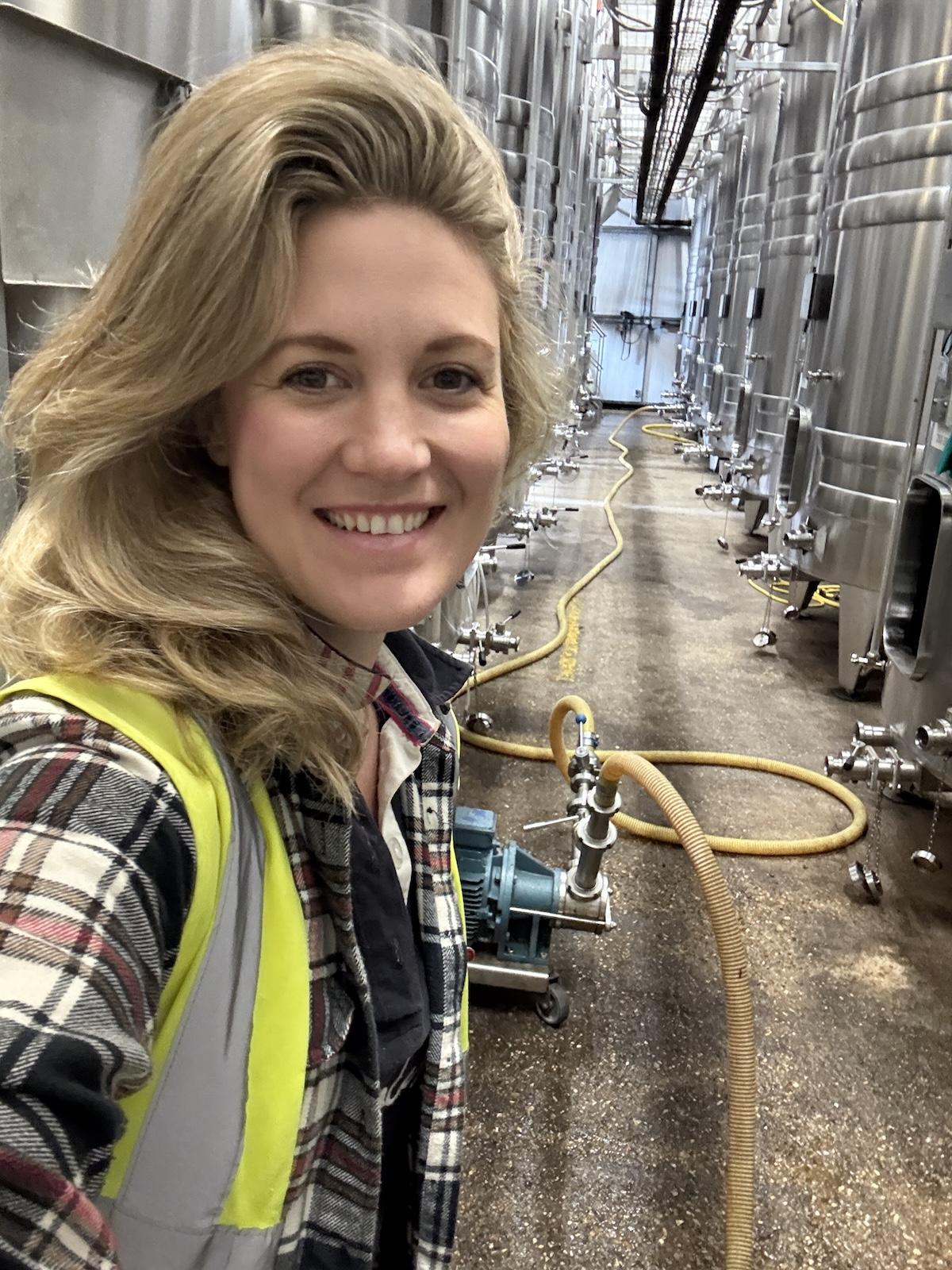
That’s how I spent three weeks working harvest at Chapel Down, the UK’s largest English wine producer in Kent to celebrate hitting my ten year milestone at Edelman.

When you reach a decade working at Edelman, we’re rewarded with a long service award of ten days of extra holiday. While most people head to the beach or explore new cities, I decided to do something completely different; immerse myself in the world of wine. Sparkling wine is my passion, and although I’d studied it, I’d never experienced behind the scenes of a winery let alone a harvest – a rite of passage for any wine lover.

My best friend, Tom, part of the winemaking team at Chapel Down, invited me to join him as one of the Harvest interns. An offer I couldn’t refuse.

2025 was a near perfect year for growing grapes.

This year was one of the best UK harvests to date: warm, dry weather, record sunshine and beautifully clean, ripe fruit. Sunshine and heat are vitally important to ripen grapes, this combination of conditions saw increased sugar development, riper fruit flavours and softer tannins. Dry conditions mean very little disease - such as grey rot - in the vineyard, providing higher yields of clean, healthy fruit leading to higher quality wine.

Make a note of the 2025 vintage, English wines are going from strength to strength and this year is going to be special. Expect more tropical and stone fruit notes, like mangos, nectarines, honeydew melons, bountiful berries such as strawberries, raspberries, cherries and boldness in the wines - simply put more interesting flavours going on in the end product.

What did I do?

Winemaking is not easy, it’s technical and requires patience at every step – not to mention, 90% cleaning. Tanks, barrels, presses, floors, grape bins: everything gets washed, sanitised, scrubbed or swept on a daily basis. The rest is the fun part: pressing grapes, adding yeast, measuring sugar, transferring juice between tanks, and monitoring fermentation across more than 120 tanks (some up to 50,000 litres).

Integrated into the 20 strong team of harvest interns, the winery operates 24hrs a day during harvest - a day shift taking twelve hours between 8am - 8pm and nights 8pm - 8am. It’s a beehive of activity - everyone working independently but also smoothly as a team. This camaraderie certainly one of the greatest parallels between my role at Edelman, leading up to a major event or PR launch, and within the winery.

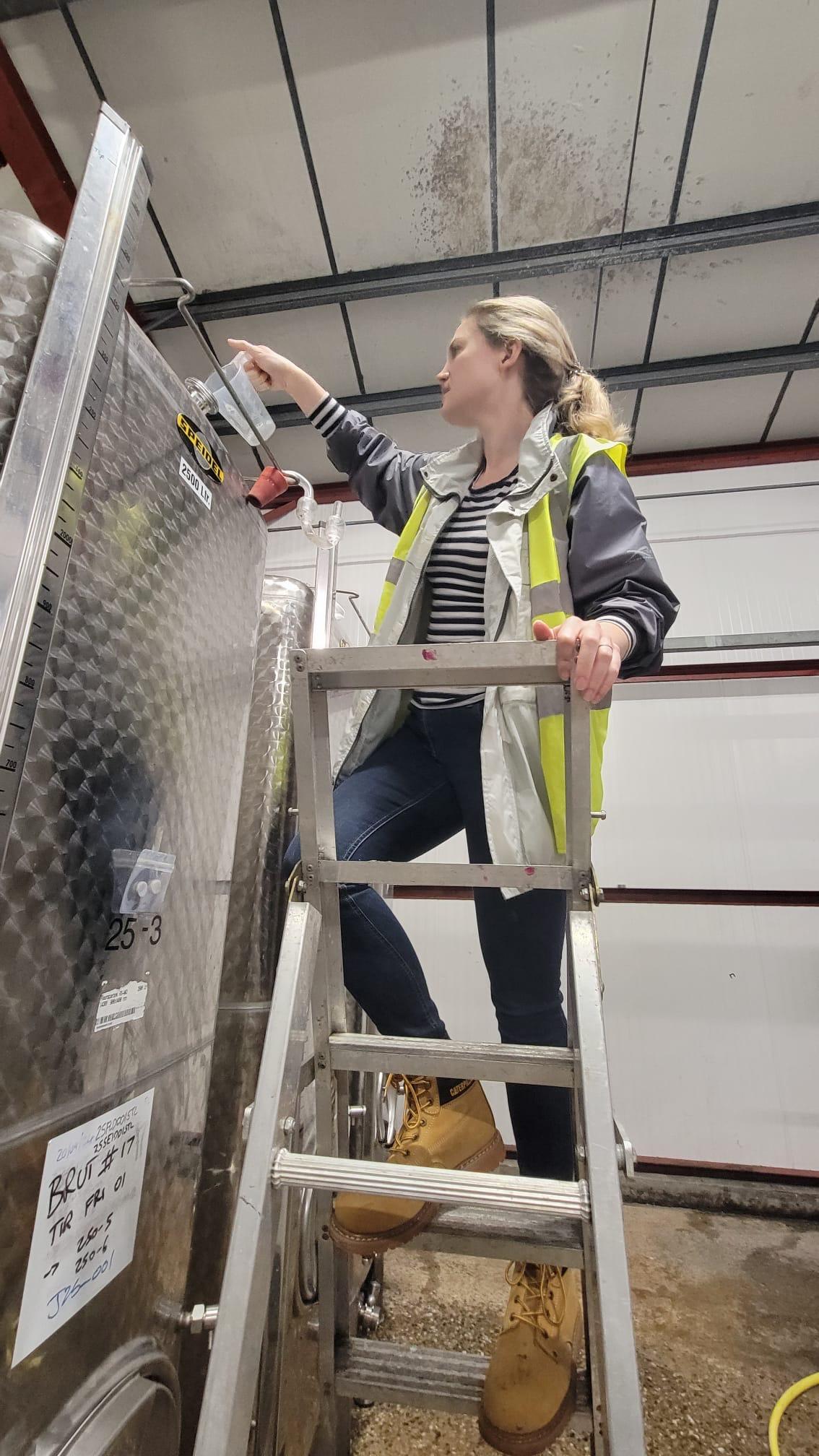
I helped in the onsite Lab where sugar and acid levels in the grapes are tested. I manually crushed grape samples; all 13 varieties grown across the estate and sourced from specialist growers are tested for ripeness to know when to pick. It’s a balancing act, the sugars need to be high but not too high and the acids low but not too low.

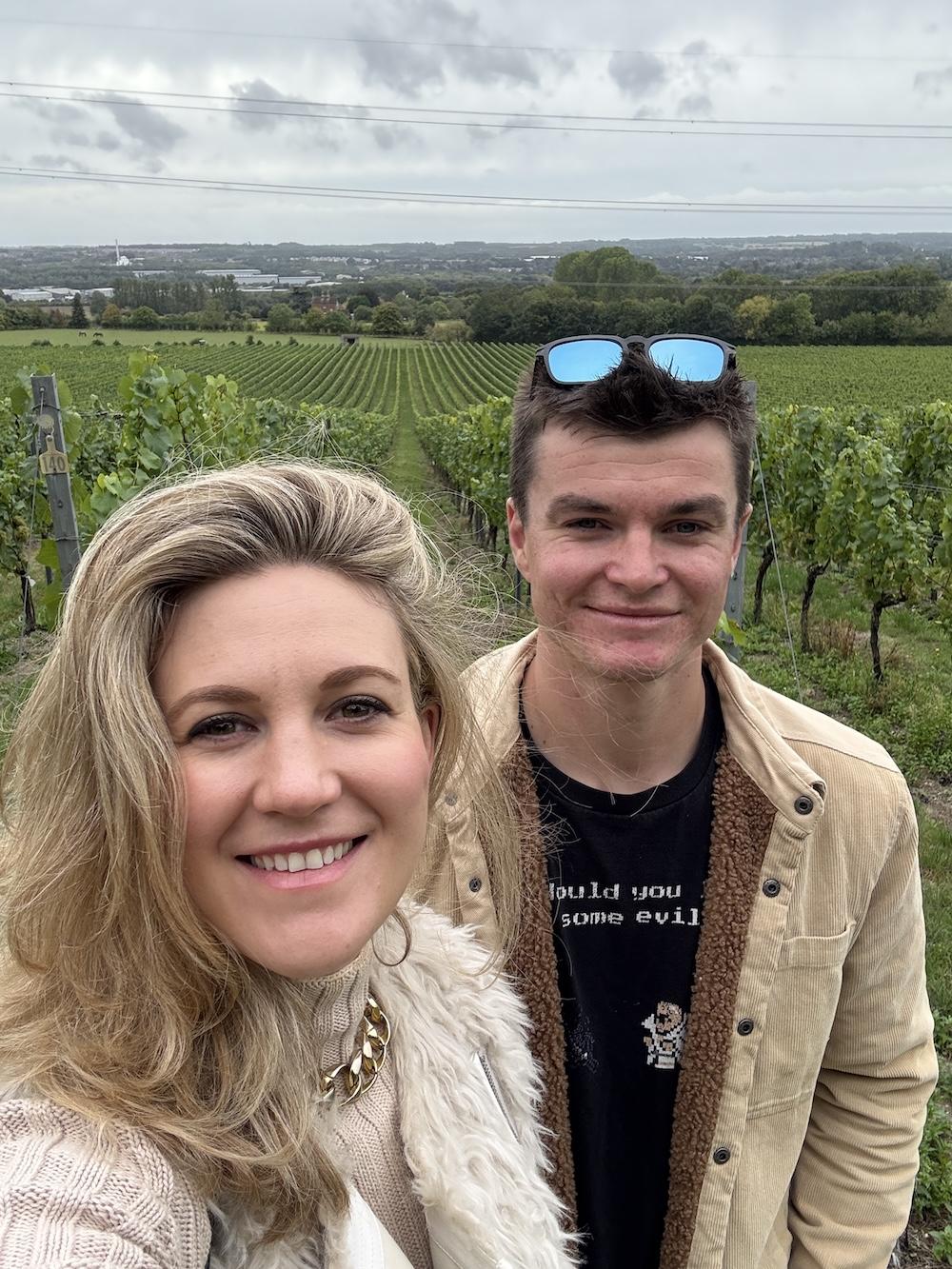
I visited some of the 400 hectares (1,000+ acres) of vineyards and I was blown away by the scale, seeing rows upon rows upon rows of vines over Kits Coty, one of the best vineyard sites in the UK on beautifully white chalk soil. A view you’d expect in France or Italy but it was a pinch me moment to overlook the rolling hills of home.

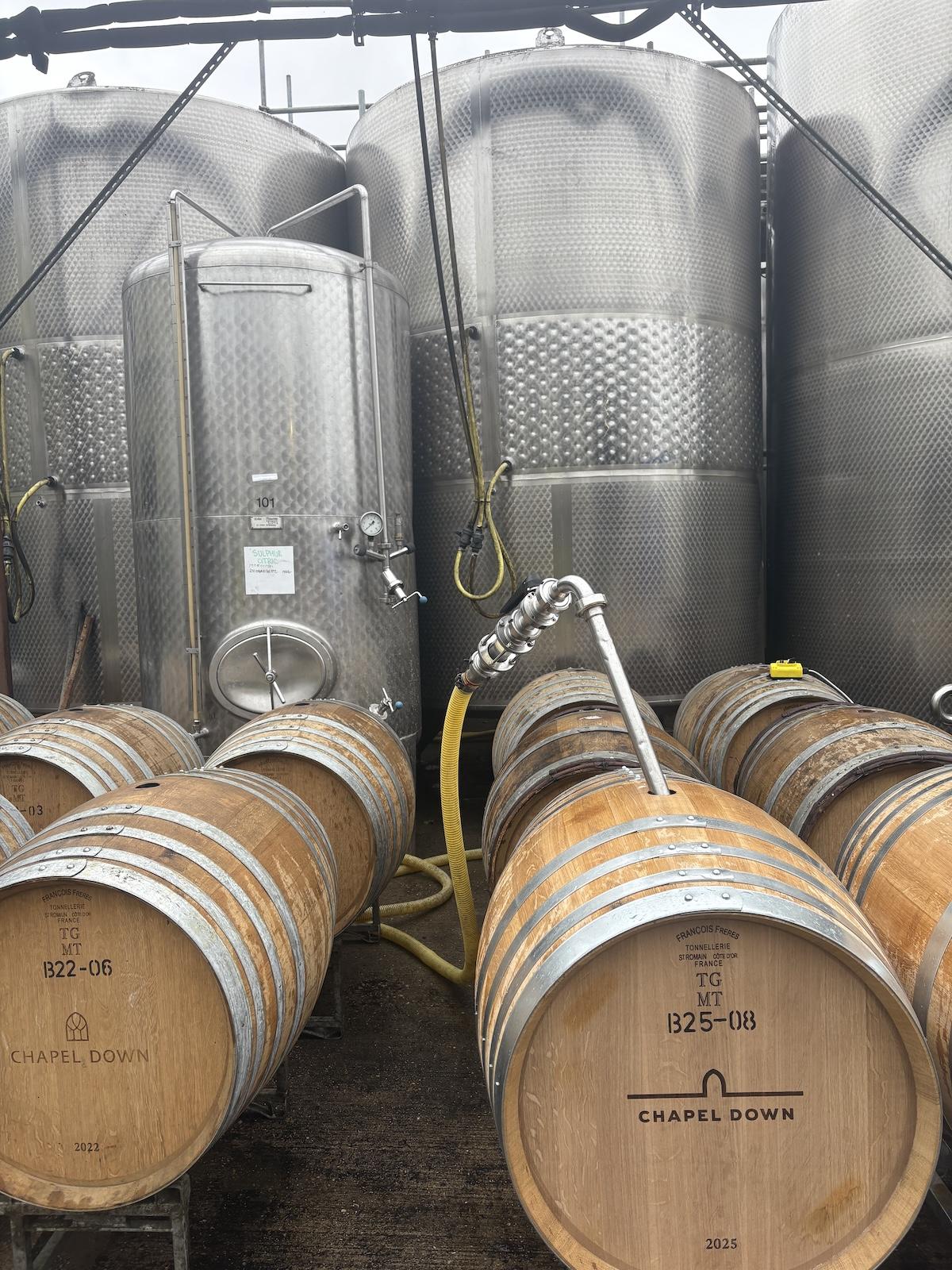
One of my most memorable moments was filling barrels for oak aged Bacchus - Kits Coty Bacchus 2025. Using the barrel spear to fill the barrels to the perfect height - 94% full - required real skill and it took me a few goes to master it. The wine rose really fast and crescendoed up far above my head, a volcano of grape juice covering me head to toe… three times. My initiation complete!

I touched pretty much every blend of the 2025 vintage. My three weeks in the winery were reminiscent of the total length of the champagne harvest but here in the UK this extends to mid October in 2025. Brave are the souls who give their all to make what we thought could never be possible; make great wine in the UK. I am incredibly proud to be part of this burgeoning young industry, to make it award winning and put it on the map globally.

My reflections on this once in a lifetime experience

Sparkling wine is an investment of time, money and patience. The 2025 fruit we pressed will be released as still wine next year but the sparkling will spend at least 18 months in bottle for secondary fermentation to create the bubbles and develop flavour, due to be released from spring 2028. The more special and premium sparkling wines are aged for longer, it will be Christmas 2029 at the earliest for these wines, and for some it will be more than a decade! There will be some time to wait before trying my final wines.

There’s something cathartic being so hands-on with the making of a food and beverage product. Through my actions a beautiful cuvée was made - the romanticism certainly not lost on me. In fact, it captured my imagination and I appreciate every single glass from now on knowing the sheer effort and number of hands it takes to get the fruit from the vine and into your glass, the finished product. 

Having time for reflection and perspective away from the laptop to realise how special and warranted the work we do really is - without strong successful marketing, differentiating a food and beverage product is impossible. 

In my first interview for the role as an Account Manager in the Brand practice, I was told “Edelman is a place full of incredibly intelligent people with entrepreneurial spirit” and they weren’t wrong. That’s to say if you want something, you can do it but you absolutely need to drive it yourself. Be motivated. Rally your stakeholders. Plan ahead in good time and you absolutely can do what I have done. These opportunities are possible. Make sure you’ve given thought to how you’ll make it work for your clients and your team. Think of the skills you’ll develop as a result of your experience you can bring back to apply to the business and your clients industries. Most importantly, have a supportive team behind you. All credit to my brand team and line manager, Ethan Tuxford - thank you.

This was my once in a lifetime chance to live a dream, and thanks to the team at Chapel Down and Edelman I lived it, and absolutely loved it. I’ll raise a glass to that.


Annabelle Torr is an associate director in the London Brand team, sharing her passion for wine @bellecuvee.

Edelman has just completed its 44th year promoting the iconic Butterball Turkey Talk-Line. I want to thank our clients at Butterball for their support for allowing us to continually evolve our work for them.

Here is what I learned from this year’s programming:

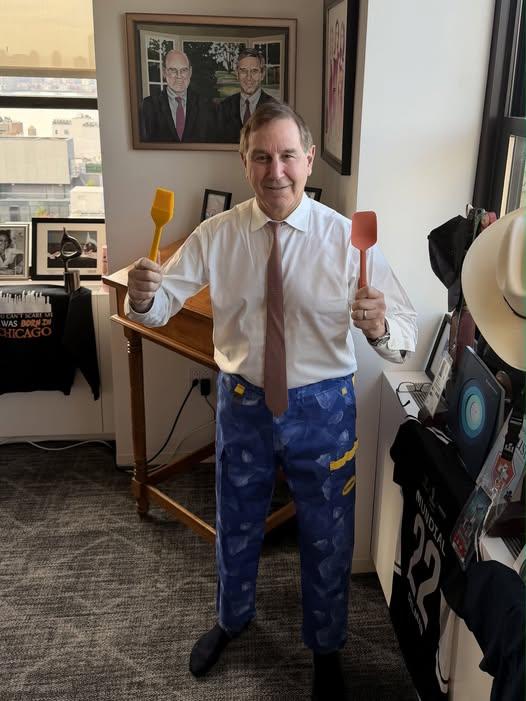
  • The Power of Collabs—Our Thanksgiving Hosting Pants produced by Hedley & Bennett were a smash hit. This proved to be a top-class partner for Butterball, a producer of aprons, knives, and other kitchen products. The blue and yellow pants were even modeled by me with my usual shirt and tie (just for Facebook, don’t worry). Our team organized three weekly giveaways in the month of November. We seeded the pants with food, entertaining and lifestyle creators to drive unboxing videos and social conversation and partnered with David Henrie of Wizards of Waverly Place to maximize reach. In all, we drove stories in F&B outlets such as Allrecipes and Food & Wine, lifestyle outlets such as Parade and SheKnows, and entertainment outlets such as Access Daily and E! News.
  • Expertise Matters—Our Turkey Talk-Line experts did over 100 interviews in local markets including Atlanta, Boston, Chicago, Dallas, Denver, Houston, Los Angeles, Nashville, NYC, Phoenix, Portland, and Tampa. The interviews were substantive, on turkey preparation, hosting tips, and calling 1-800-BUTTERBALL. These experts also were booked on national outlets such as ABC News, AccuWeather, CBS News, CNN, FOX LiveNOW, Inside Edition, MLB Network, NBC News Daily and News Nation.
  • Morning Shows Seeking Happy Topics—We booked Turkey Talk-Line expert Bill Nolan on TODAY, where he spent seven minutes with hosts Carson Daly, Savannah Guthrie, and Willie Geist on best practices for thawing, roasting, checking for doneness, stuffing, carving, and serving. Butterball was on TODAY three times, Good Morning America twice, CNN three times.
  • Washington Events Work—Star turkeys Gobble and Waddle were selected by Agriculture Secretary Brooke Rollins, then greeted by Fox and Friends host Steve Doocy at the Willard Hotel, and ultimately pardoned at the White House by President Trump. This led to further coverage on CBS Morning, FOX & Friends, and USA TODAY.
  • Timely Research Essential—Our team executed a Butterball Togetherness Report on how food brings people together around the holidays. We paired this with consumer information on pricing for the Thanksgiving dinner. Butterball executives were booked on Bloomberg News, CNN This Morning, FOX News, Good Morning America, News Nation, and Yahoo Finance.

Great brand PR programs can be the leading force multiplier for brand marketers. It now requires surround sound, living in culture with crazy ideas such as Hosting Pants that connect to Gen-Z, plus genuine expertise, sharp research findings and clever events. I am so proud of our team headed by Lindsay Garrison. This is indeed the best of Edelman.

Richard Edelman is CEO.


By day three of the Global Health Exhibition in Riyadh, my step count was heroic, my caffeine intake borderline concerning, and I had officially run out of adjectives for the sheer scale of it all. It’s one of the largest and most dynamic health gatherings I’ve ever experienced, a place where conversations about the future of care, technology, and collaboration unfold at every turn.

What struck me most isn’t just the size, it’s the sense of purpose. You can feel that health in this region has moved beyond vision statements. It’s now about execution, partnership, and measurable progress.

Here are five realities that stood out to me, lessons that speak to how the Middle East is reimagining health at pace and at scale.

  1. Future of health” means different things to different players ... and that’s its strength.
    From AI diagnostics to personalized prevention, every stakeholder is defining innovation through their own lens. The diversity of ambition is what gives the ecosystem its energy. Everyone is building toward transformation, but in their own way.
  2. Health is becoming a platform for global collaboration.
    What’s happening in Riyadh is part of a wider regional momentum, one that’s positioning the Middle East as a hub for international health cooperation. Partnerships are expanding across borders, disciplines, and sectors. Health is fast becoming a common language of progress and influence.
  3. Technology is advancing fast, but people remain the point.
    The appetite for digital transformation is undeniable. Yet the real measure of success will be how well these innovations improve everyday experiences for patients, professionals, and communities alike.
  4. The private sector is the region’s quiet accelerator.
    While governments are setting bold visions, private players are driving much of the action, from new models of care to data-driven prevention and AI-enabled infrastructure. The collaboration between public and private is what’s giving this region its speed.
  5. Health is now central to economic transformation.
    Across the GCC, investment in health is no longer just about resilience; it’s about diversification. By linking health innovation to national growth, countries are redefining what prosperity looks like.

Somewhere between the AI booth and the longevity pavilion, it hit me: the region isn’t waiting for the future of health, it’s building it. The Global Health Exhibition was a reminder of just how much momentum there already is, and how much more is coming from Riyadh, Abu Dhabi, and Dubai in the months ahead.


The development and deployment of AI across industries has been one of the year’s defining stories, marked by soaring market valuations, rapid data-center buildouts and nonstop corporate experimentation. But there is a soft underbelly of the AI Boom, a deep sense of unease about the employment effects of the technology and a lack of understanding of the benefits to the average consumer. The 2025 Edelman Trust Barometer Flash Poll: Trust and Artificial Intelligence at a Crossroads, conducted across five nations (Brazil, China, Germany, UK, U.S.) and released today shows that trust in AI is at an inflection point. In fact, in the three developed markets surveyed, acceptance of AI is linked to trust, an average of 100-point swing in attitude from those who distrust and reject to those who trust and embrace the technology.

There are four significant trust divides for AI: Geography; Industry; Income; and Age.

  • Developing markets such as Brazil and China are much more enthusiastic about AI than respondents in Germany, the UK, and U.S. Three times as many Americans reject the growing use of AI (49 percent) as embrace it (17 percent) while the Chinese are the mirror image, with almost five and a half times as many embracing AI (54 percent) as rejecting the technology (10 percent).
  • Our Industry findings were surprising, with Technology (3.5 to 1) and Financial Services (1.5 to 1) employees embracing AI at work, those in Retail, Manufacturing and Healthcare ambivalent, while those in Education (1.5 to 1)Food (1.5 to 1)and Transportation reject it (2 to 1).
  • There is a large Mass-Class Divide on AI in the Developed Markets, with 71 percent of the UK and 65 percent of the American bottom income quartile feeling they will be left behind rather than realize any advantages from gen AI. Importantly half of the Middle- and nearly half of the High-Income American respondents also believe they will be left behind without realizing net gains from AI.
  • Unsurprisingly, the youngest cohort is most supportive of AI; in the UK there is a forty-one-point difference between the 18-34 and the 55+ generations (59 percent trust in AI vs. 18 percent), though in the U.S. only 40 percent of the young generation trust AI, perhaps because of the slow market for entry level jobs.

How to Bridge The Divides?

The most powerful driver of AI enthusiasm is information. There is real benefit in personal experience; when Gen AI helps me understand complex ideas, there is a near 40-point rise in trust in most markets, with near 50-point rise in the UK. Gen AI also gets credit for getting things done faster and enhancing creative skills. Among the AI resistant respondents, we find that there is scant evidence of very negative personal experiences (under 20 percent). Those who avoid the technology do so because of data concerns, not because they’re intimidated. We have uncovered a powerful data point around truth and transparency; in the developed nations, two-thirds of respondents or more believe that Business leaders potentially won’t be fully honest with employees on the impact of AI on jobs.

Who Should Take the Lead on Building Trust in AI?

It must be My Employer, respondents are on average1.5 times more likely to feel comfortable with their employer using AI than Business in general and twice as likely than Government. Employees are 2.5 times more motivated to embrace AI if they feel their job security is increasing, not the threat of Job Insecurity (50 percent vs. 21 percent). Employees also want to feel that their embrace of AI is voluntary, not mandatory; in the UK and U.S., 2 in 3 AI distrusters feel it’s being forced upon them. There is a Mass-Class Divide in the workplace, with only one in four non-managers regularly using AI, versus nearly two-thirds of the people managers. The winning formula for trust is employees finding that AI is helping them find solutions at work, doubling their trust in the underlying technology in some markets. Employers need to use peer-to-peer communications on AI instead of top-down missives, with “someone like me” on average two times more trusted than a CEO or government leader to tell the truth about AI. It is also a workplace priority to get a high-quality training program for effective AI use; this is supported across all political affiliations as well.

A lingering fear in developed economies is slowing AI adoption. This is driven by job losses tied to globalization and eroded trust in leaders and experts after COVID-19 and rampant disinformation. Yet there is a strong countersignal. Respondents say they would be comfortable using agentic AI for finances, healthcare, major purchases, and job searches by an average of 5.5-to-1 margin if they trust the technology.

AI is transforming daily life at unprecedented speed, making it essential for companies to build the conditions for its acceptance. The talk track for CEOs of AI companies should embrace the simplicity of Franklin Delano Roosevelt’s Four Freedoms, which he articulated in the wake of the Great Depression. Freedom of Speech and Expression. Freedom of Worship. Freedom from Want. Freedom from Fear. Trust will drive growth of AI but is conditional on Actions earning Trust, from training to job transformation. The technology industry and anyone seeking to leverage AI needs to take this special report seriously because there is no divine right of acceptance of innovation.

Richard Edelman is CEO.


This article originally appeared on Fortune.com


Familiarity breeds contempt,” the saying goes, except when it comes to artificial intelligence.

According to the Fall 2025 Edelman Trust Barometer Flash Poll: Trust and Artificial Intelligence at a Crossroads, hands-on experience is the fastest route to trust. The more people use AI, the more they trust it, and the more they trust it, the faster they embrace it.

Across five major markets surveyed—Brazil, China, Germany, the UK, and the United States—trust has emerged as one of the most powerful forces determining whether AI adoption accelerates or stalls. In the poll, trust in AI ranged from 87 percent in China and 67 percent in Brazil to just 39 percent in Germany, 36 percent in the UK, and 32 percent in the United States.

Beneath these national divides, one pattern stands out everywhere. Positive personal experience transforms perception. Among respondents who said AI had improved their understanding of complex ideas, majority in Brazil, Germany, UK, and the U.S. expressed trust in AI technology.

Trust Sets the Pace of Innovation

For the past several years, the industry has focused on persuading people to accept AI through ethical frameworks or assurances of safety. This remains important, but the new evidence suggests it’s not enough. The data show that trust in AI increased the likelihood of enthusiastic adoption by about 16 percent, making it one of the two strongest predictors, just behind how informed people feel about AI.

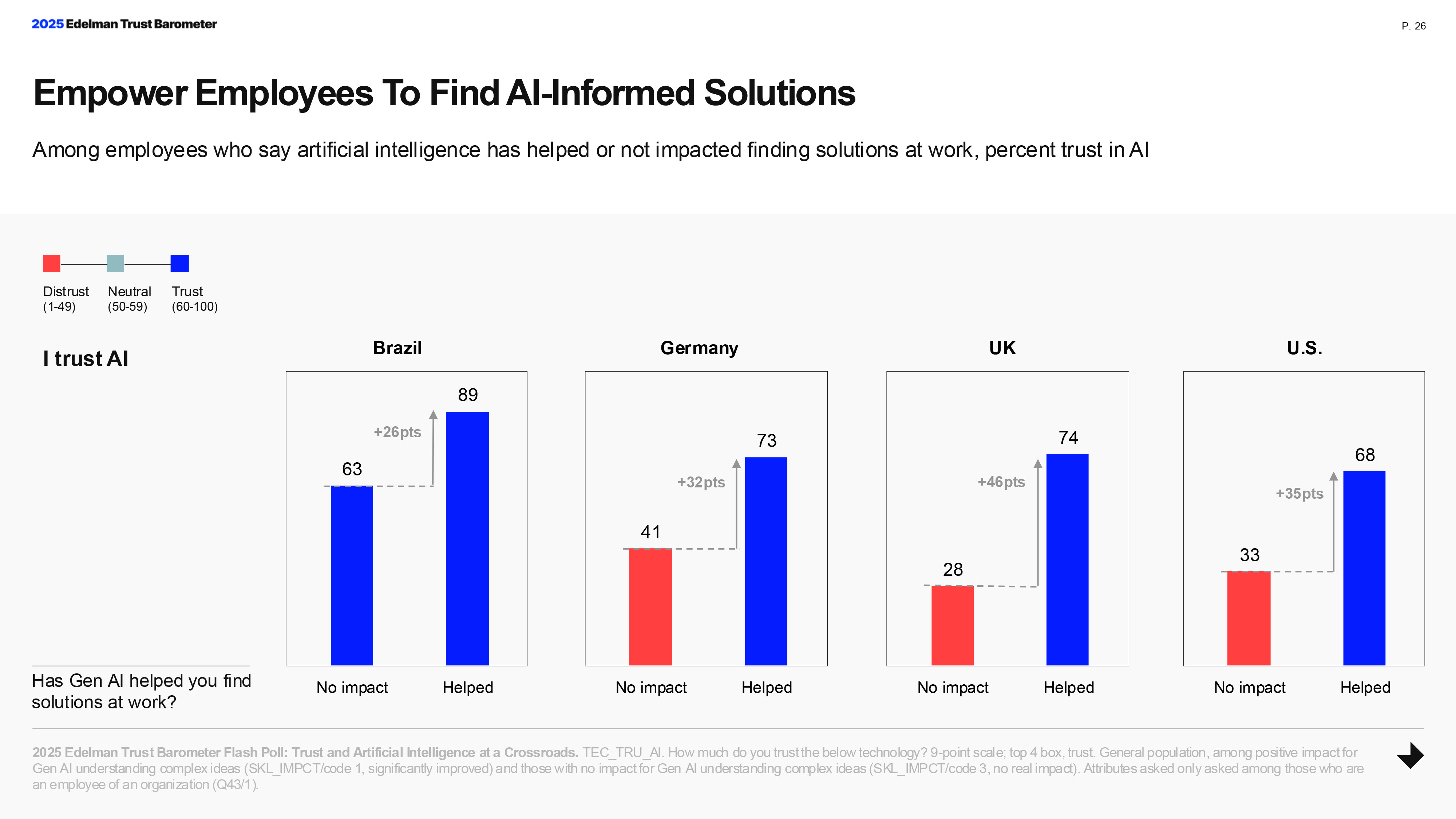
And trust grows from experience. When people personally benefit from AI, when it helps them work faster, understand complex ideas, or solve real problems, their confidence rises sharply. Across four of the five markets surveyed, employees who said AI had helped them find solutions at work were far more likely to express trust in it than those who said it had made no impact – and the gap ranged from 26 to 46 percentage points.

Flash Poll Trust and Artificial Intelligence at a Crossroads

That link between confidence and adoption suggests that the path forward for business and government is not simply to innovate faster, but to earn trust faster.

For companies developing or deploying AI, this insight has immediate implications. Building trust requires more than public commitments to transparency and responsible design. It requires giving people meaningful ways to interact with AI technology and see its value firsthand. Training programs, pilot projects, and open demonstrations can build this credibility.

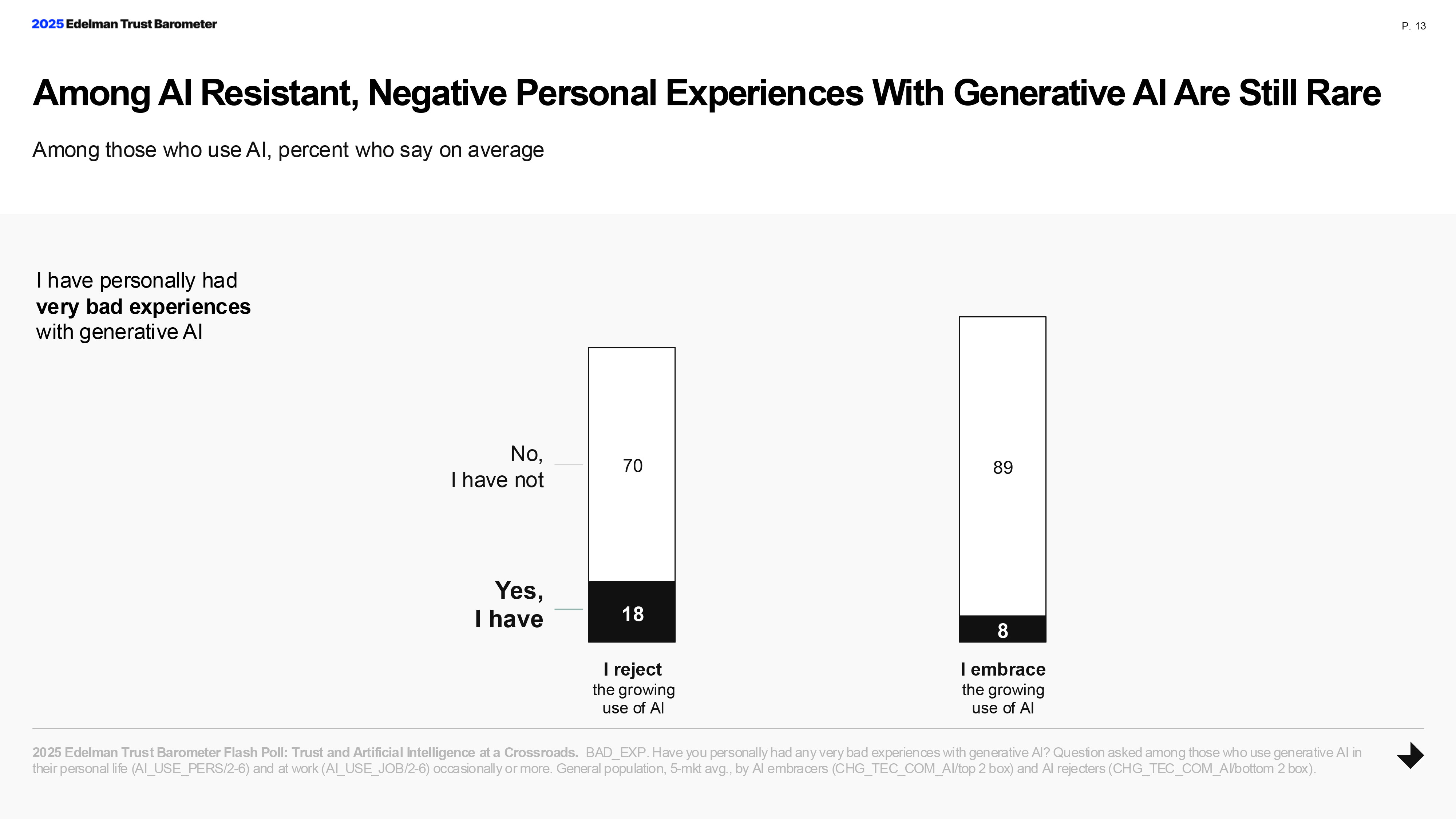
At the same time, the data show that fear of AI is often rooted more in perception than experience. Even among those who reject AI, only 18 percent report having a bad experience. This suggests that distrust is largely anticipatory or imagined. Bridging that gap between perception and lived experience may be the single biggest opportunity for business and government to build confidence in AI technology.

Flash Poll Trust and Artificial Intelligence at a Crossroads

Two Worlds of AI Adoption

The poll reveals a stark divide in how societies are approaching AI. Brazil and China stand apart as high-trust environments where optimism is fueling widespread adoption. In both countries, more than two-thirds of respondents say they trust AI, and majorities report feeling confident that generative technologies will improve their mental health and work lives. By contrast, in Germany, the UK, and the United States, trust levels are near or below forty percent, and skepticism remains the dominant sentiment.

For businesses and policymakers, this divergence presents a double challenge. In high-trust markets, the task is to sustain optimism through responsible deployment and straightforward evidence of benefit. In low-trust markets, the task is to rebuild confidence in the institutions behind the technology. Without that foundation, even the most advanced systems will struggle to gain acceptance. In this environment, the role of business becomes pivotal.

Business Has the License to Lead

Understanding where trust resides is equally important. One finding from the poll stands out: people place greater confidence in business than in government to use AI responsibly. Across the five markets, only 34 percent of respondents on average said they were comfortable with government’s use of AI, 46 percent said the same about business overall, and 56 percent of employees are comfortable with their own employer.

This pattern mirrors a broader trend seen in the Trust Barometer over the past several years. According to the 2025 Edelman Trust Barometer, business is now the only institution viewed as both competent and increasingly ethical, while other institutions continue to lag on credibility. In the context of AI, that trust creates both opportunity and obligation. Companies that deploy AI in their operations are expected to lead with transparency, explain how AI affects jobs, and invest in retraining to help employees adapt.

If trust determines the pace of adoption, then business determines the direction. By demonstrating openness, accountability, and a commitment to shared benefit, companies can turn cautious interest into confident engagement and show that responsible use of AI can advance both innovation and inclusion.

The challenge for leaders is no longer just to innovate faster, but to earn trust faster, because in the years ahead, trust will decide not only who adopts AI, but who benefits most from it.

Gary Grossman is Executive Vice President of Corporate Technology US at Edelman and has published extensively on AI issues and trends.


There was real energy and dynamism at The Drum’s 2025 B2B WorldFest this month, as marketers convened to shape the future of the industry. One theme resonated across many of the panel discussions and conversations: trust is the new currency of B2B marketing.  

The myth that customers follow a linear purchasing journey has long been disproved. However, the context in which businesses operate has been further complicated by increasing business caution and disruption (particularly within large buying groups), generational shifts, and the role of AI in reshaping expectations of content and how brands are discovered.

This complexity has illustrated that marketers need to earn the right to the time of busy business decision-makers. To cut through the noise, communicating with trust and authenticity is more important than ever — two elements high on attendees’ agendas. 

We were delighted to speak to this need in a special Edelman panel on how B2B brands earn and sustain trust, leverage reputation, and ultimately turn brand strength into commercial advantage. I was joined on stage by Paola Garbini (Head of European Marketing, Oliver Wyman), Mike Argile (EMEA Senior Marketing Lead: Copilot & Agents, Microsoft), and Kate Stanners (International Chief Creative Officer, Edelman) for the discussion, which you can watch via The Drum here.

The theme of trust and authenticity continued throughout the day’s conversations; here are my takeaways from the action-packed event reflecting this trend: 

Trust is the biggest competitive advantage for businesses 
When it is challenging to reach a consensus across large buying committees, to convince the CEO and CFO to sign off on large contracts, and to grow existing customers, trust is a powerful factor in getting a company shortlisted to tender — accelerating decisions and closing deals. While it may seem intangible, trust can be quantified, benchmarked, and used as a commercial metric. 

Authenticity builds connection in a sceptical age 
Bloomberg’s Mishal Husain reminded marketers that “authenticity starts with noticing the small details.” In B2B, this means sharing genuine stories of people, problems, and progress without being overly polished. Long-form, honest storytelling still matters, especially as decision-makers crave depth over noise.  Brands that showcase vulnerability and purpose will earn credibility, not just clicks — beautifully illustrated when Paola Garbini talked about Oliver Wyman’s ‘Behind the Breakthrough’ series, where the firm’s C-suite clients speak openly about overcoming transformation in their business and the defining moments in their professional growth. 

We need to drive action as well as thinking
Thought leadership is a widely used term, but one of the best ways for business brands to build trust, authenticity, and evidence is to go beyond theory and drive tangible action through their campaigns. Mike Argile pointed to actions like Microsoft investing $30 billion in the UK AI sector to demonstrate the company's vision and ambition. DP World’s ‘Move to -15’ campaign was another example of a business convening its wider industry to bring about major reductions in energy and emissions from the shipping of frozen food. 

Gen Z buyers demand transparency, not targeting 
Meta’s Andrea Gellert described younger, digital-native buyers as “allergic to the sales funnel” and the notion of a sales meeting. They expect to research, decide, and engage on their own terms, using LLMs, online research, peer-led communities, and seeking views of ‘people like them.’ B2B brands must meet them where they already are and consider how much and where they share information — a key theme identified in our Gen Z Lab’s recent ‘The Great Gen Z Divide’ Report.

Communities are the new marketing channels 
A panel with Trustpilot and Open Banking marketers reinforced that the most trusted voices aren’t brands, but peers. “Community is the new persona,” said Open Banking’s Mel Lazarus. Building spaces for advocates to connect, share, and influence each other delivers more credibility than any ad campaign.

Brand and demand are roommates, not rivals 
Sage’s Harry Davies and EY’s John Rudaizky both challenged the outdated divide between brand and demand. Davies noted that “when we pause brand investment, our cost per sale rises — and we can prove it.” Rudaizky also emphasised that emotion is a force multiplier in B2B, which earns attention, builds credibility, and proves that creativity and commercial outcomes are inseparable.

Creativity fuels trust and differentiation 
My colleague, Kate Stanners (Edelman’s International Chief Creative Officer), urged marketers to rediscover imagination, sharing an example of a construction equipment manufacturer which refitted its bulldozers to clear mines in conflict zones and used animations of its engineers to tell the story. Microsoft’s Mike Argile was inspired by Lego-creating experiences, which encourage play in business as a process of unlocking new ideas and strengthening teams. 

Partnerships outperform sponsorships 
Tata Consulting Services and Iron Mountain showcased how long-term sports partnerships, built on shared innovation and purpose, create sustainable brand value. Brand Finance revealed fascinating data demonstrating that a high proportion of senior business leaders identify with long-distance running — informing a marketing programme centred on marathons, which boosted brand recall, authenticity, and storytelling for a services brand. 

AI is an enabler, not the storyteller 
While AI can amplify reach and efficiency, as well as act as a brilliant sparring partner, real-world cultural nuances, unexpected connections, authentic imperfections, humour, and human judgment are what will enable business brands to stand out and build trust. 

ABM x Brand Orchestration 
Account-Based Marketing (ABM) and Brand should not function as separate silos, but as unified, orchestrated tactics across the entire buyer journey. My colleague, Suraya Adnan, highlighted this as the smart strategy with all channels and tactics unified towards a single objective, driving pipeline today and in the future. 

In short, if the buyer journey is disrupted, we’re overwhelmed by content. At a time when audiences are increasingly sceptical and self-selecting in how they engage, earning trust is what builds relationships, closes deals, and drives growth. 

Andrew Mildren is Managing Director, Business Marketing for Edelman EMEA

Subscribe to Article