Global
(EN)
- Global (EN)
- Africa (EN)
- Australia (EN)
- Belgium (EN)
- Brasil (PT)
- Canada (EN)
- Canada (FR)
- China (CN)
- France (FR)
- Germany (DE)
- Germany (EN)
- Hong Kong, China (EN)
- India (EN)
- Indonesia (EN)
- Ireland (EN)
- Italy (IT)
- Italy (EN)
- Japan (JP)
- Korea (KR)
- Latin America (ES)
- Malaysia (EN)
- Middle East (EN)
- Netherlands (EN)
- Spain (ES)
- UK (EN)
- Global (EN)
- Africa (EN)
- Australia (EN)
- Belgium (EN)
- Brasil (PT)
- Canada (EN)
- Canada (FR)
- China (CN)
- France (FR)
- Germany (DE)
- Germany (EN)
- Hong Kong, China (EN)
- India (EN)
- Indonesia (EN)
- Ireland (EN)
- Italy (IT)
- Italy (EN)
- Japan (JP)
- Korea (KR)
- Latin America (ES)
- Malaysia (EN)
- Middle East (EN)
- Netherlands (EN)
- Spain (ES)
- UK (EN)

global
Start your journey with Edelman
Looking for work that matters? Explore careers at Edelman and join a global team committed to shaping conversations, building trust, and driving change.
BROWSE CAREERS
Contact
Whether you're looking for strategic guidance or specific expertise, our team is ready to help. Contact us to explore how Edelman can partner with your business.
Contact Us
'Career Ladder's' Max Klymenko On Trust, Careers and Creators
PepsiCo's Stephen Kehoe On Building Trust Amid Global Turbulence
Edelman's Power of 55
Discover Edelman’s Power of 55 – a curated list of trusted 55+ creators shaping longevity marketing and helping brands reach today’s high-spend older consumers.
Find out more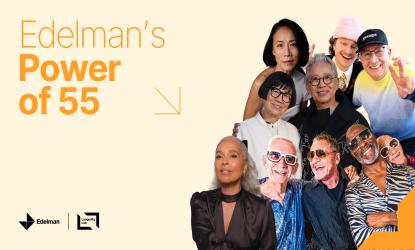
The Longest Table's Maryam Banikarim On Breaking Bread to Rebuild Trust
Andrew Ng on Separating AI Facts from Fiction
2025 will be remembered as a difficult year for the communications sector. The IPG Omnicom merger created the largest firm in the world but will require between 10-15,000 redundancies. Dentsu is selling its international holdings. WPP share price has plummeted by 50 percent, leaving the company valuation at one-third of annual revenue.
As part of the industry consolidation, several of the large legacy ad agencies were eliminated by the holding companies. The death knell was sounded for Leo Burnett (merged with Publicis into LEO), FCB (merged with BBDO), DDB (merged into TBWA) and Mullen Lowe (merged into TBWA). This is on top of the WPP consolidation of Y&R into VML, JWT into Wunderman, then Wunderman into VML. How did this happen?
First, the holding companies separated media buying from creative agencies starting forty years ago in Europe and 25 years ago in the U.S. The net effect of this change was to take the strategic function out of the agencies.
Second, holding companies organize agencies by function. This started with media, which operates as a single P&L and maintains brands such as OMD or Mindshare for conflict management. Omnicom Advertising now manages all the group’s ad agencies, and it is rumored that WPP will follow suit. This allows reduction of senior people who are key to client relationships.
Third, WPP introduced horizontality, which meant that client teams were constructed with best talent from across the holding company. In prior periods, the key relationships were held at the agency level (JWT with Ford for 100 years). With the client leaders now reporting into the holding company, the agency’s position was diminished to smaller, regional client management or providing talent to Team Coca Cola, eliminating the critical role of creative and strategic partner to clients.
Fourth, the holding companies took away key growth areas from the agencies such as healthcare or influencer. The FCB office in Chicago, for example, was a thriving, multi-sector agency but then the health unit was aggregated into a global operation, FCB Health, then into IPG Health, a holding company global collective. The acquisitions of influencer agencies by WPP and Publicis could have been important boosts to either the advertising or PR agencies but were put into the media buying units as part of a flywheel distribution method for content.
Contrary to the proclamation on BBC Radio by one of the authors of the consolidation strategy in communications, PR is alive and well. In fact, we are very well placed to thrive in a world where media is culture and culture is media. We are uniquely able to operate across brand and reputation, with a deep knowledge of public affairs necessary in the present politicized environment. We have the keys to the castle in LLM search given that earned media results are the top driver of outcomes. We can be the agency that gets the first call now that so many of the long-standing partners have been put out of business by their holding company owners in the pursuit of efficiency. Let’s win all the jump balls and get our industry back on its growth path, serving our clients with brilliance, passion and integrity.
Richard Edelman is CEO.



Stewart “Brittlestar” Reynolds on Trust, Humor, and Staying Relevant
For years, Gen Z has been largely disengaged from traditional media, instead prioritizing social platforms, short-form video, and real-time content. As a result, media relations have often taken a back seat in communications strategies aimed at reaching this audience.
But that thinking is now due for a reset. While Gen Z may not be tuning in to traditional outlets, they’re reading the results. As AI-powered search tools pull directly from news sources to generate summaries, a generation long assumed to be media-agnostic is now consuming headlines, reporting, and context—often without realizing it. This shift gives earned media a new seat at the table in Gen Z engagement strategies.
AI is Gen Z's new information hub
According to a 2024 report by Media Technology Monitor, 38 per cent of Gen Z Canadians (aged 18 to 26) have used generative AI tools such as ChatGPT, the highest adoption rate of any age group. A 2025 survey by Toronto Metropolitan University’s Social Media Lab found that of the Canadian Gen Z adults (aged 18–24) who have used generative AI tools, 91 per cent of them use it for study, 82 per cent for leisure, and 77 per cent for work. In other words, AI has become a go-to for how they learn, play, work, and most critically, get their information.
As they increasingly turn to these tools, trusted editorial content is resurfacing through the AI-generated outputs they consume. AI systems act as curators, elevating content from outlets they deem authoritative. And since trustworthy content is the foundation of AI answers, securing earned media coverage in those credible outlets has therefore become essential to reaching Gen Z.
The Trust Gap Shaping AI Engagement
This shift is taking place in a broader context of deep mistrust. According to Gen Z & Grievance: An Edelman Gen Z Lab Special Report, two-thirds of Gen Z globally worry that government, business leaders, journalists and reporters are intentionally misleading them. And yet, those are the very sources AI systems rely on to generate answers. For communicators, the impact of this development is profound: to shape what Gen Z sees, believes, and shares in AI-powered environments, your message must live within the sources these systems trust most—because that’s what will shape their reality.
AI-powered systems now deliver synthesized answers, rather than presenting a list of hyperlinks like traditional search engines. These models are trained on extensive libraries of credible sources, including journalism, academic research, and encyclopedias. Instead of relying on keyword matches, they emphasize quality and trustworthiness by prioritizing reliable editorial content. As a result, answers often reflect narratives shaped by traditional media, even when users never visit the original sources.
In many cases, users only see a brief, AI-generated summary with no attribution. If a response is informed by a Forbes article or CNN segment, the original outlet may go unrecognized. While some platforms provide links, most users won’t click through if the summary feels sufficient.
Why Earned Media Matters More Than Ever
This means the role of media relations in reaching Gen Z is expanding. Gen Z might not read a full-page profile or watch a panel discussion, but they will absorb the takeaways through a podcast excerpt, an Instagram carousel, or a smart assistant’s response – all of which are increasingly being shaped by AI. Additionally, because these tools often resurface the same credible content repeatedly, instead of a one-time impression, a quote or insight can live on as part of AI’s responses to related queries further amplifying the impact.
As Gen Z continues to turn to AI for trusted information, the role of traditional media takes on a new kind of relevance. Content from trusted editorial sources now shapes the answers Gen Z receives, even if they never visit the original outlet. For communicators, this makes earned media coverage a priority that can no longer be overlooked. If your messaging doesn’t appear in the ecosystems that AI tools trust, it risks being left out of the conversation altogether.
About the Edelman Trust Barometer Flash Poll: Trust and Artificial Intelligence at a Crossroads
The Edelman Trust Barometer Flash Poll: Trust and Artificial Intelligence at a Crossroads was produced by the Edelman Trust Institute in addition to the annual Edelman Trust Barometer. The Flash Poll surveyed 5,000 respondents across 5 countries between October 17 and October 27, 2025. It is the firm's first study dedicated to the question of Trust and AI.
About Edelman
Edelman is a global communications firm that partners with businesses and organizations to evolve, promote and protect their brands and reputations. With 6,000 employees across over 60 offices, Edelman develops communication strategies that build client confidence and stakeholder trust. The firm boasts an array of accolades, including PRWeek's Agency Dynasty of the Past 25 Years and Global Agency of the Year (2023) and Cannes Lions Independent Agency of the Year for the Good Track (2024 & 2022). Recognized as a standout agency by AdAge (2023) and honored with multiple Cannes Lions, including Titanium, Grand Prix and seven Gold Lions since 2021, Edelman consistently sets the industry standard. Since our founding in 1952, we have remained an independent, family-run business. Edelman owns specialty companies Edelman Data x Intelligence (research, data), Edelman Smithfield (financial communications), and UEG (entertainment, sports and lifestyle).