I am reeling from the massacre of Jews celebrating the first night of Hannukah on Bondi Beach in Sydney and the murder of two students at Brown University over the weekend. In this context, I am trying to find constructive ways forward. One great idea is Disagree Better, a program created by Governor Spencer Cox of Utah when he was running the National Governors Association last year. I heard Governor Cox and Governor Jared Polis of Colorado, one a Republican, the other a Democrat, recently at the Ad Council board of directors meeting in New York City.

Here are the principles of the program:

  1. Disagree Better by How You Think—Avoid assumptions about the other side. Examine the “why” behind beliefs including your own. Consider that you might be wrong. Most importantly, your opinions are what you think, not who you are.
  2. Disagree Better by How You Listen—Listen to understand, not just to reply and win. Commit to listen more than you speak. Do not interrupt. Be aware of your own facial or body language.
  3. Disagree Better by How You Speak—Avoid name-calling or labels. Explain your views in positive, not negative, language. Keep your voice calm. Know how to step back respectfully if the conversation is going off track.
  4. Disagree Better by What You Do—Invite someone you disagree with for lunch. Attend a cultural or religious event outside of your own faith. Avoid posting inflammatory content. Help a neighbor regardless of views (special call-out to the fruit vendor in Sydney who tackled the shooter and prevented more deaths…a true hero)

Governor Cox was eloquent in explaining the program as fighting back against “conflict entrepreneurs” who use language to get attention. “There is more commonality than publicly believed. The perceived gap between us is larger than the actual gap. You cannot let politics destroy friendships or family. There is an ethical aspect to the program. We need to ask each other why you feel this way about an issue, whether abortion, guns, voting rights or Gaza. We need to prevent polarization, to find common ground through healthy conflict.”

I spoke at length with Marianne Viray, who runs Disagree Better. She has organized cross-partisan governors, U.S. Senators, and U.S. Representatives appearing in ads that will run in public service time in local markets. She co-sponsored an event with Governor Cox and Governor Josh Shapiro of Pennsylvania just last week at the Washington National Cathedral. It was moderated by Today Show host Savannah Guthrie and was covered by NBC, CNN, The Washington Post, Politico, and other outlets. She went on to say that Disagree Better has done almost nothing in the corporate sector–yet; “we should feature CEOs in upcoming PSAs because there is a real economic cost to incivility in the U.S., from absenteeism to lack of productivity.”

I love this assessment of the mission of Disagree Better from board member and constitutional scholar Yuval Levin, writing in The Free Press. “When we say we are divided, we often mean that we disagree too much and have too little in common. In reality, Americans don’t disagree nearly enough. The common misimpression is that disagreement is a mark of civic failure and that the very existence of people who don’t share our goals and priorities is a problem to be solved…Social media, polarized political press, the one-party university, the one-party church and increasingly performative political culture are all grounded in that misimpression. They are built to let us avoid exposure to conflicting views…Our digital partisan cocoons facilitate division.”

The 2026 Edelman Trust Barometer will document a massive level of division in society, from mass-class divide to age divide to nationalism. We must find a way to believe in the future, to see that our families will be better off with technological change, scientific advances and social mobility premised on opportunity. This disintegration of common purpose puts communications into the central role of providing quality information that enables proper decisions and a right to improvement with effort.

Richard Edelman is CEO.

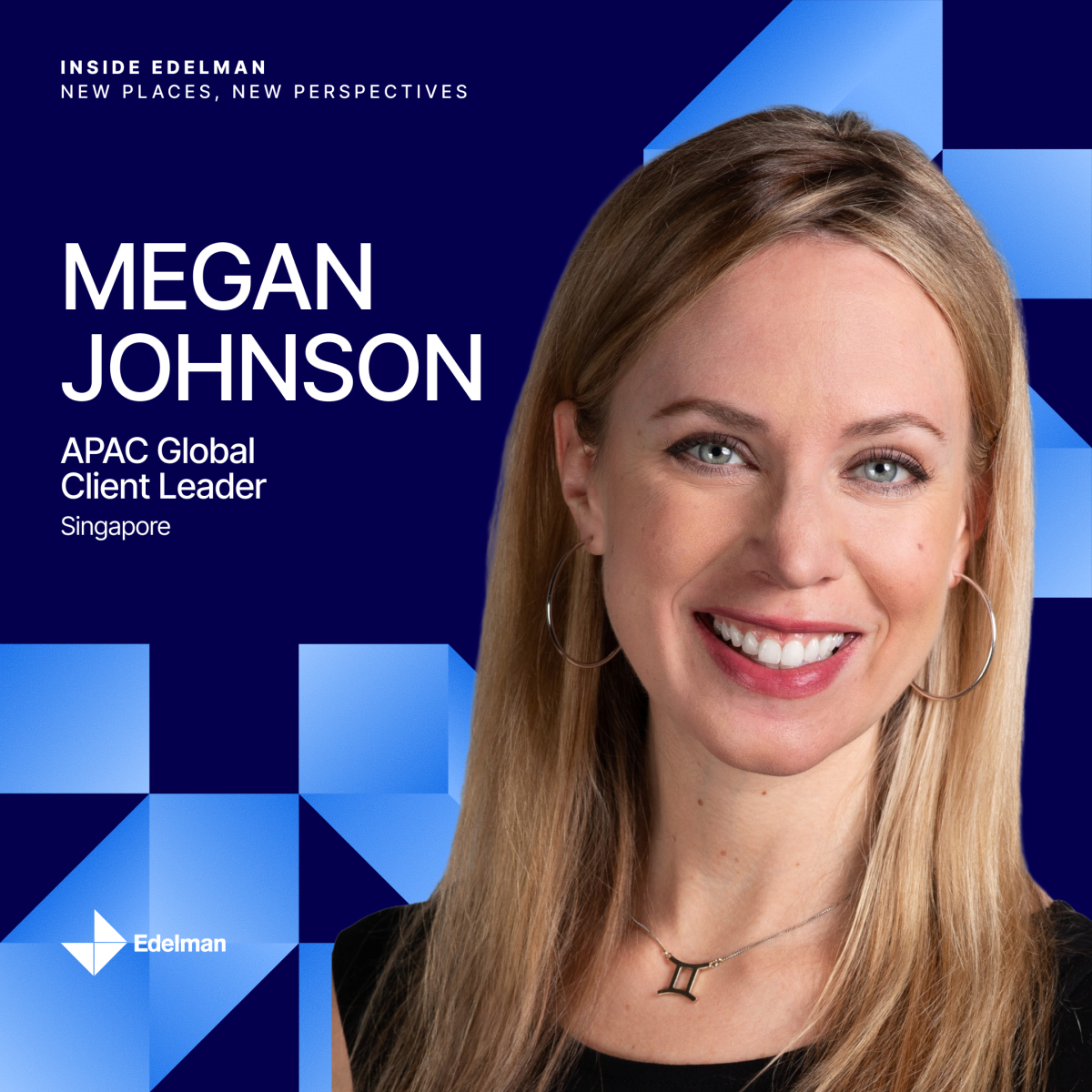
From Canada to the U.S., India, and now Singapore — Megan’s global journey reflects a deep curiosity, a love of change, and an openness to the unexpected. Each move has broadened her perspective, strengthened her adaptability, and deepened her appreciation for the shared Edelman spirit that connects teams across continents. As she settles into life in Singapore, she reflects on the experiences, relationships, and lessons that continue to shape both her career and her understanding of the world.


What is something you’ve discovered about yourself during your time abroad?

As part of my Edelman career, I’ve had the wonderful opportunity of working in different offices across different countries – from Canada to the US, India, and now Singapore. While I wouldn’t say I “discovered” this necessarily, but my travels have certainly reinforced how much I like change. Trying something new, embracing the unexpected, and being uncomfortable all help open your eyes to what the world has to offer.

How has the experience of working in a new market expanded your understanding of Edelman’s global work or approach?

What’s struck me in every office I’ve worked in is the balance between familiarity and local uniqueness. Each office feels connected through our shared values, yet every local market brings its own voice and way of doing things. Experiencing those differences has shown me how diverse perspectives strengthen our global work and make our network richer and more dynamic.

Is there a favorite local custom, place, or routine that has become meaningful to you in your host country?

I’m still getting settled in Singapore, but if I look at my time in India … that experience will always hold tremendous meaning for me – my first leap into an adventure very far away from home. The sights, the smells, the sounds (I will forever be desensitized to honking), the food (!), the laughs, and warmth of all of those who helped me along the way – I couldn’t be more thankful.

What new skills, perspectives, or ways of working have you gained from your host team?

Understanding how to work with different cultures is fascinating. No country is alike, but the diversity of Asia in particular keeps you on your toes. You have to listen first, be patient, adaptable, open to changing how you might typically do things, and roll with it. And most importantly – have a good laugh as you learn (and make a few embarrassing mistakes) along the way.

What is one highlight or proud moment from your time abroad that you’ll carry forward in your career?

It comes down to the relationships. I have met, worked with, been in the trenches with, and become lifelong friends with so many colleagues over the years. Those partnerships, experiences, and memories are everlasting, and have – and will continue to shape – all aspects of my life and career.

Megan Johnson is a Global Client Leader for APAC based in the Singapore office.


The dust has settled on the Omnicom–IPG merger. The combined entity has promised Wall Street $750 million in savings, driven heavily by a reduction in force of 10,000 to 15,000 people. In the process, the new Omnicom last week eliminated several legendary agency brands, folding FCB, DDB, and MullenLowe into a surviving trio: BBDO, McCann, and TBWA. This mirrors Publicis’ consolidation of Publicis and Leo Burnett into LEO, while WPP has effectively ended JWT, Grey, and Y&R as operating entities.

As holding companies double down on scale and operational efficiency, they’ve unintentionally created a meaningful opening for agencies that differentiate themselves through deep client relationships, earned creative, and ideas rooted in action rather than advertising architecture. Instead of chasing savings, smart firms are chasing outcomes by moving faster, partnering more closely, and solving real problems with work designed to drive change and deliver results.

Beyond the opportunity created, there are four important points to be made:

  1. Call the Agency Now Means Who and For What? — The long-standing relationships between creative agencies and clients, once protected by the perceived irreplaceability of big network brands, are now up for grabs. As legacy names disappear and holding companies consolidate, clients are questioning whether their agency of record is still the same entity, the same team, or even the same capability set they originally hired. Agencies with clear purpose, stable teams, and integrated earned-first capabilities are now best positioned to become the new “first call”, not by default, but by delivering unmistakable value.
  2. Geographic Reach Matters – Legacy ad agencies in Chicago and San Francisco have evaporated. The Chicago-based firms Burnett, Needham and FCB are no more. Large Midwestern clients such as SCJ or P&G will now have to look to others for primary agency support. The same can be said for large tech companies based in San Francisco as Goodby Silverstein & Partners, and other Bay area firms have been winnowed to miniature versions of themselves. Firms with established beachheads in these regions can thrive by picking up clients actively seeking new partners. Executing multi-local campaigns is every bit as essential as delivering multinational campaigns.
  3. Legacy Matters but Only with Reinvention — If you stand still, you will be roadkill. Legacy can be a powerful asset as clients value institutional memory, cultural relevance, and accumulated trust. But firms must continuously evolve to effectively meet the changing demands of clients and the marketplace. Today, reinvention means integrating earned-first thinking into creative, operating at the intersection of commerce, culture, and society, embracing AI, and delivering work that drives action and change while earning trust. Evolve your legacy, don’t simply rely on it.
  4. Benefit of Being Privately Owned — The industry is undergoing profound change, from the rise of AI to the decline of network TV to clients’ growing preference for project-based work. Independent firms are best positioned to meet this transformation because they can take big swings and invest quickly in the right tools, technology, offerings, and talent. Independence provides an agility and long-term orientation that holding-company agencies simply can’t match.

The investment thesis at the moment is consolidation, the drive for scale. But the client needs are still top-level service, imagination, relationships, and intelligence that spans both global public affairs and local culture. I like Edelman’s chances in this world of fewer competitors promising efficiency instead of brilliance tied to action.

Richard Edelman is CEO.
 

December 10, 2025 – NEW YORK – Edelman has named Anna Vogt as Global Chief Strategy Officer. She will lead Edelman’s global strategy community and advance the firm’s focus on effectiveness, cultural relevance, and earned-first brand building. Vogt will report to Tristan Roy, President, Integrated Solutions & Delivery.

In this role, Vogt will partner with strategists, creatives, and client leaders across the network to elevate Edelman’s strategic product and develop platforms and ideas that spark cultural conversation and deliver measurable business impact. She will also be charged with advancing the firm’s Earned Flywheel framework and scaling the use of data and AI-powered intelligence tools, including TrustStream, Edelman’s proprietary LLM-based system that delivers real-time trust signal analysis and predictive insights.

“Anna is an exceptional strategic leader with a rare ability to translate culture, data, and human behavior into strategies and programs that deliver both relevance and results,” said Roy. “She has a proven ability to integrate strategic disciplines across areas like social, UX, creator, AI, data and beyond. She is exactly the right person to help propel Edelman’s strategic ambition forward.”

Vogt’s appointment reflects the firm’s continued investment in strategic leadership amid strong momentum in effectiveness, data and AI-informed strategy, and creativity that earns attention. Recent findings, including Edelman’s Beyond the Buzz report and the Earned Effectiveness Paper with WARC, show that culturally salient, earned-first ideas consistently outperform traditional approaches across profit, market share, and sales.

A globally experienced strategist, Vogt currently serves as EMEA Chief Strategy Officer at VML, overseeing strategic output across the region. She began her career as a WPP Fellow before holding senior strategy roles at BBH, MullenLowe (as Head of Planning), and TBWA London (as CSO). During her career she has worked with iconic global brands such as Unilever's Persil/OMO, Nestlé's KitKat, British Airways, Adidas, Dulux and Dubai Tourism.

Vogt has led and shaped some of the industry’s most awarded strategic and creative work with recognitions including a Cannes Lion Grand Prix, a Gold IPA Effectiveness Award and the UK Effie Grand Prix. Her work has been celebrated globally for its ability to fuse strategic clarity, cultural insight, and commercial impact.

She also co-led the research that informed Cannes Lions’ first Creative Strategy Council, later helping to create the Creative Strategy Lions category, a significant milestone in defining the role of strategy in modern creative work.

“I’m excited to join Edelman at such a pivotal moment and work with colleagues and clients on ideas that unlock the full power of brand trust and earned creativity,” said Vogt. “My goal is to make strategy an essential force across the firm and a powerful ally for our creatives and clients. When people work with Edelman, they should feel confident that growth will follow.”

Edelman continues to be recognized globally for creative and strategic excellence. The firm was ranked #3 worldwide out of 44 agency groups at the WARC Effectiveness Awards and was the only earned and North American agency to medal at the IPA Effectiveness Awards. Edelman also delivered a standout year at the Cannes Lions, winning nine Lions in 2025, including Gold, for Progresso’s Soup Drops, one of the year’s most celebrated earned-first campaigns.


World Economic Forum’s Daniel Dobrygowski on What it Takes to Trust AI

Amsterdam, 3 December 2025 – Edelman today announced the appointment of  Sandra Maas  as Managing Director Corporate in Amsterdam, reinforcing the senior leadership team that drives the firm’s transformation in the Netherlands. Maas will lead the Corporate Practice, uniting specialists across reputation, crisis and issue-management, stakeholder engagement, internal communications, financial communications and executive advisory.

Sandra joins the restructured leadership team under Arent Jan Hesselink, President & CEO of Edelman EMEA, who earlier this year returned to Amsterdam to accelerate the office’s strategic evolution.

“Sandra brings the leadership and judgement required for the next chapter of Edelman Netherlands,” said Hesselink. “She has advised major organizations through transformation and uncertainty and understands how trust underpins resilience and helps businesses succeed. She will be central to helping clients navigate an increasingly volatile business environment. Sandra’s appointment at this moment underscores the strategic, integrated role we want to play in helping our clients succeed in this time of disruption and transformation.” 

With more than 25 years of experience across consulting and in-house roles, Maas brings deep expertise on how trust and stakeholder expectations shape business performance. She has held senior positions at consulting firms and multinational companies, including Partner at FGS Global and Global Communications Business Partner Manager at IKEA (Ingka). Her work spans complex reorganizations, crises, leadership transitions and regulatory scrutiny for companies including Coca-Cola, Kellogg’s and Blokker Holding.

“It’s an honor to join Edelman at such a pivotal moment,” said Maas. “Issues now cut across public, political and consumer arenas in real time. Our integrated teams and senior talent across brand, corporate, digital and stakeholder engagement help clients navigate this complexity. Edelman’s trust data and proprietary insight platforms give us unmatched understanding of stakeholders, and our AI tools will deepen that intelligence and help us move faster.”

Building on Amsterdam’s Strategic Reset 
Sandra joins as the Amsterdam office gains momentum following a strategic reset with significant investments in technology and senior leadership.

This strategic reset entails:

  • Positioning Amsterdam as the company’s primary innovation center in the EMEA region with the goal to help clients benefit faster from AI-enabled integrated communication strategies.
  • Implementing a sector first-model giving clients access to teams that understand their industries, in areas such as Energy, Food & Beverage, Technology and Finance.

Edelman versterkt senior leiderschap met de benoeming van Sandra Maas tot Managing Director Corporate 

Amsterdam, 3 december 2025 - Edelman kondigt vandaag de benoeming aan van Sandra Maas tot Managing Director Corporate in Amsterdam. Sandra gaat de Corporate Practice leiden en brengt specialisten samen op het gebied van reputatie, crisis- & issuemanagement, stakeholder engagement, interne communicatie, financiële communicatie en executive advisory. Haar komst is onderdeel van de strategische vernieuwing die Edelman recent in gang heeft gezet met focus op senior leiderschap, een EMEA AI-centrum en geïntegreerde sector-expertise.

Sandra maakt onderdeel uit van het leiderschapsteam onder leiding van Arent Jan Hesselink, die eerder dit jaar terugkeerde naar Amsterdam om het kantoor te leiden en verder te transformeren - een taak die hij uitvoert naast zijn rol als President & CEO van Edelman EMEA.

“Sandra brengt het leiderschap en de ervaring die nodig zijn voor de volgende fase van Edelman in Nederland,” aldus Arent Jan. “Ze heeft grote organisaties ondersteund in tijden van verandering en onzekerheid en weet als geen ander hoe vertrouwen de basis vormt voor veerkracht en zakelijk succes. Met haar komst kunnen we onze klanten nog beter helpen zich tot diverse stakeholders te verhouden in een wereld die steeds onrustiger en minder voorspelbaar is. Met haar aanstelling benadrukken wij het belang van strategische en geïntegreerde communicatie-oplossingen voor onze klanten”.

Met meer dan 25 jaar ervaring aan zowel klant- als bureauzijde, beschikt Sandra over diepgaande expertise ten aanzien van stakeholder-verwachtingen en vertrouwen en de invloed hiervan op de resultaten van organisaties. Ze vervulde senior functies bij adviesbureaus en multinationals, waaronder als partner bij FGS Global en Global Communications Business Partner Manager bij IKEA (Ingka). Ze heeft onder meer gewerkt aan complexe reorganisaties, leiderschapstransities en crises voor organisaties als Coca-Cola, Kellogg’s en Blokker Holding.

“Het is een eer om juist nu bij Edelman te starten,” zegt Maas. “Issues ontwikkelen zich real-time en spelen zich vaak tegelijkertijd af in publieke en politieke arena’s en bij de consument. Onze geïntegreerde teams, op het gebied van brand- en corporate communicatie tot digital en stakeholder engagement, helpen klanten deze complexiteit met vertrouwen te navigeren. Edelmans Trust-barometer en aanverwante data bieden ongeëvenaarde inzichten, en onze AI-tools helpen onze klanten nóg sneller en effectiever te communiceren.”

Voortbouwen op de strategische reset in Amsterdam
Sandra start bij Edelman, nu de transformatie volop in beweging is met significante investeringen in technologie en de uitbreiding van het senior team.

De strategische reset behelst het volgende:

  • Edelman zet in Amsterdam het EMEA AI-centrum op. Hier ontwikkelt en test het bureau versneld nieuwe manieren van werken, diensten en oplossingen om klanten optimaal te bedienen in een AI-gedreven markt.
  • Edelman zet sector-benadering centraal. Hiermee krijgen klanten toegang tot geïntegreerde teams die hun industrie echt begrijpen, op het gebied van Energy & Industrials, Food & Beverage, Technology en Financial Services. 

Edelman has just completed its 44th year promoting the iconic Butterball Turkey Talk-Line. I want to thank our clients at Butterball for their support for allowing us to continually evolve our work for them.

Here is what I learned from this year’s programming:

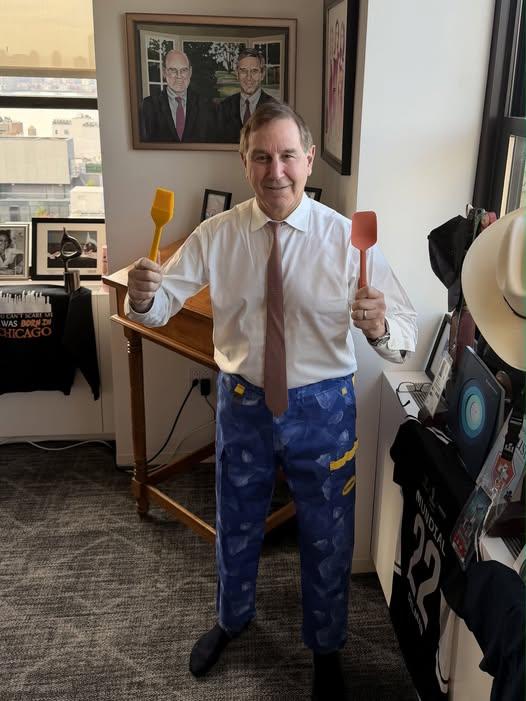
  • The Power of Collabs—Our Thanksgiving Hosting Pants produced by Hedley & Bennett were a smash hit. This proved to be a top-class partner for Butterball, a producer of aprons, knives, and other kitchen products. The blue and yellow pants were even modeled by me with my usual shirt and tie (just for Facebook, don’t worry). Our team organized three weekly giveaways in the month of November. We seeded the pants with food, entertaining and lifestyle creators to drive unboxing videos and social conversation and partnered with David Henrie of Wizards of Waverly Place to maximize reach. In all, we drove stories in F&B outlets such as Allrecipes and Food & Wine, lifestyle outlets such as Parade and SheKnows, and entertainment outlets such as Access Daily and E! News.
  • Expertise Matters—Our Turkey Talk-Line experts did over 100 interviews in local markets including Atlanta, Boston, Chicago, Dallas, Denver, Houston, Los Angeles, Nashville, NYC, Phoenix, Portland, and Tampa. The interviews were substantive, on turkey preparation, hosting tips, and calling 1-800-BUTTERBALL. These experts also were booked on national outlets such as ABC News, AccuWeather, CBS News, CNN, FOX LiveNOW, Inside Edition, MLB Network, NBC News Daily and News Nation.
  • Morning Shows Seeking Happy Topics—We booked Turkey Talk-Line expert Bill Nolan on TODAY, where he spent seven minutes with hosts Carson Daly, Savannah Guthrie, and Willie Geist on best practices for thawing, roasting, checking for doneness, stuffing, carving, and serving. Butterball was on TODAY three times, Good Morning America twice, CNN three times.
  • Washington Events Work—Star turkeys Gobble and Waddle were selected by Agriculture Secretary Brooke Rollins, then greeted by Fox and Friends host Steve Doocy at the Willard Hotel, and ultimately pardoned at the White House by President Trump. This led to further coverage on CBS Morning, FOX & Friends, and USA TODAY.
  • Timely Research Essential—Our team executed a Butterball Togetherness Report on how food brings people together around the holidays. We paired this with consumer information on pricing for the Thanksgiving dinner. Butterball executives were booked on Bloomberg News, CNN This Morning, FOX News, Good Morning America, News Nation, and Yahoo Finance.

Great brand PR programs can be the leading force multiplier for brand marketers. It now requires surround sound, living in culture with crazy ideas such as Hosting Pants that connect to Gen-Z, plus genuine expertise, sharp research findings and clever events. I am so proud of our team headed by Lindsay Garrison. This is indeed the best of Edelman.

Richard Edelman is CEO.
 

The Arab Youth Outlook 2026

Discover The Arab Youth Outlook: how the region’s largest generation is navigating pressure, identity, and opportunity — and what brands must do to earn their trust.

Find out more

By day three of the Global Health Exhibition in Riyadh, my step count was heroic, my caffeine intake borderline concerning, and I had officially run out of adjectives for the sheer scale of it all. It’s one of the largest and most dynamic health gatherings I’ve ever experienced, a place where conversations about the future of care, technology, and collaboration unfold at every turn.

What struck me most isn’t just the size, it’s the sense of purpose. You can feel that health in this region has moved beyond vision statements. It’s now about execution, partnership, and measurable progress.

Here are five realities that stood out to me, lessons that speak to how the Middle East is reimagining health at pace and at scale.

  1. Future of health” means different things to different players ... and that’s its strength.
    From AI diagnostics to personalized prevention, every stakeholder is defining innovation through their own lens. The diversity of ambition is what gives the ecosystem its energy. Everyone is building toward transformation, but in their own way.
  2. Health is becoming a platform for global collaboration.
    What’s happening in Riyadh is part of a wider regional momentum, one that’s positioning the Middle East as a hub for international health cooperation. Partnerships are expanding across borders, disciplines, and sectors. Health is fast becoming a common language of progress and influence.
  3. Technology is advancing fast, but people remain the point.
    The appetite for digital transformation is undeniable. Yet the real measure of success will be how well these innovations improve everyday experiences for patients, professionals, and communities alike.
  4. The private sector is the region’s quiet accelerator.
    While governments are setting bold visions, private players are driving much of the action, from new models of care to data-driven prevention and AI-enabled infrastructure. The collaboration between public and private is what’s giving this region its speed.
  5. Health is now central to economic transformation.
    Across the GCC, investment in health is no longer just about resilience; it’s about diversification. By linking health innovation to national growth, countries are redefining what prosperity looks like.

Somewhere between the AI booth and the longevity pavilion, it hit me: the region isn’t waiting for the future of health, it’s building it. The Global Health Exhibition was a reminder of just how much momentum there already is, and how much more is coming from Riyadh, Abu Dhabi, and Dubai in the months ahead.


Trust Drives Performance

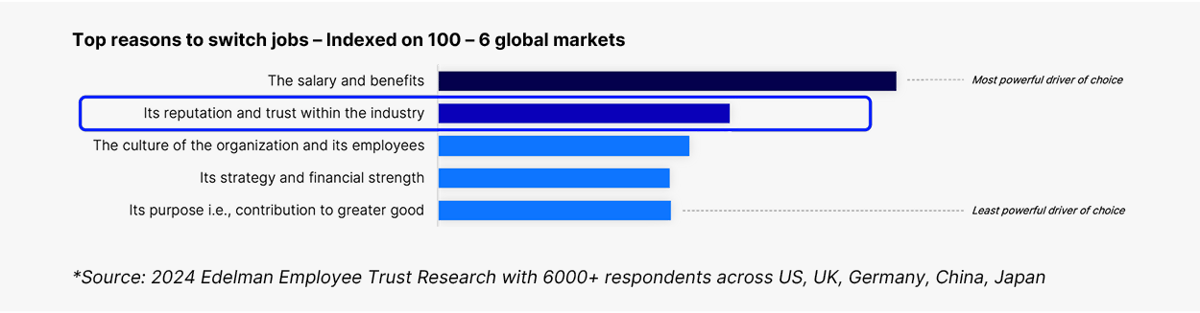
Trust isn’t just “nice to have” – it’s the second most important reason employees switch jobs, ranking just after salary and benefits, and ahead of culture, leadership and other factors (2024 Edelman Employee Trust Research).

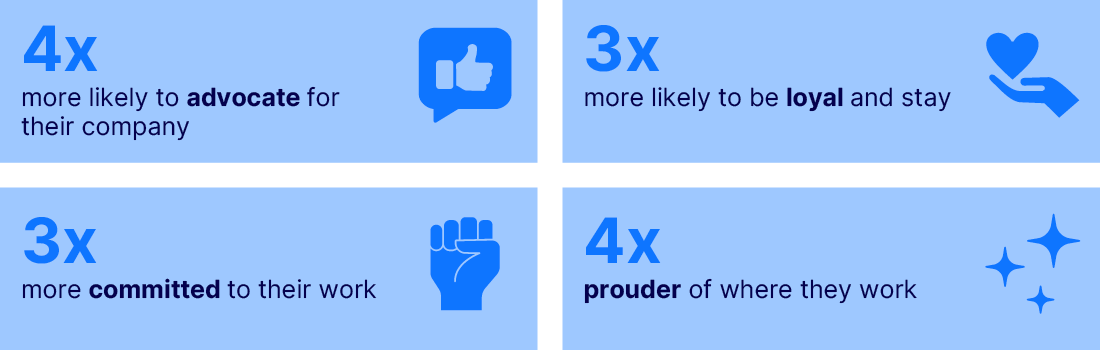
Employees who trust their employer* are:

Employees who trust their employer are 4x more likely to advocate, 3x more likely to be loyal, 3x more committed, 4x prouder

When top talent leaves, they take with them expertise, institutional knowledge and networks that keep things moving faster and better. In tight markets for artificial intelligence (AI), engineering, sustainability, tech skills and more, that gap is a double whammy: business performance dips while hiring lags.

Top reasons to switch jobs – 6 global markets

*Source: 2024 Edelman Employee Trust Research with 6000+ respondents across US, UK, Germany, China, Japan

Trust Drives Performance

Employees who trust their employer are more likely to:

  • Speak positively about the organisation
  • Be more engaged in their work
  • Stay with the organisation longer
  • Feel proud to work for the organisation

Why Trust Matters More Than Ever

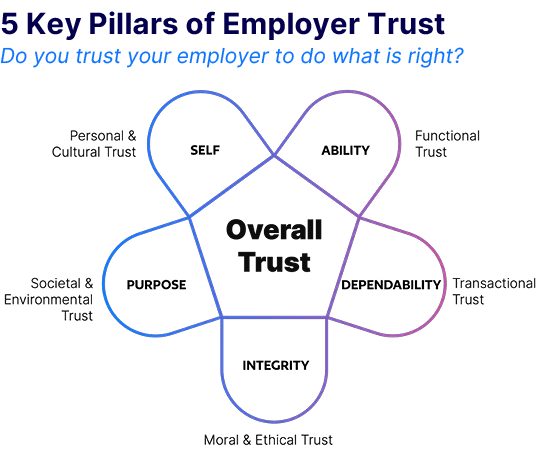
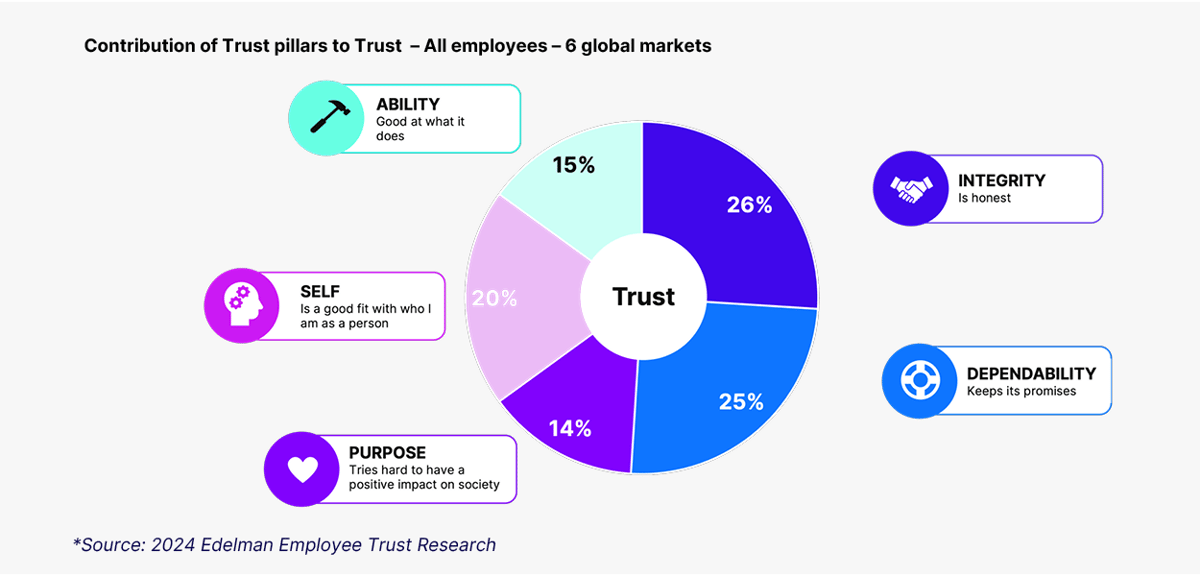
Reputational trust fuels an organisation’s talent attraction potential. Employers seen as trustworthy have the edge in recruiting – and retaining – top talent. Based on Edelman’s 25 years of research on factors shaping public trust, five key pillars consistently define brand and employee trust:

  • Ability – the organisation is good at what it does
  • Integrity – the organisation is honest
  • Dependability – the organisation keeps its promises
  • Purpose – the organisation tries hard to have a positive impact on society
  • Self – the organisation is a good fit with who I am as a person
Five key pillars of employer trust

Source: 2024 Edelman Employee Trust Research

Among the five Trust Pillars, Integrity (employer who is honest), Dependability (employer who keeps its promises) and Self (a good fit with who I am as a person) rank highest in building employee trust globally.

Contribution of trust pillars to overall employer trust

Source: 2024 Edelman Employee Trust Research

Trust is Context-Specific

In today’s uncertain climate, employees anchor their trust more on how they are treated and whether they feel valued at their workplaces, including the organisation caring for their best interest.

Employee trust levels are also driven by whether organisations are a reliable source of information, take responsibility when things go wrong and communicate openly and honestly with employees on the state of the business.

Our work shows that employee trust levels in their employers vary across markets, industries and employee groups. While leaders can’t control national or economic shifts, they can influence how employees experience trust within their organisation.

How Leaders Can Build Trust During Change

In periods of transformation – shifting geopolitics, economic uncertainty and disruptive AI – how can Communications, Human Resource, Change and Business Leaders earn and anchor employee trust?

1. Check

Even when things seem to be going well, leaders should regularly assess the employee experience. Transparent, frequent check-ins help organisations understand how change is landing on the ground, and where trust may be at risk.

  • Clarify major change elements affecting employees.
  • Use formal and informal channels to gather feedback regularly.
  • Refine change communication based on signals from the ground.

2. Commit

Employees need to know what leadership is truly committed to – and what it realistically can’t promise. Clear commitments, backed by consistent behaviour, are powerful signals that reinforce trust over time.

  • Focus communication on commitments the organisation can realistically keep.
  • Explain how organisational values connect to employees’ day-to-day work.
  • Share progress transparently and make refinements when needed.

3. Communicate

Leaders must move beyond one-way announcements to two-way dialogue with employees. When employees see their questions and feedback reflected in decisions and improvements, trust deepens.

  • Communicate background, purpose and timelines consistently.
  • Provide opportunities for employees to ask questions and give feedback (town halls, surveys, 1:1 meetings).
  • Share examples of how employee input shaped decisions or changes.

What’s clear is that transformation is certain. Employee trust is not. It deepens when employees feel respected and valued in times of change – and it fuels better performance in the long run.


Curious how our team can support your next transformation? Learn more about our APAC Workplace Advisory offering.

You can also subscribe to our newsletter to receive these periodic insights directly in your inbox.


Subscribe to 2025