
The Edelman Trust Barometer Special Report: Institutional Investors delivers valuable investment criteria and insights on trust drivers for institutional investors. This year’s findings span a range of topics including Environmental, Social and Governance (ESG) practices, shareholder activism, multi-stakeholder commitment and more.  

The Canadian edition of the report reveals that a resounding 95% of investors expect their firms to intensify their focus on ESG. As companies recover from the impacts of COVID-19, more institutional investors will be looking to businesses to focus beyond short-term value creation and play a greater role in society. The bar for ESG factors has never been higher.  

This fourth annual global report surveyed 600 institutional investors, including financial analysts, chief investment officers and portfolio managers across six countries (Canada, U.S., U.K., Germany, the Netherlands and Japan), representing firms that collectively manage over $20 trillion in assets. The report is a supplement to the Edelman Trust Barometer launched annually in January at the World Economic Forum. 

Contact us at FinancialCommunicationCanada@edelman.com to learn more about the Edelman Trust Barometer Special Report: Institutional Investors findings and upcoming events. 
A story that helps young kids to deal with fears, worries and hopes

You probably know us for being grown up ‘storytellers’ at Edelman Amsterdam, but a group of our colleagues recently decided to combine their insight and skills as mums, dads, carers, homeschool ‘teachers’ and marketing and communications professionals to create our first ever kid’s story book ‘Tommy and The Blue Bird’.

In chatting with her little boy, aged four, Seema our Creative Director saw a need to find a way to talk about fears, worries, hopes and the things we take for granted with her son and further conversations with workmates with kids in their lives reaffirmed her view. With well documented research, including arguments recently set out by The New YorkTimes suggesting that ‘it’s our mind-set’ about stress that matters most – the idea of writing and illustrating an online book for kids (and parents) on how to change our mindsets in tough circumstances was born.

The result’ - Tommy and the Blue Bird’ is designed to help kids as well as parents understand that if we embrace our worries, it can only make us stronger. Click the link to read the book to your kids via your mobile phone/tablet: https://adobe.ly/34NLsdM

If you’d like any additional information on how our creative process works, give us a shout.


Creating Common Culture in a World of Virtual Work: Start with a Refreshed Employee Value Proposition

Every company has a distinct culture whether deliberately created or not—because when people come together, culture happens. But what’s the impact on culture in a highly distributed workforce when people are no longer spending time together in person? Edelman’s recent Trust Barometer Special Report found that those working remotely will probably continue to do so for the foreseeable future; only 31 percent of global employees working from home are likely to re-enter the workplace in the next three months, while 75 percent have the option to work remotely indefinitely.

If culture is activated by shared experiences that create a sense of belonging, how do you shape and maintain a culture in the new virtual work reality? Culture is a valuable business asset because it supports behaviors and values that help achieve a company’s long-term strategy. That makes this moment an important cultural inflection point for most organizations. When shared experiences are virtual at best and non-existent at worst, a company could risk becoming a collection of individual actions and beliefs instead of a culture of common purpose.

In addition, many employees find a lack of shared experiences can make work feel transactional. They are missing the unifying sense that comes from working together in person.

Taking action

Companies have been working hard to maintain what was special about their workplace culture. However, efforts to replicate routines and behaviors from the office are not faring well because virtual work differs so dramatically from in-person work. As Stanford professor Jamil Zaki suggests in his Washington Post column about personal growth in the face of the pandemic, “When an earthquake topples a building, architects are unlikely to rebuild exactly what was there as before…reconstruction offers a chance to build back better.” Similarly, company leaders need to forego a replication strategy when it comes to the remote employee experience. Instead, they need to re-architect the terms of what it means to join, work and stay at their company in a new virtual or hybrid work environment.

Many companies are already taking steps to re-architect their culture by reevaluating the most fundamental aspect of the employee experience—their employee value proposition (EVP). This crisp articulation of what employees can expect at work in exchange for their productivity and performance extends far beyond culture to include total rewards, brand image, and more, but it is a wise place to start for companies looking to revisit and re-articulate what is so core to their employee experience. Recalibrating an EVP for the current context can strengthen your culture in a remote world.

Your EVP evolution starts with auditing what you’re currently offering across the full employee experience against the backdrop of the new realities of work.

What motivated employees to join and stay at a company just a year ago has shifted dramatically—not only because of Covid-19 but other societal tensions as well. So an EVP re-set is imperative. Companies cannot work in a context that is no longer relevant. Increasingly, we know that an employer’s response to racial injustice and ESG issues—such as climate change—shape employee perspectives and choice. For example, in Edelman’s September 2020 global survey, 71 percent of respondents now rate “my employer” as the most trusted institution to respond to systemic racism. There is a new expectation that companies and leaders don’t just speak out on issues, but actually lead societal change. Aligning your EVP to speak to the values and concerns of employees is no longer a “nice to have,” but a business imperative.

The companies that will fare best and position themselves for future growth are those who take the time to re-evaluate and re-articulate their EVP to both recruits and current employees. Employers must change their organizational cultures to match the shifting world around us.

Felicia Joy, Alissa Schepisi and Elena Grotto are Senior Vice Presidents at Edelman.


2020 trust highs evaporate amid persisting uncertainty


When we unveiled the findings of Edelman’s annual Trust Barometer in Australia earlier this year, we were admittedly a bit surprised to find all-time-highs in trust across every institution we study – business, government, media, and NGOs – particularly given the negative trends in trust we had seen elsewhere around the globe.

But as we sifted through the data and reflected on the context around when the annual survey was in field (Oct-Nov 2020), the logic stood up. At the time, there was confidence in Australia’s economic recovery, the virus was very much under control, and life as we knew it pre-pandemic was, in many ways, returning. In spite of this, however, our unique brand of Aussie skepticism kicked in, and we asked ourselves at the time: Are these levels of trust sustainable? Could it be that Australia is in a “trust bubble”?

Turns out, it appears our suspicions were well-founded.

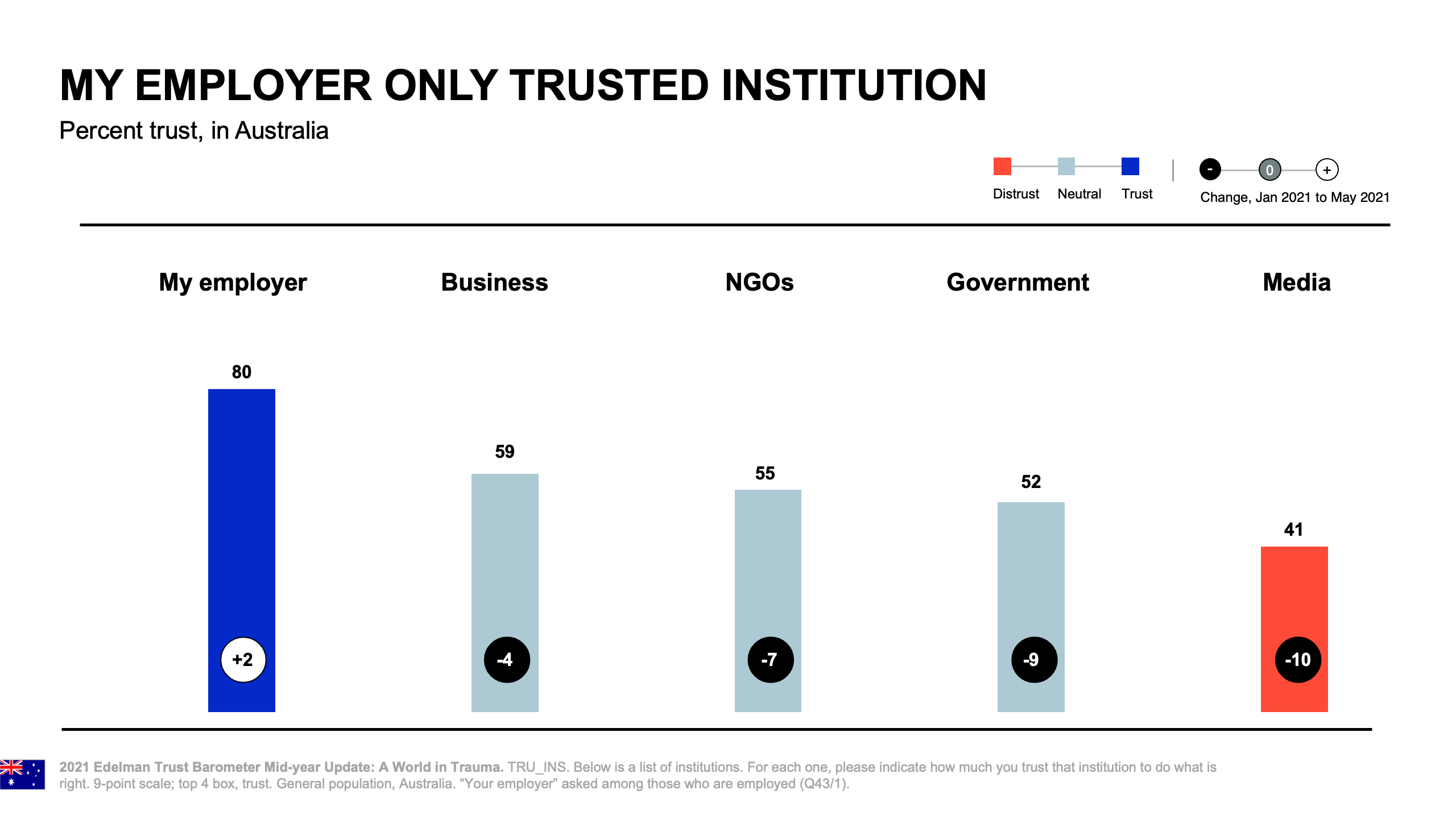
Edelman’s most recent Australian survey, which measured the levels of trust in Australia’s institutions at the end of May 2021, shows trust fell sharply across all four institutions: media (-10 points), government (-9 points), NGOs (-7 points) and business (-4 points). These results dramatically strip away most of 2020’s gains, pulling government, business and NGOs down from "trusted" standing to "neutral”, while media plunged into “distrusted” territory.

When we reflect on the first half of 2021, perhaps it’s less surprising that public trust has taken a hit.

Snap lockdowns continue to chip away at Australia’s collective patience. Challenges with the vaccine rollout, from high hesitancy rates to low supply and lack of urgency, raise questions over the operational management of our Covid-19 exit plan – not to mention the sustained public discord between Federal and State governments. High-profile battles between industry and regulators continue to play out, whether that’s AUSTRAC’s march on financial crime or the ACCC’s gridlock with tech platforms that underscored how vulnerable the public’s access to information can be. Women’s rights again took centre stage with new abuse allegations in Canberra, the formation of March4Justice, and the formation of a Women’s Cabinet. And an even sharper light was cast on the wider systemic prejudices and injustices that plague our institutions, and specifically how they acknowledge the rights of Indigenous Australians.

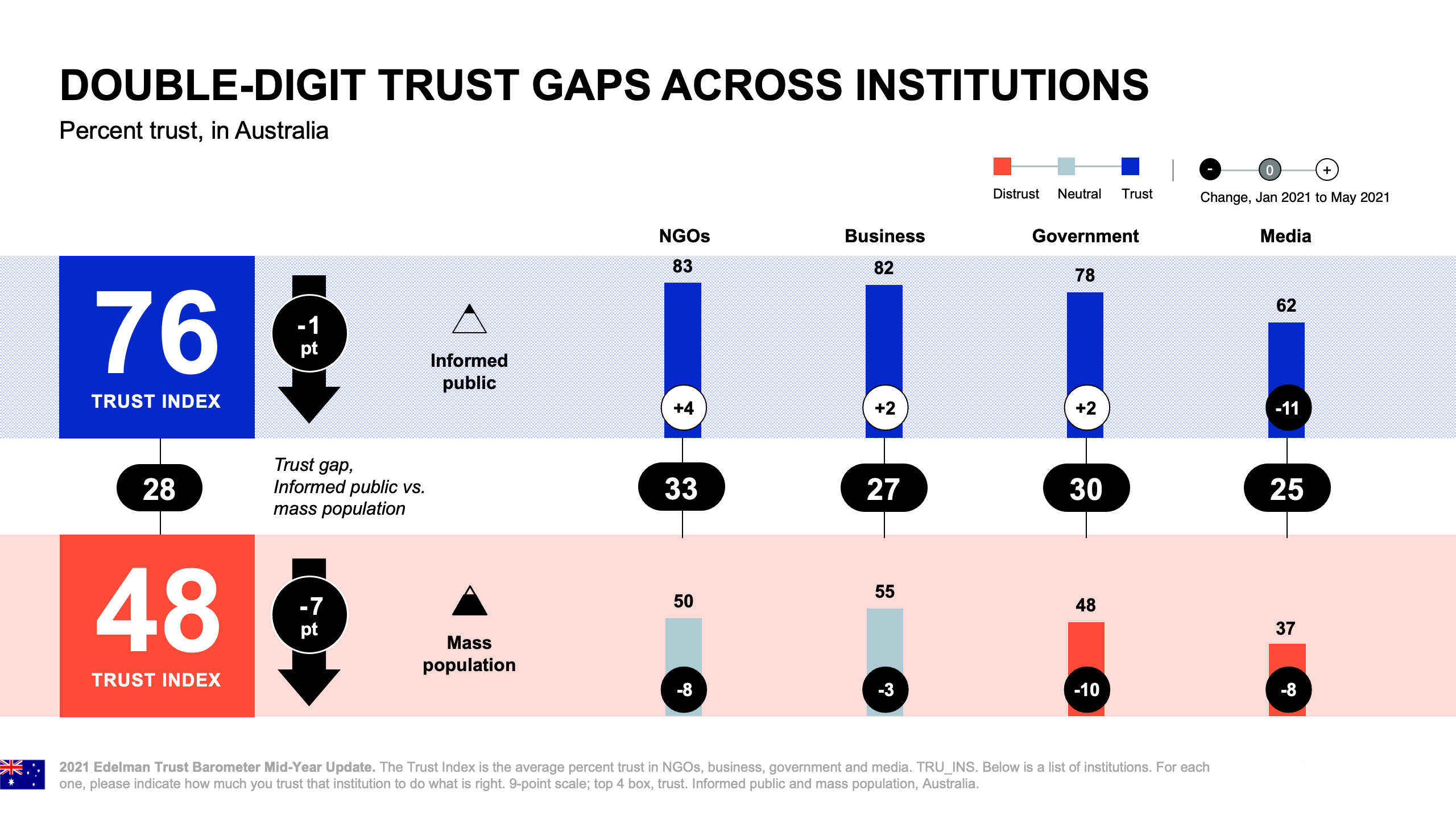
And perhaps it is for these reasons that our mid-year survey confirmed an alarming trend we’ve seen in Australia – as the country again recorded the largest trust inequality anywhere the world. With a whopping gap of 28 points between the trusting informed public (well-informed adults in the top income and educational brackets) versus the more cynical mass population – the story of Trust in Australia is now one of two divergent realities.

Trust Barometer 2021 Mid-Year Update - Trust Gap

While this gap is not new to Australia, it’s widening at a worrying pace. For our institutions it brings an additional layer of complexity as they try to share information and communicate effectively with two distinct audiences: one that trusts, and one that doesn’t. In a world still reeling from the crisis of pandemic, failure to navigate these waters adroitly can translate to devastating, real-life impact – for example, consider how rampant vaccine disinformation has disproportionately impacted uptake among economic and racial minority groups.


But amid what seems to be a dark future, there are signs of hope.


“My Employer” emerges as the only trusted institution, climbing 2 points to a staggering 80 per cent, suggesting employers are in a significantly advantageous position to address larger social problems by providing trustworthy information and guidance to their employees. But overreliance on employers as a savior is an unstable and unsustainable formula; they cannot go it alone.


Trust Barometer 2021 Mid-Year Update - My Employer


Expectations on business to solve societal problems are already at extreme highs. Sixty-one per cent of respondents believe Australia will not be able to overcome our challenges without corporate involvement. So, where to from here?

It’s clear employers and business must continue to lead on societal issues, and join in coalition with government, NGOs and media to find a common purpose. But most importantly, for our institutions, now is the time to double down on a bias toward action. A new paradigm was borne in the onset of the pandemic, and trust was built as regular and transparent communication demonstrated leadership and accountability amid the chaos. But with the full scale and impact of the pandemic now more clearly in focus, communication alone cannot solve the complex, enduring problems our society continues to face.

Will a renewed bias toward action be what it takes? For our institutions in Australia, this is yet to be seen, and it must be their focus if they wish to regain the faith of a nation.


Hugo Heimendinger

As noted by many, 2020 was a year of seismic digital acceleration, fueled by the pandemic, social and civil unrest, and wide-spread ambiguity – events we all experienced together. We witnessed how these events reshaped our world and watched communities, brands and organizations rapidly embrace change.

We’ve seen life and work move online, demand for action in areas, such as data privacy, misinformation, trust in digital platforms, brand safety and inclusivity, a wide-spread embrace of touchless technology, the acceleration of social audio platforms and the growing influence of creators and niche communities (e.g. GameStop). The topics that follow are a few areas of focus that are recurring in my conversations with brands, businesses, platforms and industry partners.

1. Social Commerce Takes Flight

Commerce is flourishing everywhere and has gone from being a singular destination in a journey to being dispersed and embedded into nearly every experience, whether natively in social feeds or in influencer livestreams. In the second half of 2020, we saw social platforms take advantage of consumers’ willingness to adopt social commerce and announce updates such as Instagram Shops, new Pinterest shopping formats, TikTok + Shopify Partnership and more. Brands will need to think about how they can leverage social media to enable commerce along every stage of the customer experience.

2. Customer Targeting Moves to Opt-In Data

With raising concerns about privacy online, consumers are expecting real action to be taken to protect their data. We’ve seen platforms take steps to improve users’ privacy and will be seeing more of this, such as Google’s FLoC, Neustar’s PeLICan, Criteo’s SPARROW and other post-cookie solutions to audience and cohort targeting. Marketers will see a shift away from third-party targeting and towards consumers’ choosing to share their first-party data with brands. Earning that first-party data will require a new and modern approach to value exchange, empathy and trust.

3. Virtual Is the New IRL

2020 saw an acceleration of technology being used to allow, enable and enhance experiences. What may have been a novelty in the past, technology will now be required to enable everything from business-to-business sales conferences to healthcare practitioner and patient engagements to shoppable consumer experiences. The year ahead will see necessity turn into further invention using technology to drive improvements in experience, commerce and communications.

4. Brands Unlock the Business Value of Social Communities

With many businesses disintermediated from customers, many brands saw 2020 as a year to take a fresh look at how their online communities could differentiate their brand, unlock growth insights, create direct customer relationships and drive preference and advocacy in their category. The past year truly saw the acceleration of social community as a communications ecosystem to social community as a business asset.

5. Taking a Proactive Stance Against Misinformation

According to this year’s Edelman Trust Barometer, business is the most trusted institution and the only one that is seen as both ethical and competent. With misinformation (and disinformation) now a dominant concern for nearly every institution, business must act as an information guardian to flatten the misinformation curve by providing straightforward, unbiased facts and information to all of their audiences, especially their employees and customers. Business must also understand its own operational, commercial and reputational risk when it comes to misinformation and build and steward communities, maintain misinformation sensing capabilities and contingency plans to guard against organizational risk.

6. Executives Go Social

While certainly a trend prior to 2020, last year we saw many executives invest both time and energy into their social media presence as these channels afforded them the ability to speak directly with all of the stakeholders of an organization. Social platforms humanized these executives during difficult external events and allowed them to speak on behalf of their organization about both business and purpose during a year of global consequence.

7. The Rise of Social Entertainment

Despite news of misinformation, data privacy and the unintended consequences of increased screen time, the past 12-18 months may also represent a turning point in the role of social media, including gaming and streaming communities (themselves increasingly becoming more social environments) for entertainment. Platforms, including TikTok, Instagram, Snapchat, Triller, Twitch and Fortnite, are increasingly blending their own creator and content capabilities with both new and sometimes even more traditional entertainment content (e.g. concerts), reshaping the way people consume social media. Twitch has signed musical acts, Triller is buying the rights to boxing cards and Fortnite is hosting concerts.

The intersection of business and entertainment has always been a rich one. It’s now a social one, too.

In addition to the above, I’m also spending a lot of time thinking about the evolving role of a company’s dotcom in the context of distributed commerce, and how the stories that brands publish online will need to be increasingly architected to connect not just to transactional data signals but also to earned, cultural and trust data signals.

What’s categorically clear from the last year is that permanent shifts in online behavior have required businesses, brands and organizations to accelerate their efforts in transformation, technology, platforms and communications.

As far as I can tell, there won’t be any slowing down.

Tristan Roy is Global Chair, Digital

I attended the virtual Yale CEO Summit this week, hosted by the inimitable Professor Jeffrey Sonnenfeld. One of his favorite exercises is to survey the CEO attendees on issues of the day. The most important finding from yesterday’s conclave was that 71 percent of the CEOs would be in favor of mandatory vaccination of their employees so that the world can recover more quickly from Covid-19.

The New York Times columnist Andrew Ross Sorkin wrote about the topic earlier this week, “Business leaders are uniquely positioned. They can tell employees that they may return to the workplace only if they get vaccinated…it could create a competitive advantage for a service like Uber if the company said all of its drivers were vaccinated…Some companies could even require their customers to be vaccinated, for example an airline where only passengers who were vaccinated could fly on the planes...the Business Roundtable should get its members to sign a joint commitment to mandating vaccinations to help prevent a backlash against individual companies.”

I got another view from Dr. Steven Corwin, CEO of New York-Presbyterian Hospital. He said yesterday on Bloomberg TV that roughly 30 percent of his employees are “not sure” about taking the vaccine. “Communities of color have long been experimented on, so they need to be convinced. We have a vigorous educational effort to make sure people understand the safety of the vaccine and the risk/benefit of the vaccine versus getting the disease itself. And we are embarking on that [effort].” Dr. Corwin is in line to get the vaccine at the end of January but said he would get it earlier than that if his staff wanted the reassurance that the CEO of the hospital was willing to take it. “I’m game to do it…I think it’s safe, effective and necessary,” he noted.

I discussed the CEO Summit finding with Dr. David Nabarro, World Health Organization Special Envoy for Covid-19, my frequent discussion partner over the past nine months. He said, “Personally I am against mandatory vaccination. I think it neither right nor productive to force people to take the shot. I am also against unilateral action by employers: decisions on vaccination policy should be based on dialogue, and agreements reached, between employers and employees.”

Dr. Nabarro went on to say, “The priority now is to secure high-level political agreement and necessary funding to enable everyone in our world to be vaccinated as soon as effective and safe vaccines have been approved. This will include plans for digital health passports, which warranty vaccination or recent Covid tests. A central part will be well-devised and sensitive responses to vaccine hesitancy. Remember, this is all about building people’s trust as well as maintaining public health.”

I am deeply uncomfortable with the idea of compulsory vaccination, at least at this moment in the pandemic. We should first try to persuade highest-risk employees, then some of whom are feeling young and immortal, others who are carrying historical burdens starting with Tuskegee and including many other incidents of bias in medical product testing and still others who are fearing the worst about the politicization of public health. We will prompt a backlash among employees who feel cornered after being locked down or working on the front lines with inadequate protections.

We have a serious Info-demic, in which mainstream media is seen as politicized and chasing clicks, while social media is a stew of disinformation. This is why the information and education campaign must be given a chance. And as the vaccine becomes available to more people over the coming months there will be more evidence to make the case for its effectiveness. There is a mandate for companies to educate their employees about the various vaccine options (mRNA versus traditional, one-shot or two). There must be detailed context provided on clinical trials conducted for each vaccine, the length and breadth of the trial, the ethnic background, age and sex of the participants. There must be a serious discussion of the side effects, including allergic reactions. And business should cooperate with the Ad Council, which will shortly be breaking a mass media campaign on vaccination, featuring ordinary citizens and celebrities who will protect each other by taking the jab.

The number one task for every Chief Communications Officer must be the provision of credible information that allows individual employees to make rational decisions about vaccination. ‘My employer’ is the most trusted institution; business must not squander its hard-earned trust gains by looking for short-term solutions to boost sales. We are better than that.

Richard Edelman is CEO.

Edelman Canada’s view on the Digital Charter Implementation Act

The digital landscape is constantly evolving, and right now we’re in the midst of a major shift. For years, global corporations have been leaning on data – big and small – to fuel their innovation with little regulation safeguarding these practices. Now, we’re seeing an emphasis placed on the privacy and protection of consumers above all else.

The emergence of a privacy-first digital landscape was reinforced by the Government of Canada last month with the tabling of Bill C-11 – the Digital Charter Implementation Act – to establish two new pieces of legislation that govern privacy within the private sector: the Consumer Privacy Protection Act (CPPA) and the Personal Information and Data Protection Tribunal Act.

If passed, the new legislation will give Canadians more control and require greater transparency over how private sector organizations handle their personal information – with significant financial penalties for violations. And in turn, this will have substantial impact on how organizations operate, and reach and influence audiences. 

As marketers and communicators, there are things we can – and should – be doing to protect brand reputation, build and maintain trust with stakeholders, and prepare for the mandated changes.


BUT FIRST, AN OVERVIEW OF WHAT MAY CHANGE

Details of the new legislation will undergo public and industry consultation in the House of Commons and the Senate. As drafted, the Bill has similarities to the EU’s General Data Protection Regulation (GDPR) and California’s Consumer Privacy Act (CCPA) with responsible data management at its core. Emphasis will be placed on: 

  • Meaningful consent. Modernized consent rules to ensure individuals are provided with the plain-language information they need to make meaningful choices about the use of their personal information and data.
  • Data mobility. To further improve control, individuals would have the right to direct the transfer of their personal information from one organization to another. For example, directing your bank to share your personal information with another financial institution. Organizations will be required to be transparent about how this data is being shared or handled. 
  • Disposal of personal information and withdrawal of consent. The legislation would allow individuals to request that organizations dispose of their personal information, and in most cases, permit individuals to withdraw consent for the use of their information.
  • Algorithmic transparency. New requirements for businesses to disclose how they’ve used automated decision-making systems like algorithms and artificial intelligence to make predictions, recommendations or decisions about individuals.
  • De-identified information. The practice of removing direct identifiers – like a name – from personal information is becoming increasingly common, but the rules that govern how this information is used are not clear. The legislation will clarify that this information must be protected and provide guidelines around when it may be used without consent.
  • Repercussions. The Government of Canada has made it clear that there will be significant consequences for those who do not adhere, including penalties for those who do not report breaches to the commissioner, notify individuals or keep records of such incidents. Organizations that knowingly contravene obligations could be subject to a fine of up to 3-5% of global revenue or $10-$25 million. In addition, a Tribunal will be put in place to oversee the administration of penalties.

More on the principles of the CPPA & the Data Protection Tribunal Act here.


WHAT THIS MEANS FOR YOUR ORGANIZATION IN THE SHORT AND LONG-TERM 

1.      Now is the time to assess your privacy and data practices. Privacy topics have never been more mainstream than they are now, and this news brightens the spotlight.  

  • Understand the data your company handles and what it’s used for. A recent study from Edelman Canada (2017) surveying Information, Data, Security & Technology Officers across Canada found that only half of respondents believe their critical stakeholders – from senior leadership to legal teams and employees broadly – are aware of the type of data their company stores and processes.
  • Review your current processes for personal data collection, storage, usage and removal – and prepare to make changes


2.      Start working on your privacy narrative. Organizations will be required to obtain meaningful consent, which means your stakeholders must clearly understand what data is being collected, how it is being handled and trust you to manage it properly.

  • Most Canadians (85%) feel a “greater reluctance to share their personal information with organizations in light of recent news reporting of sensitive information, such as private photos or banking information, being lost, stolen or made public (2016 Survey of Canadians on Privacy, December 2016, OPC). Privacy is more than a policy on a piece of paper – work with your leadership team to foster a culture of transparency and define your privacy narrative – for internal and external distribution. 


3.      Beyond the penalties, your brand reputation is on the line. Thousands of organizations a year are victims of data security breaches. Ensure your organization is prepared to respond to and defend against an incident.

  • Ensure your employees have ongoing training for cyber threats and appropriate data storage, usage and sharing
  • Undergo a data security and privacy preparedness assessment
  • Create or update your breach response plans to ensure your team is prepared to manage notifications quickly and effectively after a breach
  • Host annual training for your internal teams responsible for a data breach response – including IT, communications, legal


4.      Targeting will continue to evolve and play a key role with creative and content as primary drivers of impact. Data-driven audience targeting will evolve to open and balance opportunities to reach more diverse audiences while still driving impact. The advertising industry has been expecting this type of legislation to come to Canada for several years and has been working in partnership with the governing bodies to balance the needs of consumers and corporations. We will see a shift in deep targeting across both data management platforms and “walled gardens” as they need to adhere to the same rules – and first-party data ownership and message relevancy will play a key role in optimizing programs.

5.      Consider whether your organization needs a seat at the table for legislation consultation. The House of Commons will begin studying Bill C-11 once Parliament resumes sitting in early 2021. Making changes to the Bill is possible through direct engagement with Parliamentarians, either by written submission, appearing as a witness at the Committee studying the Bill, or both. Knowing that privacy advocates will be looking to further strengthen protections, it will also be important to continuously monitor all legislative activity related to the Bill and be prepared to react and respond
accordingly.

THE WAY WE SEE IT: WE MUST TAKE A NEW APPROACH TO COLLECTING AND PROTECTING FIRST-PARTY DATA – ONE GROUNDED IN TRUST

Trust can’t be bought. It must be earned. Organizations that offer a more mutual value exchange will do best in this environment, and that requires reimagining the role of data and adopting a new approach, one with “data with empathy” at its core.

Edelman’s global chief data & analytics officer, Yannis Kotziagkiaouridis, describes this as the process of identifying insights into who people really are, beyond the superficial or transactional level the industry has been collecting for years. With a true understanding of cultural and human insight, companies can connect with audiences by creating emotive, meaningful and connected experiences, ultimately leading to a mutual data value exchange in which trust is the foundation. 

How organizations treat and protect data is now part of their brand promise and risk profile.


CONNECT WITH OUR EXPERTS

For more information on the evolving digital landscape and how your organization can adapt, contact Dave Fleet, Executive Vice President & National Practice Lead of Digital.

To engage with Government as Parliament studies the Bill, please connect with Christopher Vivone, Senior Vice President and National Practice Lead, Public & Government Affairs.

For counsel or support in defining your privacy narrative or preparing a data security response plan, contact
Greg Vanier, Senior Vice President, Crisis & Risk & National Lead of Data Security and Privacy

For more information on performance marketing and third-party targeting, please reach out to Nirmala Bahall, Senior Vice President of Performance & Paid Marketing.

To better understand first-party data collection and the impacts this legislation may have on your processes, please contact Catherine Yuile, Executive Vice President, Data & Intelligence.


By registering, this confirms you agree to the storing and processing of your data by Edelman Canada as described in the Privacy Statement


An organization’s reputation is a form of social currency. It is a binding force by which stakeholders form trust and often drives consumer decision making. This is particularly true in cybersecurity attacks, as new tactics to leverage company reputations as collateral damage during such events are on the rise.

According to the IBM Cyber Resilient Organization Report, 51 per cent of organizations reported a significant business disruption during the past two years. Researchers have suggested that most recently this increase may be due to increased risks associated with COVID-19, including remote working vulnerabilities and targeted phishing campaigns, among others.

Unlike the cybersecurity attacks we’ve seen in the past, many hacking groups are switching up the way they do business, and the impacts of these sophisticated intrusions and the commodification of corporate reputations, can have real and devastating consequences. These types of incidents not only present the obvious IT infrastructure disruptions, but also make it increasingly difficult for organizations to maintain control of the narrative and deliver timely and transparent updates to their stakeholders.

In 2020, we have seen a rise in highly aggressive tactics by hacker groups to manipulate victims into compliance. For example, we are aware of multiple hacking groups who are known to threaten distribution of stolen information via ‘mass media’ channels, including the use of dedicated leak sites, potentially leading to early-on widespread stakeholder awareness of an ongoing cybersecurity attack. It’s important for communicators to understand the need for transparency to their stakeholders in these situations; while also working with IT and legal teams to ensure the appropriate stakeholders are communicated to at the right time.

Here are some things to consider when preparing to respond to a potential cybersecurity attack.

  • Develop a communications response playbook: Ensure that your organization has an up-to-date response playbook that considers the most likely scenarios, including extortion attacks in which hackers use your reputation as leverage.
  • Practice and train:  Scenario exercises to train corporations on their communications response capabilities has grown in popularity at Edelman, where we work directly with our clients to ensure they are well-equipped to respond and mitigate potential reputational risks associated with a wide range of potential issues ahead of time.
  • Establish back up communication channels: For communicators, in addition to releasing the appropriate information at the right time, cybersecurity attacks can at times require communication teams to manage the situation with limited access to IT systems and internal communications functions. Identifying back up communication channels ahead of time can help ensure that a steady cascade of information can continue to flow.
  • Know what your insurance will pay for: Many insurance companies offer a host of protections and policies to ensure that organizations are equipped to manage through unexpected data security and privacy incidents, including external communication support.

 The costs to respond to a cybersecurity attack in Canada are on average $6 million (CAD), according to the Canadian Chamber of Commerce Cyber Security in Canada, however it is not as easy to understand the financial implications of a loss of trust. According to the 2018 Edelman Trust Barometer, ‘safeguarding privacy’ became one of the most important trust-building mandates for businesses globally. With hackers now weaponizing your reputation, the stakes are higher than ever.

A sudden and unexpected cyber incident can have long-term and significant impacts on an organization’s overall well-being. However, a well-managed incident can ultimately strengthen and build trust with key stakeholders through effective and tailored communications. Planning and preparing to mitigate potential cybersecurity risks of all kinds can help lighten the load and provide some assurance that, should an incident arise, your organization will be prepared.

If you would like to learn more about Data Security and Privacy Communications, please contact Cleo.Clatney@edelman.com.

What does a typical day in the life of a Financial Communications Advisor look like? 

The first thing I do when I start work is check on any overnight requests from clients, significant market-moving news, announcements of transactions, significant people moves, anything that I should know about or that requires immediate action. This is usually followed by a few internal or client calls, sometimes together with legal and financial advisors to discuss details of upcoming transactions, earnings announcements or other significant events.

Throughout the day I will receive calls from journalists trying to verify rumours, I will keep track of the news flow and check for any market commentary from analysts on companies too. Importantly, I spend a lot of my days drafting communications materials and documents and sparring with colleagues and other advisors on the correct approach and messaging. Furthermore, I’ll reach out to journalists to gauge their interest in an interview with a particular client’s CEO and ensure that all the prep work is done before the interview takes place.

What three skills do you think are essential to fulfil your role? 

You have to be curious about business and capital markets 

You have to be analytical, notice trends, be able to digest financial / legal documentation for communications purposes 

You have to be able to think on your feet in advising clients, and switch easily between vastly different businesses from one minute to the next 

What do you like best about working at Edelman? 

The dynamics and the colleagues – there really never is a dull moment, but the colleagues make it manageable, fun and worthwhile! 

What are some of the challenges you face in your day-to-day role? 

Balancing client expectations – usually the requests aren’t quick fixes and have many (potentially legal) implications when they’re not done right, so you really have to devote time, triple check work and ensure your advice is correct. 

Obviously, we don’t always control the news flow, so when a news outlet decides to publish a story, we need to deal with it ASAP. Flexibility is key. 

Describe your working week using 3 emojis 

?‍??? 

What’s been your most memorable moment at Edelman so far? 

Any announcement day of a major transaction that we’ve been working on for (often, very long) weeks is a thrill – usually these transactions are significant news events so there is a lot of media attention. Obviously, travelling to different places for client or internal engagements is always a highlight too (when restrictions don’t apply!) 

What’s your favourite part of a working day? 

Whenever I’m able to show my expertise during client meetings or when we’ve had significant impact on the critical decisions that are being taken in a particular process. 

How do you stay motivated? 

Every announcement or milestone poses new challenges – especially in financial comms where you are dealing with business-critical events and aren’t always in control of what’s going to happen next. 

What’s your top tip for working from home? 

Walk and talk – I pace around my house when I’m on the phone and go outside when I can! 

Did anything surprise you when you joined Edelman? 

The willingness to work hard for clients and help each other get the job done well. 

Finally, how do you see your career path developing in the future? 

I really enjoy the advisory side of comms, so I see myself further developing myself in FinComms and becoming a recognised adviser for major business events and M&A transactions in particular.

It seems unreal to think of a time when upward of 100,000 healthcare professionals (HCPs), journalists, and consultants would gather in a large congress centre to discuss the latest scientific advances – but it happened, not so long ago. However, this year, with the onset of COVID-19, many medical congresses were moved to a virtual set-up or postponed until further notice. For many major congresses, the fully virtual set up was an alien concept. Encouragingly, they were met with positivity by their key stakeholders, as a preliminary survey found that the majority of HCPs were optimistic about the virtual setting.

That positivity remains alive today, with many congress attendees preferring the flexibility of the virtual format (in fact, you wouldn’t be mistaken if you saw a leading HCP sharing a selfie of themselves during a virtual session this year – some even sat in their home office drinking a beer!). The virtual format is more accessible, as supported by attendance figures at many congresses – for example, attendance increased by over one third for the European Respiratory Society (ERS) congress (2020 vs. 2019) and there was a record number of attendees at the American Society of Clinical Oncology (ASCO) 2020 meeting. Additionally, the new format allows attendees to easily access relevant content – saving them the effort of trawling through lengthy congress centre halls to review posters and hoping for a seat in the presentation of their choice. Furthermore, there is no longer the predicament of conflicting presentations, as the recordings can for the most part be watched on demand.

While the general feedback was positive, some HCPs voiced concerns about networking – or lack thereof – with the virtual format. In order to mitigate this, organisers and presenters got creative, utilising social media channels to target their audiences and promote collaboration across the scientific community. An advantage of this new setting is that, with attendees reachable via computer, networking is less serendipitous and it is possible to enhance collaboration almost instantly following a presentation, which would not have been as easy in a traditional congress setting. As attendees are reliant upon virtual platforms for networking during the meetings, additional questions can be fed into livestream platforms to establish real-time discussions of the data that are more robust and long-lasting.

Another bonus of virtual congresses that should not be forgotten is the environmental and economic benefits of remote attendance. While a number of ways to make congresses more sustainable had previously been suggested, there was still a considerable environmental cost associated with conventional events. The onset of COVID-19 forced organisers to embrace digital solutions and reassess the necessity for participants to be onsite. The virtual format not only eliminates travel but also reduces associated costs – which we would hope to be channelled elsewhere (e.g., into research and development).

Moving forward, experts predict medical congresses will not return to how they were pre-COVID; instead, they are likely to remain virtual, with face-to-face meetings only as needed. While the future – in which we hope to see the provision of an effective vaccine for all soon – remains uncertain, one thing we can be sure of as we approach 2021 is that the virtual set up is now our new congress ‘norm’ for the year to come. Organisers will be encouraged to take key learnings from this year, adopt new digital strategies and ensure activities in 2021 are less scrappy, more sustainable, and work towards honing an optimal congress experience for all. As a famous statistician somewhat futuristically wrote back in 1983, it is time for ‘fewer conferences, better conferences, and conferences held for the right reason’.

Subscribe to 2020