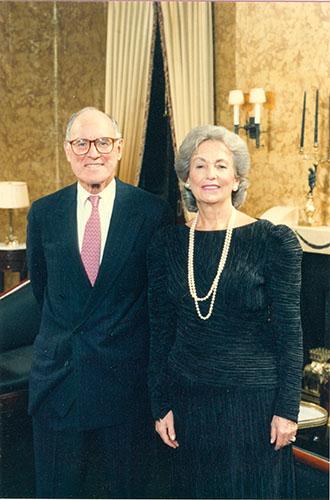

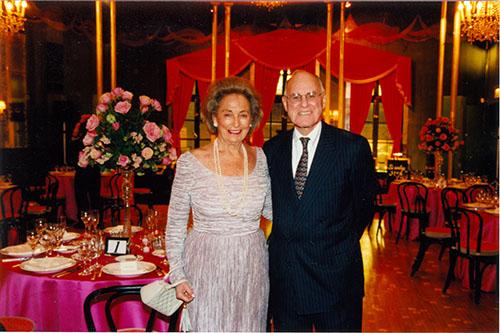
It has been eleven years since the passing of my parents, Dan and Ruth Edelman. It is fitting that they passed in the same year, 2013. They were inseparable in life, complementary in their skills, aligned in their goals of family, business and community. For this dynamic duo, there was no separation of the three facets of life.

My father was hard driving, demanding, well-informed and resilient. A paradigm Type-A personality, Dan was determined to get ahead. He was as competitive on the tennis court as he was in business. He loved sports, especially the Chicago Cubs and the Bears (his fraternity pal was Sid Luckman, legendary quarterback for the Bears, a lifetime friend). He was a Phi Beta Kappa graduate of Columbia University; his success in school was due to both brains and supreme effort, taking notes on his notes to prepare for exams. He loved his country and was proud of his four years of military service during World War II in psychological warfare and military intelligence.

Dan started Daniel J. Edelman, Inc. with four people in the Merchandise Mart in Chicago. He invented the media tour while at the Toni Home Permanent Company in 1948, sending six sets of identical twins around the U.S. to be interviewed by local media. He understood the power of celebrities in media relations, using Vincent Price for California Wines, George Hamilton for the Sole Leather Council and Phyllis George for Toni. He also recognized the possibility of entrepreneurs telling their own stories, including Orville Redenbacher of popcorn fame, Colonel Harland Sanders for KFC and Charles Lubin, founder of Sara Lee. Dan was proud of the case study on the Toni media tour written by Harvard Business School Professor and marketing guru Theodore Levitt.

Dan was an inveterate dreamer, believing that Edelman could become a global force in public relations. He established the first overseas office in the UK in 1965, followed by operations in Germany and France. Then came Asia, Dan’s true obsession, beginning in Kuala Lumpur and Singapore, then Hong Kong in the mid-80s. The acquisition of Interasia in 1993 propelled Edelman to the top rank in China. Korea, India, Australia and a start-up in Japan followed soon thereafter. Canada and Latin America joined the Edelman roster via acquisition in the 1990s. When we rose to the top of the PR ranking in 2011, his admonition to the Edelman team, “It is great to be the largest firm, but we must always strive to be the best firm.”

Ruth was my father’s partner in building the company. She was out with him five nights a week, entertaining clients, going to charity events and building the brand. She was an astute judge of talent, spending quality time with senior Edelman team members, listening and advising them on family matters or business issues. She was a social force, walking boldly up to important figures, winning them over in five minutes, then introducing them to my father, whom she described as “the most brilliant man.” She ran her household as a tight ship, up early calling around to her friends on the events of the prior night, making sure the kids were fed and on the way to school, going on to do the charity work, supervising homework then preparing for the evening. It was a busy life of friendships with CEOs, influential politicians, sports stars and journalists. My mother courageously battled manic depression for 40 years. She lobbied in the U.S. Congress to raise funds for mental-health research and shared her condition with the public to end the stigma associated with mental illness and increase access to care.

My parents connected on the pursuit of excellence and in service to the community. The three kids (Renée, John and I) were expected to do well in school. We were also to excel in sports. I had a weightlifting coach at age 10 because my mother said that she could "blow me over." She rousted me out of bed promptly at 7 a.m. during the summer to oversee the circuit training for football, replete with a whistle and stopwatch. Competition among the siblings was encouraged and high achievement demanded. Touch football games on the lawn at our summer house in Charlevoix, along with morning sessions with neighborhood kids on the SRA learning plans are examples of life at the Edelmans. My parents devoted hours to charities in Chicago, including the Art Institute, Operation PUSH, Chicago Lyric Opera, Immigrant Service League and Rush Hospital.

Renée, John and I have done our best to keep the ethos of Edelman and Zeno as special institutions that partner with clients to grow their businesses while having a positive impact on society. We do this to maintain the tradition of excellence in creativity and performance. My three daughters, Margot, Tory and Amanda, understand the responsibility of being an Edelman, to put the interests of the company, its people and its communities, ahead of personal needs. But the Edelman legacy spans beyond our family and to the 6000+ employees across DJE– each and every one of them have made our history, achievements and all that we have yet to accomplish, possible. To the DJE team, I’m deeply proud and grateful.

I found this quote from George Bernard Shaw that is a fitting tribute to my parents. I have a copy now sitting on my father’s desk in the Edelman Museum in Chicago as a North Star for the people of DJE Inc.

“This is true joy in life, the being used for a purpose recognized by yourself as a mighty one, the being a force of nature instead of a feverish, selfish little clod of ailments and grievances complaining that the world will not devote itself to making you happy. I am of the opinion that my life belongs to the whole community and as long as I live it is my privilege to do for it whatever I can. I want to be thoroughly used up when I die, for the harder I work the more I live. I rejoice in life for its own sake. Life is no “brief candle” for me. It is a sort of splendid torch which I have got hold of for the moment and I want to make it burn as brightly as possible before handing it on to future generations.”

Richard Edelman is CEO.
Edelman, the global communications firm, has announced the addition of two senior leaders to its management team.

David Kingsmill-Moore joins as Managing Director, UAE, bringing over 24 years of strategic communications experience, with an extensive career that spans leadership roles across the Gulf and Europe. 

In his role, David will offer strategic counsel to clients spanning corporate and energy, with a strong focus on client quality and operational efficiency. He will also act as a regional crisis advisor, serving clients on complex crises across a range of issues and reputational matters.

Having spent 13 years working in the UAE, Saudi Arabia, and Bahrain, David has served major government and private sector clients. His previous role as a Partner at Consulum Government Communications saw him lead high-profile accounts, including Qiddiya Investment Company (QIC) and the Public Investment Fund (PIF).

In a further addition to the leadership bench, Marta Guasch has been appointed as Regional Head of Technology to develop and lead the Edelman Technology practice in the Middle East. Marta joins from Edelman’s London office, bringing 15 years of public relations and communications experience within the technology sector and the Middle East region.

Since joining Edelman in 2016, Marta has become known for her strategic vision and deep understanding of technological advancements, which will play a key factor in delivering solutions that drive trust, business results and enhance client reputation in the technology sector.

On the new appointments, Omar Qirem, CEO, Edelman Middle East said “I am delighted to welcome both David and Marta to the team. This leadership expansion reflects our continued focus on expanding our presence in the region and the strengthening of our senior bench of experienced advisors.”

The announcement follows the recent hire of Nidaa Lone, Head of Abu Dhabi, who manages Edelman’s regional headquarters. Both Nidaa and David will report to Omar Qirem. 

Edelman Middle East has also hired Zoe Audibert as Regional Marketing Lead for the Middle East. Zoe has relocated to the UAE from the UK where she was part of Edelman’s wider EMEA marketing team. 

Edelman currently operates three wholly owned offices in Abu Dhabi, Dubai, and Riyadh, and has a network of affiliates across the region.

ABC News' George Stephanopoulos on journalists' battle for truth

Bridging the Trust Gap: Insights from Edelman Canada’s Indigenous Peoples & Trust Study


Trust is foundational, yet fragile. As businesses and institutions navigate Reconciliation with Indigenous communities, understanding trust is more important than ever. In 2024, to coincide with National Day for Truth and Reconciliation, Edelman Canada launched its Indigenous Peoples & Trust Study. This research uncovers how trust is experienced differently among Indigenous peoples, highlighting opportunities for change.

Trust has always been at the core of Edelman’s research, and this new study is no different. By diving into the trust dynamics specific to Indigenous peoples in Canada, the findings provide a framework for how businesses, governments, and other institutions can approach Reconciliation with purpose and authenticity.


DOWNLOAD REPORT


Why Does Studying Trust Matter?

Trust is a forward-looking measure, offering a glimpse into how individuals and communities will engage with businesses and institutions in the future.  For over 25 years, Edelman has been studying trust across the globe, and what we’ve consistently found is that trusted organizations are better equipped to thrive. They are more resilient in crises, have more engaged consumers and employees, and generally outperform their competitors. However, for many Indigenous communities, the reality of trust is more complex, especially when dealing with institutions that have historically failed them.

The study emphasizes the importance of trust in the process of Reconciliation. Reconciliation cannot move forward without trust between Indigenous peoples and the institutions that serve them. Yet, the data reveals a stark trust gap between Indigenous peoples and many of the key institutions in Canadian society. This raises the stakes for organizations aiming to build meaningful relationships with Indigenous communities. Without trust, efforts to heal and move forward will always fall short.


The Trust Gap: A Closer Look

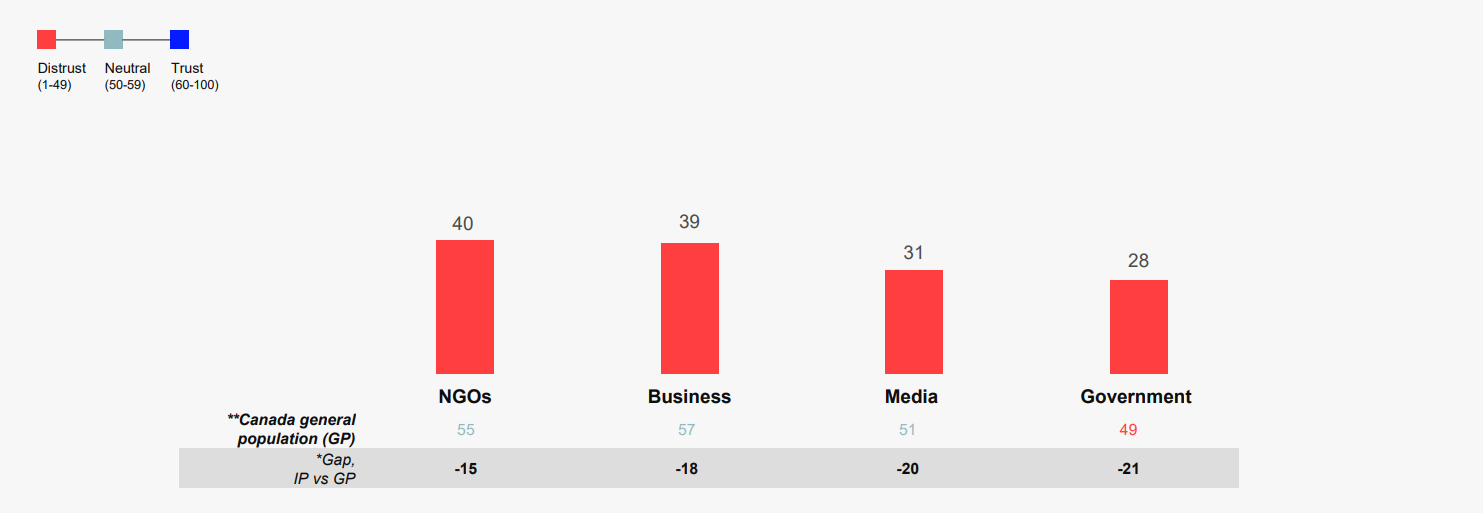
The report reveals that Indigenous respondents show significantly lower trust in most Canadian institutions compared to the general population. For example, while 49% of the general population trusts the government, only 28% of Indigenous respondents do. This disconnect highlights the broader historical context that has left Indigenous peoples feeling marginalized. This gap is echoed across other key institutions, including media and NGOs, where trust levels among Indigenous peoples are similarly low.

Trust is not easily given, especially when past experiences have often been characterized by exploitation and exclusion. The data shows that most institutions receive less than 50% trust levels from Indigenous respondents, with many falling into the "distrust" category.


Percent trust among Indigenous Peoples (IP)

Percent trust among Indigenous Peoples (IP)


However, there are some exceptions. The Assembly of First Nations (AFN) stands out as a trusted institution, with 63% trust levels among Indigenous respondents. The AFN’s role in advocating for Indigenous rights likely contributes to its higher trust levels. This highlights the importance of Indigenous-led governance and its potential role in building bridges.


The Role of Businesses in Reconciliation

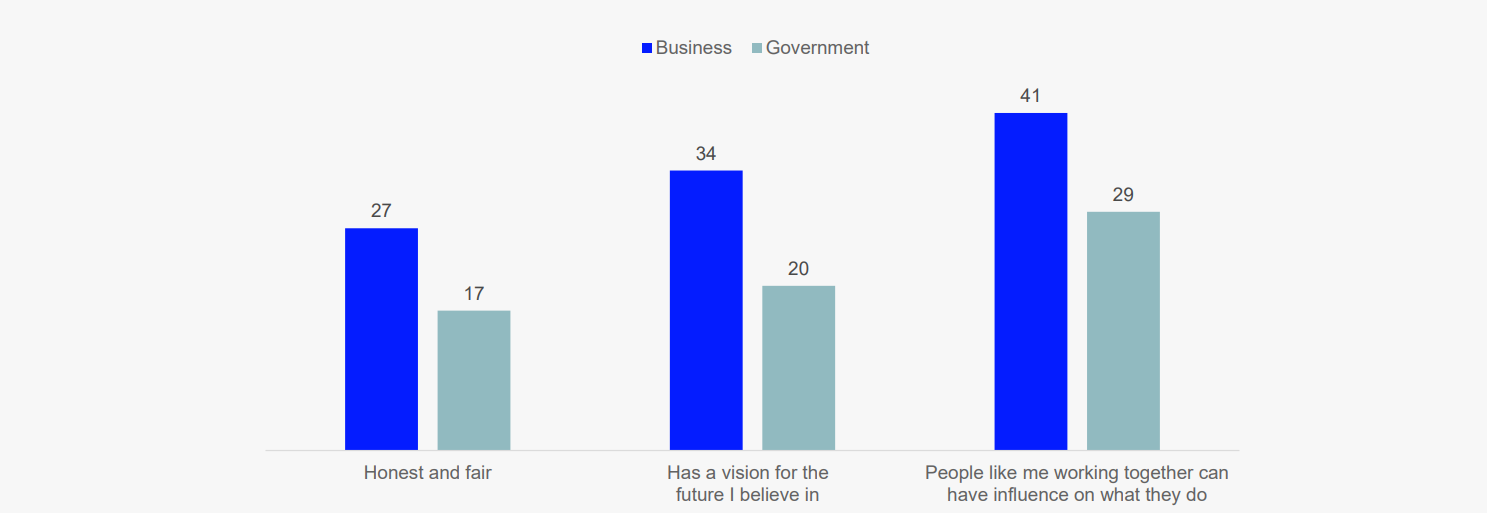
One of the key takeaways from the study is the opportunity for businesses to step into a more active role in Reconciliation. Interestingly, despite their relatively low trust ratings, businesses are seen as more adaptable and aligned with the future than governments. Indigenous respondents believe that businesses are more honest (by a margin of 10 points) and have a better vision for the future (by 14 points) than their government counterparts. This shows that businesses may be better positioned than they realize to make a meaningful impact—if they take the right steps.


Percent who agree Business and Government fall on the positive end of the scale, among Indigenous Peoples (IP)

Percent who agree Business and Government fall on the positive end of the scale, among Indigenous Peoples (IP)


So, how can businesses take a stronger role in Reconciliation?

While the federal government is often seen as the primary actor in Reconciliation efforts, businesses are also crucial partners. While businesses generally enjoy more trust than government institutions among Indigenous respondents (39% vs. 28%), only 12% of Indigenous respondents see businesses as positive actors in Reconciliation, compared to 25% who view government as playing a positive role. This discrepancy highlights an untapped opportunity for businesses to get involved in ways that go beyond the bottom line.

Economic Reconciliation is a particularly important area where businesses can lead. By focusing on hiring Indigenous employees, partnering with Indigenous-owned suppliers, and investing in Indigenous communities, businesses can contribute to the economic empowerment that is so essential to Reconciliation. Trust takes time to build, especially when trust has been broken in the past. Businesses must be committed to long-term engagement, letting go of short-term metrics in favor of deeper relationships with Indigenous communities.

Another critical aspect is transparency and accountability. As businesses look to play a larger role in Reconciliation, they must be prepared to answer difficult questions. This requires accepting criticism and being ready to adapt. Indigenous peoples are highly aware of when institutions fall short, and trust will only grow if businesses demonstrate that they are willing to learn and evolve.


What Indigenous Peoples Want to See: Communication and Action

While trust in institutions is low, the desire for Reconciliation remains high. Three in four Indigenous respondents expressed a desire to learn more about what the government is doing to advance Reconciliation. Indigenous communities want to see real, tangible efforts that go beyond symbolic gestures.

Respondents were clear: more communication, more direct engagement, and more actions are needed. It’s not enough for organizations to acknowledge Indigenous land or issue statements of support. Real progress requires working with Indigenous communities to address systemic issues like poverty, lack of access to clean drinking water, and the lasting trauma of residential schools.


The Road Ahead

So, what’s next? The findings of this study make it clear that Reconciliation is not a passive process. It requires active participation from all sectors of society, including businesses. The opportunities are there for those willing to take them, and the potential rewards—increased trust, stronger relationships, and more resilient organizations—are substantial.

For businesses, the message is simple: get involved. Trust won’t build itself. By investing in long-term relationships with Indigenous communities, demonstrating transparency, and focusing on economic Reconciliation, businesses can play a crucial role in moving the needle on trust.

To dive deeper into Edelman’s findings and understand what they mean for your organization, explore the full report, Indigenous Peoples & Trust – An Edelman Canada Study, now available online.


DOWNLOAD REPORT


The future of reconciliation starts with trust — now is the time to act.

Standard research and surveying practices often pose challenges in effectively engaging Indigenous peoples in quantitative surveys. While this sample reached across regions, genders and ages, due to the difficulty of accessing certain groups, such as those that live on-reserve, and those without internet access, it is difficult for research panels to reach a representative sample of the Indigenous Population of Canada. As such, this data is not fully representative of Indigenous Peoples across Canada.


The Innu-owned railway connecting Schefferville
The Innu- & Naskapi-owned railway connecting Schefferville. Image source: Sam Lessard, 2023.

Public & Government Affairs & Edelman APAC: Political and Election Advisory

EGA and Edelman have partnered to create an integrated advisory offer and assembled a dedicated team of experts, designed to guide organizations through the complexities and uncertainties of the current election cycle—and to manage political risk beyond this.

Find out more

I went to the Sir Harry Evans Investigative Journalism Fund dinner on Wednesday. Tina Brown, widow of Sir Harry, assembled the great and the good of journalism, the top executives or editors from Reuters, The New York Times, and The Wall Street Journal. She issued a clarion call for investigative journalists to “dig deeper,” despite the financial constraints imposed by a shrinking media industry. She cited her husband’s pioneering work at the Sunday Times in London, where he pursued the Thalidomide story of birth defects despite court restraining orders.

One of the new tactics used by unscrupulous defendants is “Law-fare”. Journalists are forced to defend lawsuits in multiple jurisdictions. The defendant uses social media in market to discredit the reporter, alleging fraud or tax evasion. This becomes especially brutal for female reporters who are subjected to sexist attacks by trolls. The goal is simple; cast doubt on the messenger so that you do not trust the message.

Transnational repression of media is accelerating. Maria Ressa, CEO of Rappler, a Filipino news site, is constantly pursued by the Filipino Government, accused of cyber-libel. The 70 Iranian reporters who are based in the U.S. have all been issued “notice of death” by the Iranian Government. Jimmy Lai, Hong Kong based journalist and founder of Apple Daily, has been jailed for his support of the pro-democracy movement.

Esteemed investigative journalists, Carl Bernstein and Bob Woodward, heroes of the Watergate era through their reporting at The Washington Post, were the final act on Wednesday. Woodward said that government officials are increasingly willing to speak on background, not on the record. He refuses to accept this pre-condition. Bernstein said that the media has become the enemy in the culture wars but cannot allow itself to be intimidated by power.

The Sir Harry Evans Investigative Journalism Fund is a UK-based charity, run in partnership with Durham University, Evans’ alma mater. The Fund offers grants to promising young journalists. One of them spoke last night, quite movingly, about his journey from a one-man country newspaper in a town of 500 people to being placed as an intern at Reuters, where he has become a core part of the team investigating Elon Musk. Edelman intends to donate in honor of my father, who was a journalist in Poughkeepsie, New York, then at CBS Radio.

At the end of the evening Bob Woodward told me that a good PR professional can be hugely beneficial to a journalist, and that we should be proud of what we do. As citizens and communicators, we must always remember the importance of the fourth estate.

Richard Edelman is CEO.

Supplemental Report: Insights for Financial Services in Canada

After years of skepticism and distrust in wake of the 2008 financial crisis, the Canadian banking industry has clawed its way back to earn the trust of customers and employees.

Find out more

2024 Connected Crisis Study

The 2024 Connected Crisis data identifies increasing volatility that is shaping the reputation risk landscape and confirms the reality that crises are now an ever-present reality for organizations worldwide. The third edition of our study continues to track the dynamic and evolving nature of these challenges, underscoring the critical need for constant adaptability and resilience in the face of ongoing uncertainty.

Find out more

The Boeing Company faced a walk-out by its workers this morning, halting production of its airliners. This is the first strike in nearly 20 years. It is indicative of growing labor activism, from efforts to unionize auto factories in the Southeast to a push for unions in retail business. In that context, I thought it would be interesting to visit Pullman, a company town on the far south side of Chicago.

George Pullman founded Pullman Palace Car Company in 1862, after President Abraham Lincoln signed the Pacific Railway Act providing Federal subsidies and land for a transcontinental railroad. Given Lincoln’s Illinois heritage, the terminus for the railroad would be Chicago.

Pullman envisaged a company town, America’s first planned model industrial community. Construction began in 1880 on a “total environment superior to that available for the working class anywhere else. He hoped to attract the most skilled workers to build his luxury rail cars and attain greater productivity due to the superior health and spirit of the employees.” By 1884, there were 1,000 homes and a series of public buildings from an open-air market to stables. Each home had gas and water, complete sanitary facilities and both back and front yards.

The factory utilized the first assembly line in America, with the train cars moving on a platform into a sequence of bays, from woodworking to interior decorating. The work was tough, with compensation based on piece work and long hours (often 16 hours a day).

Meanwhile, Chicago became the center of labor strife. In the recession of 1877, workers’ salaries were reduced in meatpacking and tractor assembly lines. The industrialists would employ replacement workers when faced with strikes, then used Pinkerton agents to infiltrate and break up the protests. This contentious situation escalated in 1886, when workers striking for an eight-hour workday at the McCormick Harvesting Machine Company, confronted Chicago police who were attempting to disperse the crowd. A bomb was thrown by the protestors, killing four and wounding 50 policemen, then a gun battle ensued. Four of the workers were tried, convicted, and hanged.

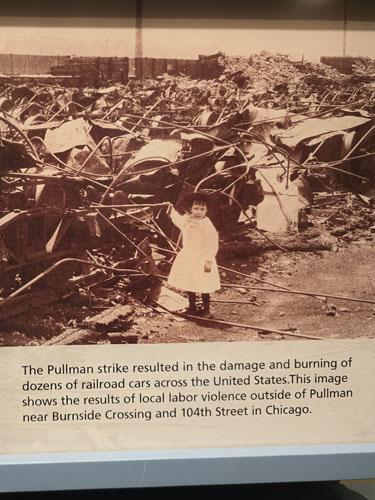
As recession gripped the U.S. again in 1894, Pullman fired one third of his workers and reduced the wages of the remaining workers by a third. Pullman refused to reduce the rent or food costs of the workers; their families faced eviction and starvation. The workers then walked off the job and were supported by 250,000 colleagues in the American Railway Union across the entire rail system west of Chicago. The strike escalated, with workers setting fire to trains and locomotives, including a U.S. mail train.

Federal troops were sent to Chicago, but the strikers escalated the battle, burning hundreds of railcars in the yard. Finally, order was restored and rail traffic resumed. According to Harper’s Weekly: “The nation was fighting for its own existence.” As a price of Federal intervention, Pullman was forced to divest all the housing and public spaces. He died two years after the strike, succeeded by Robert Todd Lincoln, son of the President.

The Pullman factory was very much in use until the 1960s, when rail transport was superseded by air travel and the automobile. The City of Chicago is now trying to rebuild the area, which has been depopulated by half given the disappearance of Pullman train assembly and the closure of a nearby U.S. Steel mill, which at its peak employed 25,000 people. A Walmart store, an SC Johnson factory and an Amazon distribution center take up about 20 percent of the site. The homes of the Pullman management and workers are now occupied by families, a low-cost arts center is available to local painters and sculptors. As with a visit to the pyramids in Egypt, it is a place where time has stopped but the lessons for modern executives are clear and present.

Richard Edelman is CEO.

What has your journey into Edelman looked like and how did you get into the communications industry? 

My journey has been somewhat unconventional. I started out as a journalist, first covering politics during the 2010 UK General Election campaign then working as a financial journalist for several years. 

As a millennial, I graduated during the Great Recession and became interested in why banks collapsed and the impact that had on the wider economy. When I entered the labour market, there were no permanent roles available. I knew understanding what had happened would make me better at my job - so I went to study for a Master’s in International Economy Policy in France (okay, I also wanted decent croissants). I then realised other career paths were available, and gradually moved away from journalism into political economy consultancy, investment writing and ultimately PR. 

Everything changed again when I was elected first as a local councillor in 2018, then as a Member of the European Parliament a year later, leading me down a new path into politics which culminated in me standing to be Mayor of London in 2021 for the Liberal Democrats. After that campaign ended, I was connected to Edelman Smithfield via a mutual industry contact, which led to me joining the business. One of the great things about Edelman is how we recognise people’s capabilities, even if they have not spent their entire career in the sector. 
 

What achievement are you most proud of? 

There are a number of specific results for our clients I could call out, but for me personally I would say it is how I successfully transitioned from politics to PR and entered my third career while still in my 30s! 
 

What do you find most rewarding about the job? 

You cannot possibly get bored because every day is different – and busy, which I like. This is the longest I have stayed with one employer in a full-time role, and the first time I have not had more than one job simultaneously! I remember an editor at The Economist saying to me when I worked there: “that’s good, you’re impatient”. 

My tenure here is a testament to how interesting and lovely both our clients and colleagues are. Of all the workplaces I have experienced, this is the one where I have felt happiest and most comfortable among the people I am working with. Our team is also incredibly smart, capable and most of all, fun! You should see us at karaoke.  
 

What are some of the biggest challenges you’ve faced throughout your time at Edelman?  

New challenges are often thrown your way and you really need to be adept at thinking on your feet. One of our clients said to us recently that judgment is the most important attribute for a person working in communications. Having that quality has steered me through some of the most challenging situations, including knowing when and how to have difficult conversations with clients. I remember the first time I dealt with a crisis situation. It was intense – when a client is under pressure, so are you. However, having worked in politics where you practically experience a crisis every day, I was well prepared! 
 

How do you stay motivated? 

By embracing the opportunity to do something a bit different and innovative whenever that arises. It might be working on a new business pitch for a company which complements but is not exactly like the rest of my client base, adapting our media training offer for a particular individual and / or firm, or exploring what new work we can do for a client which will add value and enable them to differentiate themselves within their sector. 
 

If you could offer one piece of advice to someone considering a role at Edelman, what would it be? 

If you are considering a role at Edelman Smithfield, an interest in financial services is pretty essential! If you’re a geek like me, come join us. More broadly, I’ve been really impressed with how proactive those currently working with us via our 10,000 Black Interns Programme have been about organising conversations with colleagues at all levels to better understand their roles and the business. 

Whatever you do, cultivating a network will always pay off in the long run - but in communications you need those soft skills. Finally, you hear some horror stories about agencies but ours is a welcoming and inclusive place to work.  
 

What do you do outside work to relax? 

My Edelman Smithfield colleagues will know I do a lot of yoga, as I am often seen carrying my mat in and out of office at the beginning and end of the day. I have two adorable cats, so depending on their mood at any given time being around them can be either relaxing or chaotic. 

It may sound basic, but since my political hiatus I have taken pleasure in small joys like spending time with my friends at our homes, the cinema and concerts. I do enjoy a good all-day brunch too! It’s liberating just to have free time outside of work these days.

Subscribe to 2024