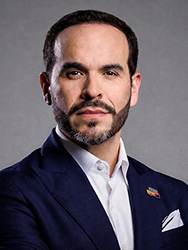
Matthew Harrington, our Executive Vice Chairman, received the SABRE Individual Achievement Award for distinguished service in public relations at PRovoke Media’s North American SABRE Awards this evening. I want to add my own thoughts about a man who has been such a singular force in the success of Edelman over the past four decades.

His first day at the firm is the stuff of legend. I met Matt through his cousin Becky, who was the girlfriend of my pal Dave Wagener in college. Matt came to our New York office at 1775 Broadway. I quickly concluded that he was bright and energetic, hiring him on the spot. We were short of staff, so I sent him out right away to help our client Scitex on its first quarterly earnings release since listing on Nasdaq. I had not thought to ask Matt whether he had done one of these before. Our client, Arthur Low, gamely guided Matt through the process and the release went out on time.

As one of our rising young executives, Matt put his hand up to move to the West Coast in the early 90s to lead our growing Visa International relationship out of the San Francisco office. He was then named General Manager when the incumbent moved to the client and ultimately became Head of West Coast Operations. Among the clients he attracted to Edelman during his tenure on the left coast were Starbucks and Charles Schwab, which are still pillars of DJE’s business. He was the first dedicated client leader to Microsoft and among the first Edelman executives to work with Samsung Electronics; his relationship with both companies continues today.

Through his work as both a client and CEO counselor, he has helped elevate and redefine the role of today’s communications professional. He has led our clients and our firm through defining moments post 9/11: Leading the Cantor Fitzgerald grieving center at the Pierre Hotel, the 2008 financial crisis and the recovery from COVID. One of his most groundbreaking engagements was with Odwalla, where he helped pioneer the use of the internet for crisis management, providing real-time updates to consumers on product safety and earning a PRSA Silver Anvil for best Communications Campaign of 1997.

Matt has been a leader on the ethical practice of public relations. He helped establish our firm’s core set of values and has been outspoken in his role as board member at USC Annenberg School’s Center for Public Relations to ensure that graduates take these values into the workplace. He has worked closely with our Crisis and Issues team to fight disinformation.

As our Chief Operating Officer for the past fifteen years, he has been my true partner in growing the business to its nearly $1 billion level. He has carried the flag for the Edelman brand to our far-flung markets, presenting the Edelman Trust Barometer, doing new business development, and meeting with opinion leaders in Davos. He is the calm, cool operator who has translated nascent ideas such as the Circle of Cross Influence into revenue and top client service.

It is important to note that he has balanced work and family life. He is an incredible husband, father and now grandfather. He has been a role model to so many in the company, mentoring Judy Mackey, Justin Blake, Lisa Sepulveda, Russell Dubner and my three daughters. I have also been the direct beneficiary of Matt’s wisdom; he is a trusted counselor whose judgment and perspective have guided me through many of the firm’s most important moments.

He has also done impressive community service on the board of his alma mater, Denison University, and Classic Stage Theatre (you need to know that Matt gave up a promising acting career to go into PR).

Matt is the epitome of the Edel-person, smart, devoted to clients, global-minded and committed to excellence. I congratulate Matt on his well-deserved award and count on him for many more years of partnership.

Richard Edelman is CEO.


Edelman Canada Multi-Year Accessibility Plan and Policies

The Accessibility for Ontarians with Disabilities Act, 20015 (AODA) is a Provincial Act with the purpose of developing, implementing and enforcing accessibility standards in order to achieve accessibility for people with disabilities and others with accessibility needs.

Find out more

APAC Affiliates & Partners

Find out more

About Us

Find out more

Statement of Purpose

Find out more

I had a coffee with Suzanne McCormick, President and CEO of YMCA of the USA yesterday morning in New York City. Founded in 1844 in the UK, with its first branch organized in the U.S. in 1851, the Y has taken on the important mission of creating connected communities. Fighting social isolation and insularity is a major objective for Edelman, given the alarming finding from our 2026 Edelman Trust Barometer: 70 percent of respondents across 28 countries were found to have an insular mindset, which means they are unwilling or hesitant to trust someone with different values, approaches to social issues, backgrounds, or information sources.

McCormick is in her fourth year as CEO. She wants to work much more with the private sector. She has forged partnerships with the National Basketball Association (bet that you did not know that Dr. Naismith created the game of basketball at a YMCA in Springfield, MA) and the National Football League. Among the companies already involved with the Y are American Express, Amazon and Walmart.

The Y has a massive footprint across the U.S., serving 18.8 million people annually, 6.8 million of whom are youth. The Y reaches 10,000 communities and has 2,600 locations. Much of the work happens in schools, with Y personnel running after-school programs. The Y is also the largest nonprofit childcare provider in the U.S. Ys collectively represent $9B in annual revenue and employ nearly 300,000 people. For many of the employees, the Y is their first job, from lifeguard to camp counselor. Each Y is independent but acts as a franchisee, with common operating standards and systems.

She believes that the Y can become the premier third space in the country. “Think of the story of our founder, George Williams, who came to London from the countryside to work in a factory during the Industrial Revolution in the 1840s. Young men had no social circle beyond bars and brothels. So, he began a Bible study class to enable wholesome connections with other young men from rural areas. This began our journey to help people find their purpose and connection in local communities.”

She has big plans for the 175th anniversary, including a once every four years gathering of Y staff and volunteers in New Orleans in September. She also wants to flag Y-Cons (a take-off on Icons), celebrities and athletes who got their start at the Y. I am no celebrity but have wonderful memories of the West Side Y preschool for my three daughters, basketball at the Lincolnwood Y and killer workouts at the Lawson Y with lunatic trainer Dick Voit and Voit’s Warriors (best line…who taught you that push-up style, lover boy).

The Y is open to a new relationship with companies interested in sponsoring national or regional programs. I can see food clients doing work in healthy eating, pharmaceutical clients helping consumers to change lifestyle through exercise and vital sign monitoring or financial services clients helping on financial literacy or tech clients using the Y for reskilling. I am meeting with McCormick at the end of May in Chicago to advance this discussion and encourage all my colleagues in PR to do the same.

Richard Edelman is CEO.


There is a long-standing idea across many African societies that a person does not exist in isolation, that identity is not self-contained but shaped, continuously, through others. It sits within the philosophy of Ubuntu, often expressed in the Zulu phrase ‘Umuntu ngumuntu ngabantu’, the idea that a person is a person through other people.

What makes this idea enduring is that it assumes a degree of openness, resting on the belief that people are, by nature, connected, and that those connections extend beyond immediate or familiar circles. There is, embedded within it, an expectation that engagement across difference is not only possible, but necessary to how societies function and how individuals come to be recognised within them.

It is becoming more relevant to consider this now, because Africa, like much of the world, is beginning to move in a very different direction, as economic anxiety rises, geopolitical tensions become more pronounced, and technological disruption changes how people engage with information and with each other, resulting in a growing tendency towards a more insular mindset.

The recently released 2026 Edelman Trust Barometer, an annual survey spanning 28 countries and more than 30,000 respondents, finds that globally, on average, around 70% of people are either unwilling or hesitant to trust someone whose values, information sources, problem-solving approaches, or backgrounds differ from their own, pointing to a more insular mindset taking hold. Across Africa’s major economies, similar patterns are emerging. In South Africa, 68% of people on average say they are either unwilling or hesitant to trust someone who is different from them. In Kenya, the figure stands at 66%, and in Nigeria, just over half of the population, at 51%, expresses the same reluctance.

The issue is that those who are more inward-looking consistently express lower levels of trust in institutions, particularly where leadership does not reflect their own values or backgrounds. The Trust Barometer measures trust across business, government, media and NGOs, and what it shows is that people in the same country are not experiencing these institutions in the same way, arriving at very different conclusions about whether they are competent, whether they act fairly, and whether they can be relied on, with income, in particular, becoming a defining line in how those judgements are formed.

In Nigeria, high-income respondents report an overall Trust Index (average percent trust in business, government, media, NGOs) of 85, firmly in the “trust” category, while low-income respondents sit at 59, at the upper end of “neutral”, leaving a 26-point gap, the highest on record for the country. This points to a growing separation in how institutions are perceived and experienced, with higher-income groups continuing to find reliability where others do not. In South Africa and Kenya, the pattern is less pronounced, but still evident. In South Africa, high-income respondents report a Trust Index of 61, compared to 53 among lower-income groups, an eight-point gap that has narrowed from earlier peaks, and in Kenya, both groups fall within the “trust” category, at 73 and 66 respectively.

Across all three markets, higher-income respondents tend to assign stronger ratings to institutions across both competence and ethics, while lower-income groups are more cautious, and in some cases more critical. When trust is not held consistently across society, institutions lose their ability to function as shared points of reference, making it harder to build consensus and move forward on issues that require collective alignment.

There is a way around this, however, and it is through a novel concept called trust brokering. A trust broker helps to create a path for progress and cooperation despite insularity by surfacing common interests and translating their needs, goals, and realities for one another.

And in Africa, that responsibility is being placed squarely on employers and business leaders. More than three-quarters of employees in all three countries say employers are obligated to help bridge divides and build trust between groups that distrust one another. The same expectation extends to CEOs, with large majorities expecting business leaders to play a direct role. What stands out, however, is a clear gap between the level of obligation placed on business and how well it is perceived to be fulfilling that role, creating a more immediate onus on organisations to respond.

What is encouraging is that people are clear about what they expect, and the actions that would make a difference are practical.

The Trust Barometer shows strong support for creating more direct interaction between people from different backgrounds, whether within organisations or through partnerships that bring together groups that would not ordinarily engage. The idea is to allow for meaningful contact, where people are required to engage with different perspectives in ways that are constructive. There is also a clear view that teams should be structured in ways that require individuals with different values and viewpoints to work together, supported by a shared sense of identity and the ability to navigate disagreement productively.

Leadership, in particular, is expected to play a more active role, with CEOs being asked to seek out perspectives that differ from their own and engage directly with groups that may be critical or distrustful, not to resolve disagreement immediately, but to ensure it is understood and accounted for. Done effectively, trust brokering at this level has the potential to overcome insularity and help close the income-based trust gap.

Ubuntu assumes that people recognise themselves in one another, even where there is difference.

What the data suggests is that this is becoming harder to sustain, as trust becomes more contained and unevenly distributed. That does not mean the principle no longer applies, but it can no longer be assumed. It has to be actively built, and African businesses are best placed to do so.

Karena Crerar, CEO at Edelman Africa.


The 2026 Edelman Trust Barometer shows that South Africans are placing responsibility on business leaders and employers to act as trust brokers and help bridge divides across society.

23 April, 2026 - South Africa - As economic pressure and uncertainty mount, people are pulling closer to what they know, demonstrating unwillingness or hesitation to trust others who are different from them. This points to a more insular mindset taking hold, with trust settling into smaller, more familiar circles and making it harder for society to move forward together. While all institutions are expected to help bridge these divides, employers and business leaders are seen as best placed to do so.

According to the 2026 Edelman Trust Barometer, nearly seven in ten South Africans (68%) say they are either unwilling (30%) or hesitant (38%) to trust someone who has different values, information sources, approaches to solving societal problems, or backgrounds.

“The issue is that those who are more inward-looking consistently express lower levels of trust in institutions, particularly where leadership does not reflect their own values or backgrounds,” said Karena Crerar, CEO at Edelman Africa. “The Edelman Trust Barometer measures trust across business, government, media, and NGOs, and what it shows is that people are not experiencing these institutions in the same way, arriving at very different conclusions about whether they are competent, whether they act fairly, and whether they can be relied on, with income, in particular, becoming a defining line in how those judgements are formed.”

For the first time since 2014, neither high- nor low-income South Africans fall into outright distrust of institutions (on average across business, government, media, and NGOs). High-income respondents record a Trust Index of 61, placing them in the “trust” category, while low-income respondents sit at 53, in the “neutral” range, leaving an eight-point gap that, while narrower than previous peaks, is quite evident. This divide extends into how these institutions are perceived. Business is rated highest on both competence and ethics scores by both income groups, while government ranks lowest, with negative scores across both measures. NGOs and media sit closer to the middle. Across all institutions but government, high-income respondents consistently assign higher scores than low-income respondents, with the gap most pronounced in perceptions of business.

“When trust is not held consistently across society, institutions lose their ability to function as shared points of reference, making it harder to build consensus and move forward on issues that require collective alignment,” said Crerar. “There is a way around this, however, and it is through a novel concept called trust brokering. A trust broker helps to create a path for progress and cooperation despite insularity by surfacing common interests and translating their needs, goals, and realities for one another.”

The responsibility to act as trust brokers in South Africa is being placed squarely on employers and business leaders, but their performance is falling short of expectations. Seventy-six percent of South Africans say CEOs are obligated to help bridge divides, yet only 52% believe they are doing well, with a similar pattern at an organisational level where 81% of employees say their employer has this responsibility compared to 66% who say it is being met. Across business more broadly, 78% see an obligation, while just 50% believe it is being fulfilled.

“The findings show strong support for creating more direct interaction between people from different backgrounds, whether within organisations or through partnerships that bring together groups that would not ordinarily engage. There is also a clear view that teams should be structured to require individuals with different values and viewpoints to work together, supported by a shared sense of identity and the ability to navigate disagreement productively,” said Crerar. “Leadership, in particular, is expected to play a more active role, with CEOs being asked to seek out perspectives that differ from their own and engage directly with groups that may be critical or distrustful, not to resolve disagreement immediately, but to ensure it is understood and taken into account.”

Done effectively, trust brokering at this level has the potential to bridge divides and narrow the income-based trust gap evident across South Africa.


2026 Edelman Trust Barometer - Africa (Slimmed down)

The 2026 Edelman Trust Barometer will reveal what’s driving belief, skepticism, and influence in today’s polarized environment, uncovering how leaders can bridge divides and use trust to drive growth, credibility, and impact.

Find out more

2026 Edelman Trust Barometer - Special Report: Trust and Health

Edelman’s Trust and Health report reveals declining trust, division, and confusion, with many people believing contested health claims worldwide.

Find out more
Subscribe to 2026