In the 2021 Edelman Trust Barometer, the UK finds itself in its lowest ever position in a league table of trust, just one place off the bottom with only Russia below it. How did the birthplace of parliamentary democracy, the “mother of parliaments,” and a respected voice of sense on the world stage find itself in such an unaccustomed place? After all, the Trust Barometer is a global ranking of trust in the very institutions for which the rest of the world has often admired the UK. What exactly precipitated this fall from grace?

To live in the UK today is certainly to experience a very different atmosphere from the one that existed only two decades ago, before the financial crisis, before the post-Cold War euphoria became a hangover of uncertainty.

A toxicity has overtaken the tone of the UK’s internal conversation. Politicians of every party, including the Prime Minister, have taken to attacking the BBC, which other countries regard as a beacon of impartiality, for its bias. Other parts of the UK media openly attack the judiciary in a nation where the separation of powers has been a given for four centuries. And everyone, from MPs to schoolchildren, has taken to attacking each other on social media.

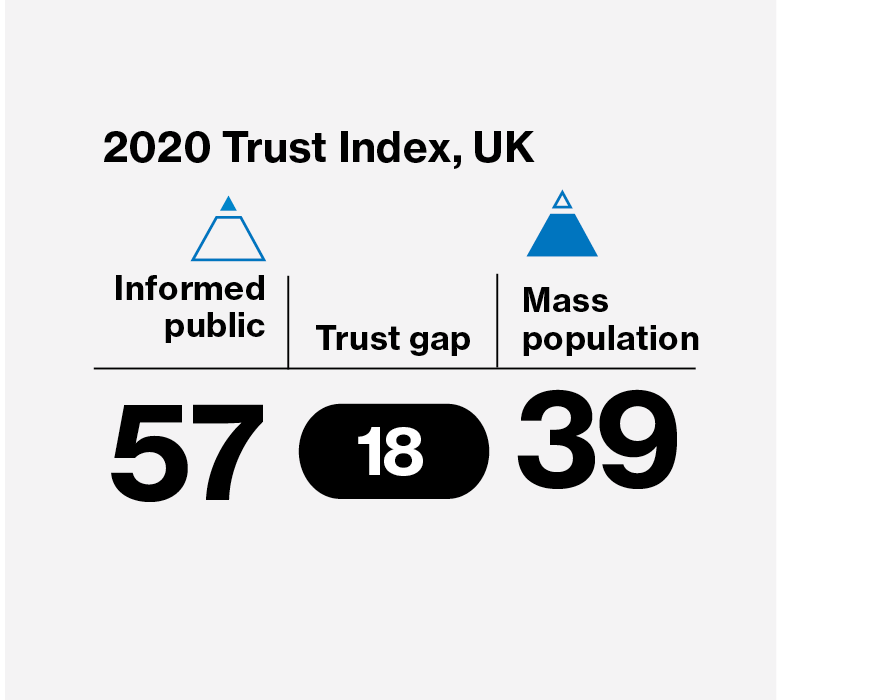
Little wonder then that the general population in Britain now distrusts its institutions with a trust score of only 42 percent. Edelman has also found a gaping trust gap between attitudes of the wealthier, more educated and more well-informed in society versus the rest (an 18-point gap). Even so, that informed public group has some fundamental worries of its own. Almost 70 percent of them agree with the sentiment that “democracy is losing its effectiveness as a form of government.” That is a stunning 14 15.5 percentage points higher than the average for the other members of the G7 group of advanced economies. Among the general population, it’s 60 percent.

Think about that for a moment: the cradle of parliamentary government, the defender of free speech, bastion of the rule of law, appears to be losing faith in the idea of democracy itself. Not only that, but Britain’s attitude to capitalism is changing. The country that gave the world its first financial capital – the City of London – is falling out of love with business-as-usual too. In the UK today, 63 percent of the informed public and 53 percent of the general population agree that “capitalism as it exists today does more harm than good in the world.”

Profound questions are being raised about globalization and unrestrained technological change, about how they fuel inequality and unfairness. Automation and downward economic mobility are stoking fears around job security. All of which is driving distrust in the UK, and to a far greater extent than the global average, the British people see their institutions as unethical.

You might well say, and you would be largely right, that other countries have gone through all the pressures and exhibited all the symptoms described above. There are two special factors, though; first, the UK is lower in trust and higher in disdain for institutions than almost all its peer group of nations; second, that peer group, and the rest of the world, just doesn’t expect Brits to be like this – such expressions of angst contradict the caricature of reserve and resolve.

Examining our 2020 findings, the explanation for these changes do in fact offer lessons for other nations.

Because it would be a mistake to think that Brexit alone was to blame for this collective loss of trust in our institutions, or indeed that somehow the UK is an outlier. Brexit is the easy answer, but it is not as simple as that.

While Brexit did prove to be the spark that lit the gunpowder, the conditions were set by years of institutional failures - the financial crash; the MPs expenses scandal; phone hacking and the advent of fake news on social platforms; and the Oxfam scandal in Haiti – that had already rocked trust in business, government, media and NGOs.

British institutions failed to recognise what happened and how to respond to it. They were too slow. Too bureaucratic. Not agile enough. Then, the failure to deliver Brexit – which had been an argument narrowly won by a British desire to “Take Back Control” – demonstrated how little control voters actually had. This disillusionment in turn injected that poisonous tone into our political discourse and consequently damaged trust in business and the media too among the informed public.

Banks after all have largely continued to behave like banks, politicians like politicians and journalists like journalists. There may have been reforms from within, but they are not easily visible from without. No wonder that when politicians dithered and then delayed over delivery, the voters put their foot down.

In the early hours of December 13, 2019, as the general election results came in, we found out the response to three years of drift: Millions of people who no longer trusted our institutions lent their votes instead to a man with not inconsiderable issues of his own around… trust.

Boris Johnson won with a simple message: “Get Brexit Done.” But voters were also voting to reject the bitter stalemate that had settled on the UK. They backed “doing stuff” over more argument.

The Brexit debate leads to the natural conclusion that Britain’s problems are the exception. But looking at the Trust Barometer and frankly the issues that many European countries face, all that has changed is that Britain is, unusually, the pacesetter. France is after all beset by yellow-jacketed weekly protests over pension reforms. Spain is divided over Catalan independence. Italy is unified only by constant political upheaval. Germany seeing the far right come from nowhere and trust in its gold-plated country brand collapsing. All four countries have institutional trust levels among the general population that are under 50 percent.

The challenge then for our institutions, whether in Britain, or most developed countries, is how to respond to the change that citizens from all walks of life are calling for. Undoubtedly, the way in which business and government co-operate will determine how they are judged. The results of special trust study we performed among the UK population shows that their reputations are inextricably linked in the minds of two-thirds of the British public, and three quarters want them to collaborate to solve social issues.

Our political and corporate leaders are on notice: incrementalism is no longer enough. Instead people are looking for big, bold change to deliver a discernible improvement in their lives. Quite possibly, given the erosion of trust in democracy and capitalism, it may also mean reform in order to make the system work better for those our institutions have left behind. Ultimately, it will require the reimagining of our institutions and systems. It is the scale of that change – economic, political, and societal – and the shape of that reform, that will ultimately determine whether we can repair trust in our core institutions.

Ed Williams is President and CEO of Edelman's EMEA region.
We are living in a trust paradox. This is an era of strong economic performance and nearly full employment; over the past two decades, more than a billion people around the world have lifted themselves out of poverty. The major societal institutions—government, business, NGOs and media—should be enjoying high levels of trust. Yet the 2021 Edelman Trust Barometer, our 21st annual study, tells us that no institution is trusted.

In past years, good economic conditions have presaged rising levels of trust, and this link still applies in developing markets in Asia and the Middle East. But in the developed world, major violations of the social contract—corporate malfeasance, government corruption, fake news—have upended this relationship. In developed markets, trust has become uncoupled from GDP growth because people feel they are not getting their fair share of growing prosperity. National income inequality is now the more important factor in institutional trust. In markets with high income inequality, the gap between trust in business and trust in government is much wider (12 points) than the gap in low inequality markets (four points). This is a worrying institutional imbalance.

Fears are stifling hope, as long-held assumptions about the benefits of hard work and citizenship have been upended. Eighty-three percent of employees globally are worried about job loss due to concerns such as the lack of training, cheaper foreign competition, immigration, automation and the gig economy. Over half of our respondents said that they are losing the respect and dignity they once enjoyed in their country. Three in four are worried that fake news will be used as a weapon. Six in 10 fear the pace of technological change; they are no longer in control of their destiny. Cue the growing number of citizen-led protests and the rise of populism.

The “mass-class” trust divide has become chronic, reaching record levels in more countries than ever, with a global 14-point gap between informed public and mass population trust in institutions. In developed markets, less than one in three people believe that they will be better off in five years. Under 20 percent of the general population express confidence in the system, and 73 percent are looking for change. More than half of our respondents believe that capitalism causes more harm than good, and that democracy is losing its effectiveness. We find ourselves far from Francis Fukuyama’s 1992 book, “The End of History,” which touted the triumph of liberal democracy.

Business once paid only lip service to this kind of societal discontent but now it has leapt into the void left by populist and partisan government. It’s no longer business as usual, with an exclusive focus on shareholder returns. Business now sees the need to play a positive role in global governance. The decision by the Business Roundtable to endorse a multi-stakeholder model for American multi-nationals; the initiation of Business for Inclusive Growth focused on fair wages by French multi-nationals; and the signing by 177 multi-nationals to the Business Ambition for 1.5°C are definitive steps toward an essential role for business as a means of improving society. These are incredibly positive developments, led by CEOs who understand that their mandate has gone beyond corporate social responsibility to fundamental operational change.

Business has been prompted to action by the recognition that stakeholders now have new expectations of the corporate sector. A stunning 92 percent of employees surveyed in the 2020 Edelman Trust Barometer say that they expect their employer’s CEO to speak up on one or more issues ranging from income inequality to diversity and training for jobs of the future. Seventy-three percent of employees expect a prospective employer to offer the opportunity to shape the future of society in a positive way. Consumers share this determination; our 2019 “In Brands We Trust?” study found that nearly two-thirds of consumers buy based on their beliefs, and 81 percent agree that “a brand I can trust” is one of their top reasons for purchase. Our Edelman 2020 Trust Barometer respondents told us that customers and employees are over five times more important to a company’s long-term success than shareholders.

This seismic societal shift has led us, after 20 years of research, to evolve our model for measuring trust. This model supplants Professor Francis Fukuyama’s trust construct from early the 1990s, which was premised on continued upward mobility, guaranteed by a strong legal structure, and was the basis of the first Edelman Trust Barometer in the year 2000. We have always known that people grant their trust based on two distinct considerations: competence and ethical behavior; for two decades we have asked people if they trust institutions “to do what is right.” Now, based on new societal expectations, we are probing deeper into “what is right,” measuring purpose, vision, honesty and fairness as the dimensions of ethical behavior. We have proved the undeniable importance of these dimensions for business through our Edelman Trust Management framework. After tracking trust in 40 global companies over the past year, we learned that ethical attributes drive 76 percent of the trust capital of organizations, while competence drives 24 percent.

This year’s Trust Barometer reveals startling imbalances among the institutions. Business ranks highest in competence, holding a gigantic 54-point gap over government as an institution that is good at what it does. NGOs are much more trusted on ethical behavior than government (a 31-point gap). Government is trusted more than twice as much as business to protect the environment and close the income inequality gap.

The four existential issues of the next decade—income inequality, sustainability, information quality and artificial intelligence—will require higher levels of cooperation among our institutions; no single entity can take on these complex challenges alone. But only about one-third of people believe that business does a good job of partnering with NGOs or government. Currently business and government are like children of different weights on an unbalanced playground seesaw; government, perceived as both incompetent and unethical, is unable to provide the necessary counterbalance to business, which is considered highly effective but too self-interested. Business must stop pushing government away. An exemplary model is Unilever*, which has pledged to cut its use of virgin plastics in half by 2025, working with partners that include the United Nations and the Government of Indonesia. All eyes are now on the tech industry, which will need to be much more open to forward-looking regulation of innovation.

Business must take the lead on solving the trust paradox because it has the greatest freedom to act. Its immediate mandates are clear. An overwhelming number of respondents believe that it is the duty of business to pay decent wages (83 percent) and provide retraining for workers whose jobs are threatened by automation (79 percent). Yet less than a third of people trust that business will do these. The time for talk is over. 2020 must be the year of action.

*Edelman client

Richard Edelman is CEO.

Not long ago, influencer marketing was a trend. Every year-end report marketers could get their hands on invariably had a chapter on “The Rise of Influencers” or “Why Influencers Are Here to Stay.” This made sense in the past because this marketing tactic – powered by social media – began in the mid-2000s and for quite some time was considered an emergent marketing tactic that lived under content creation, community management or paid media.

Today, influencer marketing is a critical part of the marketing mix. In fact, according to Business Insider Intelligence, it’s expected to grow to a $15 billion industry by 2022, up from $8 billion in 2019.

Edelman’s 10 Trends Influencing 2020 report offers an in-depth look at the 10 important influencer developments we believe will impact business, society and government in the coming year. This report is designed to serve as a guide to the challenges, experiences and opportunities your organization, employees, customers and stakeholders will face in 2020 and beyond. Here is a breakdown of three of the 10 trends we explore:

Listen Up: The Rise of the Audio Influencer

  • Podcasts offer a new medium for creativity in a landscape where influencers and sponsored posts are everywhere you look on social media.
  • 32 percent of Americans reported having listened to a podcast within the past month.
  • The worldwide podcast market is growing rapidly, and this is expected to continue as tools to facilitate the creation, publishing and management of podcasts become mainstream.

Going Steady: From Influencer to Ambassador

  • As brands seek influencer content that is authentic, relationships with influencer partners are moving from transactional to long-term.
  • As their audiences grow, brands are relying on influencers for insights into engaging and maintaining loyal fans. With long-term (or always on) influencer partnerships, audiences are more likely to trust an influencer’s recommendation and to act when key messages are reinforced over time.
  • Long-term collaborations allow influencers to have more time and flexibility to develop creative ideas that the brand and their audience will love.

In Authenticity We Trust: Get Real or Get Lost

  • Millennials and Gen Z are becoming more wary and distrustful of artificial or inauthentic influencer content, creating a new challenge for influencers and brands.
  • 72 percent of consumers said they would unfollow an influencer over disingenuous endorsements.
  • A shift from a depiction of the idealized toward more relatable and real is underway and becoming the new cultural norm.
  • Influencers and brands will prioritize authentic partnerships and collaborations to meet the increasing demand led by Gen Z and millennials seeking real and relatable experiences.

Download the Report

Ann Newland is Head of Strategic Operations of Edelman’s Influencer team.

Edelman first studied Millennials and their relationship with financial services in 2016, and each year since, our intellectual property has been inspired by unexpected learnings and industry trends. Our 2018 edition, Millennials with Money, found that 25 percent of affluent Millennials held or used cryptocurrency, and another 31 percent were interested in using it. And nearly a quarter (23 percent) were using a robo-advisor for financial advice.

At the same time, it has been a fascinating year for cryptocurrency and digital advice. Cryptocurrency has come a long way from an academic concept and digital advice is becoming ubiquitous in financial products and services. We see the overarching goal of such innovations to be greater financial inclusion and have seen bold experimentation with the future of money and the advice we get to manage it, which are the key themes we focused on in this year’s edition, Millennials & The Future of Money.

Download the Report

Higher education has plenty of big-time problems today, from falling enrollment and rising student debt to admission scandals and sports corruption. Beyond hurting the reputations of individual schools, these problems could undermine support for academia more broadly. So it’s critically important for universities and colleges to double down on building (or rebuilding) their relationships with stakeholders.

Recently, I had the chance to share the 2019 Edelman Trust Barometer report with more than 100 communications professionals at the University of Minnesota in Minneapolis. In addition to my role at Edelman, I am an adjunct professor and a member of the Dean’s Advisory Council at the DePaul University’s College of Communication. Pulling from the conversation during the University of Minnesota presentation, as well as my experience working in academia, I have highlighted three findings from the Edelman Trust Barometer that could help boost universities’ reputation even in tough times:

1. Drive Trust Through Transparent Communications

Over the past five years, according to federal data analyzed by the Chronicle of Higher Education, more than 1,200 college campuses in the United States have been shuttered, largely after funding losses. To avoid that same fate, schools need to maintain the support of their financial backers—tuition-paying students (and their families), governments, donors, investors and corporate and philanthropic partners.

One of the best ways to keep them on their side, based on the Edelman Trust Barometer’s findings, is for the president (academia’s CEO equivalent) to be upfront about troubling matters and what the institutions is doing to address problems; 71 percent of people agree that it’s important for their own CEO to respond to challenging times. Ignoring an issue or trying to spin it will only lead to greater distrust and even outright antagonism when stakeholders discover they’ve been left out or deceived. The importance of timely candor goes for good news, too. Share with stakeholders early and often.

2. Lead on Issues that Matter

The Edelman Trust Barometer shows that, globally, 73 percent of people look up to organizations that improve the economic and social conditions of their communities. This is particularly salient to academic institutions. Given their school pride, employees, students, prospective students, partners and alumni alike want to hear what their college or university is doing to make lives better, and how their individual contributions are helping.

An academic institution should align the economic and social issues it chooses to take on with its values and mission. Pretenders don’t get class credit.

3. Activate “Surround Sound” of Advocate Voices

Higher education has a huge built-in advantage over many other major organizations. Of the four groups that the Trust Barometer identifies as the most credible advocates for an institution, three are fundamental to higher education: academic experts, a person alike yourself (students, alumni and parents of both groups), and employees.

Academic institutions will reach a lot more people—and reach them more effectively—if a message is amplified by a loyal army of ambassadors. In addition to sharing stories with these influential proponents, schools need to treat them like the essential partners they are.

Given the nest of problems it has, higher education needs to invest in trust. What schools put in today will build the endowment of tomorrow.

Joseph Tateoka is vice president, Integrated Business Marketing, Chicago.

Cole Keister

In recent years, Edelman’s research has shown that as the role of brands in our lives and society has expanded, people’s expectations for brands have evolved. As always, brands must provide a reliable product and a rewarding customer experience. But now consumers have many more reasons to question how much they trust a brand. Will it protect their data and privacy? Use automation responsibly? Tell the truth in this era of disinformation? In short: Can consumers trust a brand do the right thing? 

The 2019 Edelman Trust Barometer Special Report: In Brands We Trust?, an eight-country study, shows that the vast majority of consumers across markets, ages, incomes and gender say that brand trust is essential to buying. Consumers reveal that: 

  • A major consideration for brand purchase is now “I must be able to trust the brand to do what is right,” at 81 percent. 
  • More than 70 percent link purchase to considerations that historically were tied to trust in corporations, including supply chain, reputation, values, environmental impact and customer before profit. 
  • 53 percent of consumers agree that every brand has a responsibility to get involved in at least one social issue that does not directly impact its business.  

DOWNLOAD  FULL REPORT 

Despite consumers’ call for advocacy and brands to reflect their personal beliefs, brands are largely failing the trust test.  

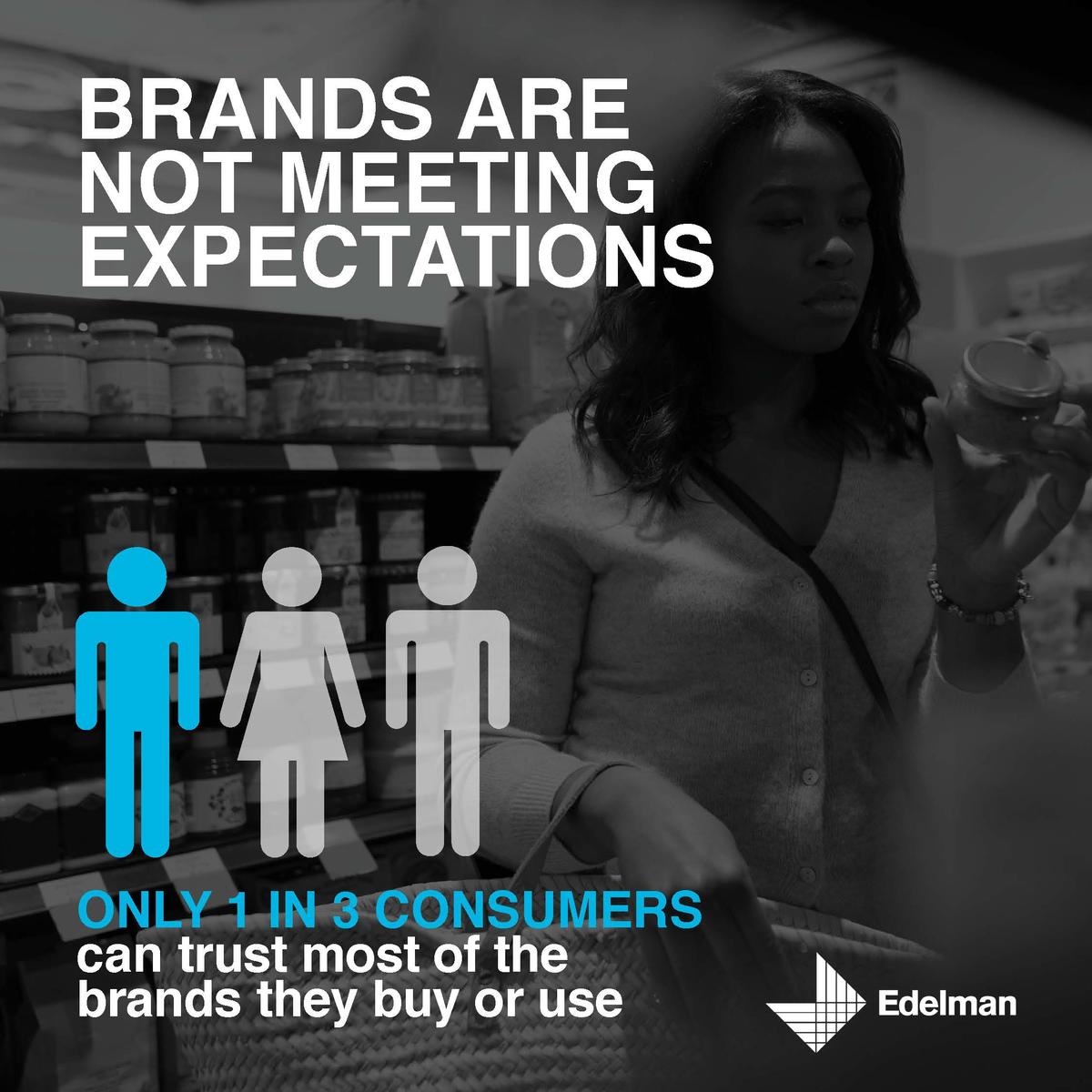
  • Shockingly, just one-in-three respondents said that they trust most of the brands they buy and use. 
  • Only 21 percent say they know from personal experience that the brands they use keep the best interests of society in mind. 
  • 56 percent say that too many brands are using societal issues as a marketing ploy. 
  • Down five points from last year, only 41 percent now agree that brands have better ideas for solving problems than the government. 

Today’s most trusted — and rewarded — brands make a difference in consumers’ lives and in the society they care about. To earn the highest levels of consumer trust, brands must back up their brand promise with action. Consumers know that brands have the power to effect real change, and they will place their trust in brands that use that power on their behalf.  

Influencer marketing is well past its infancy. In fact, this fast-growing part of today’s marketing mix was estimated as a $4.6 billion industry in 2018 in the U.S. and is expected to grow to approximately $10 billion in 2019. And it’s not just Instagram or YouTube; in China, for example, “WeChat Famous” influencers are starting their own fashion lines (and selling out). China’s influencer economy alone is estimated at $116 billion and growing.

But can influencers and the brands they partner with be trusted by the consumers who follow them? The dust is still settling from numerous high-profile missteps of well-known influencers, and fraud is pervasive. From bots to fake followers to fake engagement in the form of comments, fraudulent actors are working hard to stay one step ahead of platform algorithms, and brand reputation is at stake.

We wanted to better understand the dynamics of “trusted influence” by talking to 1,500 consumers aged 18-to-34 across the U.S., U.K and China about their relationships with influencers and the brands who collaborate with them. The correlation between influencers and trust is evident among savvy 18-to-34-year-old consumers who seek out trusted influencers and follow their every move. Sixty-three percent of consumers told us they trust what influencers say about brands more than they trust the brand’s advertisements. Consumers are following influencers primarily because they have interesting ideas or are entertaining. Also, they are more concerned about quality over quantity—only 18 percent of the consumers we spoke with indicated they are attracted to influencers for their huge following. In terms of trusted influence, size doesn’t always matter.

Consumers will continue to follow influencers as sources of information and inspiration as long as they feel trust is part of the value proposition. We believe that trusted influence—the thing that inspires taking action—is built on real relationships, and it’s these trusted relationships that influencers of all sizes and specialties should be judged by. Influencers are only as effective and compelling as the trust they receive from the consumers who support them.

And it’s not just the relationships between consumers and influencers— but between influencers and brands as well. We believe that these relationships are also built on mutual trust and an alignment of values. Thirty-five percent of the consumers we surveyed say they pay attention to and trust what influencers say because they share their values. When brands and influencers align, they possess the potential not only to amplify influence and engage targeted audiences, but also to co-create cultural relevance for the brands they partner with.

Sybil Grieb is U.S. Head of Influencer Strategy and Programming.
Ann Newland is U.S. Head of Strategic Operations, Edelman Influence.
Melinda Po is Managing Director, Shanghai.

Over the past few years, Edelman’s consumer research has uncovered the rise of belief-driven buying and highlighted the phenomenon of brands taking a stand. We’ve watched— popcorn in hand — as brands from Nike to AirBnB have used paid content and advertising to promote their shared values with consumers.

Our research this year confirms that this is a valid strategy. Ninety percent of consumers globally said it’s more important that they can trust the brands they buy. Product efficacy is still very much top of mind for them (“I can’t afford a bad purchase”). But 55 percent of consumers say that trusting a brand now matters more to them because they feel vulnerable, due to brands’ use of personal data and customer tracking; and because they feel that a brand should serve as their conduit for societal change (69 percent). In fact, 68 percent of respondents said that when a brand earns their full trust—across product, customer experience and societal impact—they will buy first, stay loyal to, advocate for and defend that brand, compared to just 47 percent who trust only the product alone.

However, there is a warning for brands on the horizon. While societal trust is an accelerant to purchase, consumers are becoming increasingly concerned that brands are taking victory laps on social issues without actually effecting any change. This “trustwashing” phenomenon is confirmed by 56 percent of global respondents who agree that brands are using a stance on social issues as a marketing ploy, and 53 percent who believe brands are less than truthful when talking about their impact on society.

For example, “Fearless Girl,” the statue of a defiant girl placed to face down the Wall Street bull statue, was quickly lauded as a powerful example of a societal stance. But almost as quickly, the company behind it, State Street Global Advisors, came under fire for systemic issues of gender pay equity and a lack of female executives. Contrast that with Dove Men+Care, which recently made hay on a stance supporting broader access to paternity leave. The content was supported by a $1 million fund offering microgrants to fathers who wouldn’t otherwise be able to take time off.

Beyond making a tangible commitment, the research points to other key trust levers for brands to pull. First, the obvious: Be honest in your marketing. Authentic and sincere marketing strengthens enduring trust with consumers. And when you’re trusted, you’ll have their attention; 76 percent of consumers report that they pay attention to communications from a brand they trust versus 48 percent of people who don’t fully trust a brand.

Second, consider the voices you’re using to tell your story. This year, 74 percent of respondents report they are actively avoiding advertising. Our online influencer survey of 18-to-34- year-olds found that 63 percent trust what influencers say about a brand more than what the brand says about itself. In addition, who are the top three most trusted spokespeople for a brand message? People like me, experts and company employees – more authentic and relatable voices.

Third, not only is repetition of your message important, but sequencing also makes a difference. The research shows that it’s better to lead with peer voices. Then deploy owned, social and paid channels to build the most trust in your message.

The lesson to be learned here? Harken back to the early days of Google, and “don’t be evil.” Let’s make sure as marketers we're holding our organizations’ collective feet to the fire and deliver on the opportunity to make real change in society.

Amanda Glasgow is Global Brand Community Chair.

Trust has always played an important role in brand purchase. Since the inception of brand as a means of differentiating products, there has been a promise made to consumers on quality, performance, ingredients and availability. In the U.K. in the 1880s, William Lever, the founder of Lever Brothers (now Unilever), launched Sunlight Soap, which guaranteed consistent quality at a time when the origins and ingredients of a bar of soap were uncertain. In the United States, Good Housekeeping magazine introduced the Good Housekeeping Seal over a century ago to reassure consumers of the quality and integrity of products, pledging a money-back guarantee for products that advertised in the publication.

Now there is a larger expectation of brands, as Edelman has found that nearly two-thirds of consumers are belief-driven buyers. Purchase conveys agreement with the values and purpose of the brand, with functional attributes now simply the price of entry. At the same time, consumers are looking to brands to fill a void in global governance left by divided and populist government. My purchase of products each week makes more of a difference than my vote every four years in the broader debate on issues such as tolerance, environment and education. I want brands to stand with me. An enduring consumer relationship is now built on the basis of delivering on the promise of Brand Democracy.

The 2019 Edelman Trust Barometer Special Report: In Brands We Trust?, conducted this spring among 16,000 respondents in eight developed and developing nations, shows this brand evolution from function to belief. On par with the usual product attributes of quality, value, convenience and ingredients, a major consideration for brand purchase is now “I can trust the brand to do what is right,” at 81 percent of respondents. More than 70 percent of respondents also link purchase to considerations that historically were tied to trust in corporations, including supply chain, reputation, values, environmental impact and customer before profit.

Brand trust is essential to purchase across diverse countries, from Brazil (91 percent) to France (63 percent), and across categories as disparate as banking (83 percent) and technology (80 percent). It’s true for men and women, for all age groups and income brackets. As our Edelman Trust Barometer study from January 2019 showed, two-thirds of respondents agree that a good reputation may get me to try a product, but I will soon stop buying it unless I trust the company behind the brand.

Brands are largely failing the trust test. Shockingly, just one in three respondents said that they trust most of the brands they buy and use (fewer than one-in-four respondents in France and Germany). Only 21 percent of respondents know from personal experience that the brands they use keep the best interests of society in mind. More than half of respondents (56 percent) said that too many brands are using societal issues as a marketing ploy. In a turnaround from last year, consumers have lost confidence that brands have better ideas for solving problems than government (down five points to 41 percent).

Where is the disconnect? First, brands need to do, not just differentiate; among people’s reasons for trusting a brand, ethical behavior (82 percent) is just as important as user experience (87 percent). Second, there’s too much reliance on advertising. Nearly threequarters of respondents say they find ways to avoid advertising (up 10 points from last year), from ad blockers to use of ad-free networks. Our online influencer survey found 63 percent of respondents aged 18-to-34 trust what an influencer says about a brand more than what the brand says about itself in advertising. Third, brands must deploy new kinds of spokespeople to build trust; most effective is “a person like me” (38 percent) or an expert (35 percent), not a celebrity (13 percent). Fourth, in a skeptical world, persuasion is achieved through repetition; only 35 percent trust a brand message after a single exposure to it, rising to 97 percent after seven exposures.

Brands that build trust earn big rewards in purchasing, loyalty, advocacy, defense and communications. When a brand is trusted, buying accelerates (53 percent versus 25 percent). More than twice as many respondents said that they would be loyal to a brand they trust versus one they do not in the face of a competitive launch (62 percent versus 29 percent). More than twice as many will advocate for you (51 percent versus 24 percent) and nearly twice as many will defend you (43 percent versus 22 percent). When they trust, people will also pay more attention to advertising (76 percent versus 48 percent).

It’s time for brands to take the next giant step. They must accept the responsibility conferred by consumers, welcoming greater accountability and measurement of their impact. They should take the risk of bold societal commitments, staying within their areas of core competence; this makes them worthy of relevance. When 61 percent of respondents say their trust in a brand is fueled by how much the brand acts on their personal beliefs, brands must move from making an impression to making a difference.

Richard Edelman is president and CEO.

About the Middle

The Middle is all about what happens when public relations, journalism and marketing meet. We go behind the scenes to talk about telling (and selling) stories to evolving audiences. The Middle brings together innovative thinkers from all sides of media. Trading notes. Straight up. The Middle is produced by Edelman Canada and recorded in Toronto.

Episode 1: Steve Rubel and Mark Ingram 

What does the future of media look like? Okay, that's a big topic. But our media geeks still take it on, talking fake news and "trumours," ultra-niche content distribution, and where trust fits in. Steve Rubel, Edelman's Chief Content Strategist and Mathew Ingram, Chief Digital Editor at the Columbia Journalism Review join host Sophie Nadeau, Edelman Canada's National Media Lead, to shed some light on what media might look like in our increasingly digital - and polarized - world.

"I like to say, while content is king, distribution is King Kong. The people who really understand the new dynamics of distribution and adapt their content accordingly will be the ones who will succeed."

- Steve rubel, Edelman's chief content strategist

If you'd like to continue the conversation, you can find all of our speakers on Twitter, Sophie is @sophienadeau, Steve is @steverubel, and Mathew is @mathewi

The Middle: Episode 1 recorded June 6, 2018.

Sophie Nadeau, National Media Lead, Edelman Canada

Subscribe to Brands & Culture